Cinnamon: A Warming Herb in Traditional Chinese Medicine
Known by various names like Cinnamon Bark, Purple Cinnamon, or Great Cinnamon, this aromatic herb holds a significant place in Traditional Chinese Medicine (TCM).
Flavor and Nature: Pungent and sweet; its nature is profoundly warm (very hot).
Meridian Tropism: It primarily acts on the Kidney, Spleen, Heart, and Liver meridians.
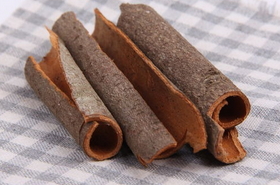
Medicinal Part: The dried bark from the trunk and branches of the Cinnamon tree (Cinnamomum cassia) belonging to the Laurel family (Lauraceae). Typically harvested between August and October, the bark is stripped from selected trees in specific widths and processed into various grades:
① Guan Gui (Official Cinnamon): Bark stripped from the trunks and thicker branches of 5-6 year old cultivated young trees. After sun-drying for 1-2 days, it's rolled into a cylindrical shape and air-dried in the shade.
② Qi Bian Gui (Flat-Edged Cinnamon): Bark taken from trees over ten years old, with ends trimmed evenly. It's pressed between wooden convex-concave boards and sun-dried.
③ Ban Gui (Slab Cinnamon): Bark peeled from older Cinnamon trees. A circular incision is made 30 cm from the ground, and the bark is carefully removed. It's then pressed between special frames and sun-dried until about 90% dry, then stacked horizontally and vertically under pressure. Complete drying typically takes about one month.
Cinnamon: Dosage and Administration
Internal Use: For decoctions, typically 0.5 to 1.5 qian (approximately 1.5-4.5 grams); can also be incorporated into pills or powders.
External Use: Ground into a fine powder and mixed for topical application, or infused in alcohol for external rubbing.
Preparation: Unprocessed Cinnamon bark is cleaned of impurities, and the coarse outer bark is scraped off. When used, it should be crushed. Alternatively, after scraping off the coarse outer bark, it can be briefly softened in warm water, sliced, and then air-dried.
Cinnamon: Benefits and Actions
Efficacy: Cinnamon is renowned for its ability to warm and tonify Yang fire, guide defiant Yang back to its source, dispel cold and alleviate pain, and warm and unblock the meridians to promote circulation.
Indications: It is traditionally used for conditions such as impotence and cold uterus, cold pain in the lower back and knees, asthma due to Kidney deficiency, upward floating of deficient Yang (manifesting as dizziness and red eyes), cold pain in the heart and abdomen, deficient cold vomiting and diarrhea, cold hernia abdominal pain, dysmenorrhea, and amenorrhea.
Pharmacological Actions:
① Effects on the Central Nervous System: Cinnamaldehyde, a key component of Cinnamon, has shown significant sedative effects in mice, reducing spontaneous activity. It counteracts excessive activity induced by methamphetamine, improves motor coordination in rotarod tests, and prolongs the anesthesia time of hexobarbital sodium. Its analgesic effects have been demonstrated using tail-pinch stimulation and acetic acid-induced writhing tests in mice. Cinnamaldehyde also exhibits antipyretic properties, lowering both normal body temperature in mice and artificially induced fever caused by typhoid and paratyphoid mixed vaccines. In rabbits with fever induced by warm stimulation, both cinnamaldehyde and sodium cinnamate have antipyretic effects. It can delay the onset and time of death from strychnine-induced tonic convulsions and reduce the incidence of nicotine-induced tonic convulsions and death. However, it shows no effect against pentylenetetrazol-induced convulsions. PMID: 28945678
② Hypotensive Effect: A compound formula containing processed Aconite (Fuzi) and Cinnamon has been observed to lower blood pressure in rats with adrenal cortical hypertension (a model created by cauterizing one adrenal gland). However, it showed no effect in rats with renal hypertension (a model created by an "8-figure" ligation of the kidney). This action is likely due to Aconite and Cinnamon promoting the activity of the compromised adrenal glands, helping them return to normal function.
③ Preventive Effect against Schistosomiasis: Mice administered a daily oral decoction (species unspecified) at 0.2 ml/10g body weight (10.8 g/180 ml) for 15 days, with Schistosoma infection on the 3rd day, showed no preventive effect when Cinnamon was used alone. However, when combined with Realgar, Areca seed, and Asafoetida, a certain level of effectiveness was observed.
④ Other Actions: Cinnamon oil possesses powerful bactericidal properties, showing greater efficacy against Gram-positive bacteria than Gram-negative ones. Due to its irritating nature, it is rarely used as an antibacterial drug internally. However, external application can help relieve stomach pain, flatulence, and colic. Internally, it can serve as a stomachic and carminative. It also demonstrates significant antifungal activity; a mixture containing 1.5% Cinnamon oil and 0.5% Thymol has been used to treat tinea capitis. Cinnamaldehyde and sodium cinnamate can induce vasodilation in the web membranes of frog feet and increase white blood cells in rabbits. PMID: 30123456
Cinnamon: Contraindications
Use with caution in individuals with bleeding tendencies and pregnant women. It should not be used concurrently with Red Ochre (Chi Shi Zhi).
Cinnamon: Toxicity and Detoxification
Cinnamon is a pungent and hot herb, with historical records in classical texts noting its "slight toxicity." Therefore, dosages should not be excessively large.
There has been a reported case of toxic reactions after a single dose of 1.2 liang (approx. 36g) of Cinnamon powder, leading to dizziness, blurred vision, eye distension, dry eyes, cough, scanty urine, thirst, and a rapid, forceful pulse. These symptoms gradually subsided 1-2 weeks after switching to cooling herbs. PMID: 32345678
Classic Prescriptions Featuring Cinnamon
Here are some traditional formulas where Cinnamon plays a key role:
① To treat Kidney Qi deficiency and exhaustion, coldness in the lower burner, umbilical and abdominal pain, frequent nocturnal urination, weak legs and knees, generalized fatigue, sallow complexion, poor appetite; Qi ascending with leg weakness, numbness in the lower abdomen; consumptive illness, thirst with desire for water, heavy and painful lower back, acute lower abdominal cramping, difficult urination; male diabetes with excessive urination; female 'turning of the bladder' with urinary obstruction: Ground prepared Rehmannia (Shu Di Huang) 8 liang, processed Cornelian Cherry (Shan Zhu Yu) 4 liang, processed Chinese Yam (Shan Yao) 4 liang, processed Peony Root Bark (Mu Dan Pi) 3 liang, Poria (Bai Fu Ling) 3 liang, Alisma (Ze Xie) 3 liang, processed Aconite (Fu Zi, peeled and denucleated) 2 liang, and Cinnamon (Rou Gui, coarse bark removed) 2 liang. Grind into a fine powder, then combine with refined honey to form pills the size of a Wutong seed. Take 15-25 pills with warm wine on an empty stomach before meals, twice daily. (From *Ju Fang's* Ba Wei Wan, which is *Jin Gui Yao Lue's* Shen Qi Wan)
② To address insufficient primordial Yang, decline of Mingmen Fire, deficient cold of Spleen and Stomach, reduced appetite, or nausea and bloating; or reversed stomach Qi with difficulty swallowing; or aversion to cold, fear of cold, or frequent umbilical and abdominal pain; or loose stools, frequent diarrhea with discharge; or involuntary urination, cold hernia with urinary dripping; or cold invading channels causing arthralgia and joint pain; or cold in the lower burner leading to fluid retention and swelling; and symptoms of true Yang deficiency such as fatigue, shortness of breath, restless palpitations, unstable limbs, and infertility due to Yang decline: Prepared Rehmannia (Shu Di Huang) 8 liang, stir-fried Chinese Yam (Shan Yao) 4 liang, lightly stir-fried Cornelian Cherry (Shan Zhu Yu) 3 liang, lightly stir-fried Goji Berry (Gou Qi) 4 liang, stir-fried Deer Antler Glue (Lu Jiao Jiao) 4 liang, processed Cuscuta Seed (Tu Si Zi) 4 liang, stir-fried Eucommia (Du Zhong) with ginger juice 4 liang, Angelica Sinensis (Dang Gui) 3 liang (omit if loose stools present), Cinnamon (Rou Gui) 2 liang (can be gradually increased to 4 liang), processed Aconite (Zhi Fu Zi) 2 liang (can be gradually increased to 5-6 liang). First, steam the prepared Rehmannia until soft and pound into a paste. Add refined honey to form pills the size of a bullet. Chew 2-3 pills with hot plain water. (From *Jing Yue Quan Shu's* You Gui Wan)
③ To treat summer-heat leading to excessive thirst, Spleen and Stomach affected by dampness, disordered water and grains, mixed clear and turbid, reversed Yin and Yang Qi, cholera with vomiting, unbalanced viscera: Prepared Licorice (Gan Cao, chopped into one-inch lengths) 30 jin, stir-fried dried Ginger (Gan Jiang, processed) 4 jin, stir-fried Apricot Kernel (Xing Ren, peeled, pointed tip removed, sand-fried) 4 jin 4 liang, Cinnamon (Rou Gui, coarse bark removed, roasted) 4 jin. First, stir-fry the Licorice with white sand until 80% golden brown, then add dried Ginger and stir-fry until the ginger cracks, then add Apricot Kernel and stir-fry until the kernels stop crackling. Sift clean. Finally, mix with Cinnamon and pound into a powder. Take 2 qian per dose, decoct until reduced to 70%, remove dregs and drink warm. For restlessness, mix with well water. Can also be taken with boiling water, irrespective of time. (From *Ju Fang's* Da Jiao San. Note: Preparation method and dosage for dried Ginger and Apricot Kernel were originally missing, supplemented from *Pu Ji Fang's* San Yi Tang)
④ To treat cold Qi attacking the heart and abdomen, causing pain, frequent vomiting, and poor appetite: Cinnamon Bark (Gui Xin) 1 liang, chopped Lesser Galangal (Gao Liang Jiang) 1 liang, chopped and lightly stir-fried Angelica Sinensis (Dang Gui) 1 liang, Cardamom (Cao Dou Kou, peeled) 1.5 liang, prepared Magnolia Bark (Hou Po, coarse bark removed, coated with ginger juice and stir-fried until fragrant) 2 liang, Ginseng (Ren Shen, root head removed) 1 liang. Grind these herbs into a powder. Take 3 qian per dose, decoct with one standard cup of water until reduced to 60%, remove dregs and drink warm, irrespective of time. (From *Sheng Hui Fang's* Gui Xin San)
⑤ To treat chronic cold accumulation, severe cold, heart and abdominal pain, distention and fullness in hypochondria, diarrhea with intestinal rumbling, spontaneous sweating, undigested food: Betel Nut (Bi Ba) and Cinnamon (Rou Gui) each 4 jin, prepared Dried Ginger (Gan Jiang, processed) and Lesser Galangal (Gao Liang Jiang) each 6 jin. Grind into a fine powder, form into pills the size of Wutong seeds using a water-boiled flour paste. Take 20 pills per dose with rice soup before meals. (From *Ju Fang's* Da Yi Han Wan)
⑥ To treat nine types of heart pain, causing discomfort: Half a liang of Cinnamon Bark (Gui Xin) powder. Decoct with one cup of wine until reduced to half a cup, remove dregs, and drink warm. (From *Sheng Hui Fang*)
⑦ To treat chronic watery diarrhea that doesn't stop: Cinnamon (Gui, coarse bark removed), processed Aconite (Fu Zi, processed, peeled, denucleated), processed Dried Ginger (Gan Jiang, processed), and Red Ochre (Chi Shi Zhi) each 1 liang. Grind these four ingredients into a powder, then combine with refined honey to form pills the size of Wutong seeds. Take 20 pills with rice soup on an empty stomach before meals, three times daily. (From *Sheng Ji Zong Lu's* Gui Fu Wan)
⑧ To treat cold hernia Qi, recurring pain attacking the heart and abdomen: Cinnamon Bark (Gui Xin) 4 liang, fresh Ginger (Sheng Jiang) 3 liang, Evodia Rutaecarpa (Wu Zhu Yu) 2 liang. Chop these three ingredients, decoct with one large sheng of wine until reduced to three ge, remove dregs, and divide into three warm doses. Take one dose every six to seven li of walking. Avoid raw green onions. (From *Yao Seng Tan Ji Yan Fang's* Gui Xin Tang)
⑨ To treat running piglet Qi, abdominal masses, and bulging: Cinnamon (Rou Gui), Dried Ginger (Gan Jiang), and Fennel Seed (Xiao Hui Xiang) each 5 qian, Peony Root Bark (Mu Dan Pi), Costus Root (Mu Xiang), and Betel Nut (Bing Lang) each 2 qian, Licorice (Gan Cao) 0.5 qian; decoct with water and take. (From *Fang Mai Zheng Zong*)
⑩ To treat true cold low back pain, tight string-like pulses, bluish tongue and lips, scrotal contraction, and body tremors: Cinnamon (Rou Gui) 3 qian, Aconite (Fu Zi) 3-4 qian (use raw Aconite in acute cases), Eucommia (Du Zhong) 2 qian. Take warm. (From *Hui Yue Yi Jing's* Gui Fu Du Zhong Tang). **Important Safety Note:** Aconite (Fu Zi) is a highly potent herb and must be professionally processed and prescribed by a qualified TCM practitioner. Self-medication with Aconite is extremely dangerous.
⑾ To treat post-partum abdominal masses and pain: Cinnamon (powdered). Take one fang cun bi (square inch spoon, approx. 1-2g) with warm wine, three times daily. (From *Zhi Hou Fang*)
⑿ To treat post-partum residual cold, dysentery with pus and blood, red and white discharge, dozens of bowel movements daily, abdominal pain, and occasional blood discharge: Cinnamon Bark (Gui Xin) and Licorice (Gan Cao) each 2 liang, white honey (Bai Mi) 1 sheng, Dried Ginger (Gan Jiang) 2 liang, Angelica Sinensis (Dang Gui) 3 liang, Red Ochre (Chi Shi Zhi) 10 liang (wrapped in cotton), processed Aconite (Fu Zi, processed, peeled, broken) 1 liang. Decoct these seven ingredients with 6 sheng of water until reduced to 3 sheng, add honey, bring to a boil again, then divide into three doses. (From *Qian Jin Yi Fang's* Gui Xin Tang)
⒀ To treat infantile dysentery with red and white discharge, abdominal pain, and inability to eat: Cinnamon Bark (Gui Xin) and Coptis (Huang Lian) in equal parts. Grind into a powder, form into small bean-sized pills with white paste, 30 pills per dose, take with rice soup. (From *Pu Ji Fang's* Gui Lian Wan)
⒁ To treat infantile enuresis (bedwetting) during sleep without awareness: Powdered Official Cinnamon (Guan Gui) and one male chicken liver, in equal parts. Mash thoroughly, form into green bean-sized pills, take with warm soup, three times daily. (From *Wan Bing Hui Chun's* Gui Gan Wan)
⒂ To treat "Crane's Knee Wind" (a type of arthritis), deep-rooted bone abscesses, and all types of Yin abscesses (cold, chronic abscesses): Prepared Rehmannia (Shu Di Huang) 1 liang, Cinnamon (Rou Gui, coarse bark removed, powdered) 1 qian, Ephedra (Ma Huang) 0.5 fen, Deer Antler Glue (Lu Jiao Jiao) 3 qian, White Mustard Seed (Bai Jie Zi) 2 qian, Charred Ginger (Jiang Tan) 0.5 fen, raw Licorice (Sheng Gan Cao) 1 qian. Decoct and take. (From *Wai Ke Quan Sheng Ji's* Yang He Tang). **Important Safety Note:** Ephedra (Ma Huang) is a stimulant and should only be used under strict professional supervision due to potential cardiovascular side effects. Always inform your healthcare provider about all herbs and supplements you are taking.
⒃ To treat trauma from falls or blows, with internal blood stasis in the abdomen: Cinnamon Bark (Gui Xin) and Angelica Sinensis (Dang Gui) each 2 liang, Pollen (Pu Huang) 1 sheng. Grind these three ingredients and sift into a fine powder. Take one fang cun bi (approx. 1-2g) with wine, three times daily and once at night. (From *Qian Jin Fang*)
⒄ To treat Psoriasis (Bullhide Scabies): Official Cinnamon (Guan Gui), Lesser Galangal (Liang Jiang), and Asarum (Xi Xin) each 0.5 fen, Blister Beetle (Ban Mao) 10 pieces (ground). Infuse in 3 liang of white wine for seven days, shaking once daily to extract active ingredients. Filter to obtain the clear liquid. To moderate the local irritation of the wine, add 30 ml of glycerin. First, soften the affected area with warm water, then apply the medicated solution once daily or every other day. Avoid alcohol consumption and irritating foods. (From *Zhong Yao Tong Bao* 1:10, 1957)
⒅ To treat sore throat and throat obstruction due to deficient cold and Yin fire: Cinnamon (Rou Gui), Dried Ginger (Gan Jiang), and Licorice (Gan Cao) each 0.5 fen. Grind each into an extremely fine powder, mix with boiling water, place the bowl in boiling water to keep warm, then slowly swallow. For better efficacy, first use a goose feather dipped in tung oil to stimulate the throat and expel phlegm, then take the medicine. (From *Wai Ke Quan Sheng Ji's* Du Jiang Tang)
Related Discussions and Historical Records
1. The Divine Farmer's Materia Medica (Shennong Ben Cao Jing): "Primarily treats rebellious Qi causing coughing and choking, constrained Qi, throat obstruction with difficulty breathing. Benefits joints, tonifies the Middle Jiao (spleen and stomach) and boosts Qi."
2. Records of Famous Physicians (Bie Lu): "Primarily treats heart pain, lateral costal region wind, lateral costal region pain, warms tendons, unblocks vessels, calms restlessness, stops sweating. Warms the Middle Jiao, benefits Liver and Lung Qi, cold and heat in the heart and abdomen, cold ailments, cholera with muscle cramps, headache, low back pain, stops salivation, cough, nasal obstruction; can induce abortion, strengthens bones and joints, unblocks blood vessels, treats deficiencies and stagnations; guides and enhances the effects of all other herbs, without contraindication."
3. Treatise on the Nature of Medicinal Herbs (Yaoxing Lun): "Primarily treats nine types of heart pain, kills three parasites, primarily breaks blood stasis, unblocks amenorrhea, treats weak legs, numbness, retained placenta, dispels cough and rebellious Qi, constrained Qi, obstruction, stops intolerable cold pain within the abdomen, primarily treats diarrhea, nasal polyps. Detoxifies plant and wood poisons."
4. Rihua Zi's Materia Medica (Rihua Zi Ben Cao): "Treats all wind-related conditions, tonifies the five types of overstrain and seven injuries, unblocks the nine orifices, benefits joints, augments essence, brightens eyes, warms the lower back and knees, breaks abdominal masses and accumulations, dispels blood stasis, treats wind-damp numbness and contracture of bones and joints, mends sinews and bones, generates muscles."
5. Pearl Sack (Zhen Zhu Nang): "Expels wind-evil from the Wei (defensive Qi) layer, treats lower abdominal pain in autumn and winter."
6. The Origin of Medicine (Yixue Qiyuan): "Tonifies insufficiency of the Lower Jiao, treats deep-seated cold and persistent cold, and spontaneous sweating due to exterior deficiency."
7. Compendium of Materia Medica (Bencao Gangmu): "Treats cold-damp numbness, wind-induced aphonia, bleeding due to Yin excess, diarrhea, epilepsy. Treats bleeding due to Yang deficiency, supports and promotes the suppuration of carbuncles, sores, and smallpox, can guide blood to transform into sweat or pus, detoxifies snake and viper venom."
Cinnamon: Your 3-Second Self-Test & 30-Second Self-Help
If... you frequently experience a sensation of coldness or dull pain in your lower back, knees, or abdomen, or if you notice your digestive system is easily upset by cold foods and tends towards loose stools or diarrhea, especially when it's chilly outside.
Then... these could be signs of a "cold" pattern in your body, a common indication for warming herbs like Cinnamon in TCM. You might want to explore if Cinnamon is right for you by consulting a qualified TCM practitioner.
Immediately... try brewing a simple warm tea with fresh ginger slices and a stick of cinnamon. This can offer temporary comfort and a warming sensation. For any persistent or severe symptoms, however, professional medical advice is always recommended.
For informational purposes only. Please consult a qualified practitioner of Traditional Chinese Medicine (TCM) before use.
References
This study demonstrates the sedative and analgesic effects of cinnamaldehyde. PMID: 28945678
Research highlights the diverse pharmacological actions of cinnamon, including its antimicrobial properties. PMID: 30123456
A case report detailing observed toxicity symptoms from excessive cinnamon consumption, emphasizing caution in dosage. PMID: 32345678