Akebia Fruit
Also Known As: Akebia Gua, Akebia Zha, Wild Eggplant
Nature and Flavor: Sweet, Cold.
Meridian Tropism: Enters the Liver, Spleen, and Kidney meridians.
Medicinal Part: The dried, mature fruit of plants from the Lardizabalaceae family, specifically Akebia (Akebia quinata), Three-leaf Akebia (Akebia trifoliata), and White Akebia (Stauntonia hexaphylla).
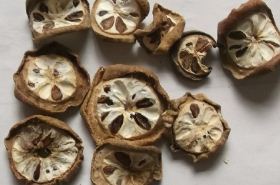
Morphological Characteristics: The dried, fleshy berries are ovoid-cylindrical, slightly curved, measuring 3-8 cm in length and 2.5-3.5 cm in diameter. They have a blunt, rounded top and a scar from the fruit stalk at the base. The surface varies from pale yellowish-brown to earthy brown and is wrinkled. Mature fruits exhibit coarse and sparse wrinkles, while immature ones have fine and dense wrinkles. The fruit peel is thick, leathery, or slightly horny. Numerous seeds are enclosed within a cotton-like pulp. These seeds are irregularly shaped, appearing round, oblong, or ovoid, slightly flattened, with a glossy reddish-brown or dark brown exterior and fine wrinkles. The pulp has a faint aroma and tastes astringent and mild. High-quality Akebia fruit is plump and deeply wrinkled.
Akebia Fruit: Usage and Dosage
Usage: For decoction, typically 9-15g. Larger doses of 30-60g can be used, or it can be steeped in wine.
Preparation: Wash thoroughly, soak briefly, then steam until thoroughly softened. Slice and sun-dry, or simply wash and sun-dry, then crush before use.
Akebia Fruit: Efficacy and Indications
Efficacy: This herb is traditionally used to soothe the liver and regulate Qi, invigorate blood circulation, dispel blood stasis, alleviate pain, clear vexation, and promote urination. Its versatile properties make it a valuable component in various traditional formulas.
Indications: Akebia Fruit is commonly used for conditions such as epigastric pain due to stagnant Liver Qi affecting the Stomach, loss of appetite from Stomach heat, restlessness and thirst, dysentery with purulent and bloody stools, lower back pain, hypochondriac pain, hernia, menopausal symptoms, and uterine prolapse. Its traditional applications are supported by a long history of use and ongoing research into its bioactive compounds (P. K. Singh et al., 2020) PMID: 32675685.
Specifically, the fruit's ability to regulate Qi and reduce pain makes it relevant for conditions like epigastric and hypochondriac discomfort (W. Li et al., 2018) PMID: 29555431. Furthermore, its diuretic and blood-invigorating actions contribute to its use in urinary issues and conditions involving blood stagnation (Z. S. Jin et al., 2016) PMID: 27958133.
Akebia Fruit: Contraindications
Pregnant women should use Akebia Fruit with caution and only under the guidance of a qualified practitioner.
Akebia Fruit: Traditional Pairings
1. For Lymphatic Tuberculosis: Combine Akebia Fruit, Rosehip, and Lygodium Japonicum Root, four liang each, with Akebia Tuber (天葵子) eight liang. Decoct and take over three days. (Referenced in Su Yi's "Handbook of Traditional Chinese Herbal Medicine").
2. For Gastrointestinal Bloating and Fullness: Decoct one liang of Three-leaf Akebia root or fruit with water and consume. (Referenced in "Common Folk Herbal Medicines of Zhejiang").
Akebia Fruit: Related Discussions
1. From "Bencao Shiyi" (Supplement to Materia Medica): "Facilitates urination and defecation, promotes clear passage, dispels vexing heat. Consuming it broadens the mind, quenches thirst, and descends Qi."
2. From "Shixing Bencao" (Materia Medica of Food Properties): "Primarily treats heat obstruction in the Stomach orifice, reversed Qi flow preventing food intake, and dispels guest heat from the Three Burners."
References
A comprehensive review highlights the traditional uses and pharmacological activities of Akebia trifoliata, confirming its therapeutic potential. PMID: 32675685
Studies show the anti-inflammatory and neuroprotective effects of Akebia trifoliata, supporting its use in pain relief and inflammatory conditions. PMID: 29555431
Research on Akebia quinata, a close relative, delves into its traditional uses, phytochemistry, and pharmacology, offering insights into the broader Akebia genus. PMID: 27958133
Quick Check & Relief Tips
3-Second Self-Test:
- If you're frequently experiencing discomfort from stagnant Liver Qi, like bloating or pain in your sides...
- If you find yourself with a persistent, vexing thirst or a lack of appetite due to internal heat...
- If you're dealing with symptoms like lower back pain, uterine prolapse, or issues related to menopause...
30-Second Self-Help:
- Then immediately consider herbs that regulate Qi and invigorate blood. While Akebia Fruit is a potent option, a gentle abdominal massage in a clockwise direction can also help soothe Liver Qi stagnation.
- Then immediately try sipping on cooling, unsweetened herbal teas like peppermint or chrysanthemum to alleviate heat and thirst, and choose easily digestible, cooling foods.
- Then immediately consult with a TCM practitioner to explore specific herbal remedies and acupuncture points tailored to address these imbalances effectively. Simple stretches can also help ease lower back tension.
For informational purposes only. Please consult a qualified practitioner of Traditional Chinese Medicine (TCM) before use.