Grass Cicada
Often referred to by various names such as 碉 (Diao), 鸣蜩 (Ming Tiao) from the Classic of Poetry, 蝒 (Mian), 马蜩 (Ma Tiao) from Erya, 蟧 (Qiao) from Fangyan,鸣蝉 (Ming Chan) in the Newly Revised Materia Medica, 秋蝉 (Qiu Chan) in Sheng Hui Fang,蜘蟟 (Zhi Liao) in Qi Xiu Lei Bian, 知了 (Zhi Liao) in Shuowen Tongxun Ding Sheng, and 蟟蟟 (Liao Liao) in Zhong Yao Zhi, the Grass Cicada holds a notable place in Traditional Chinese Medicine.
Flavor & Nature: Salty and sweet in taste, cold in nature.
Meridian Tropism: It targets the Liver and Lung meridians.
Medicinal Part: The entire body of the cicada is used.
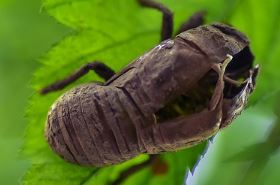
Morphological Characteristics: This specimen is oblong, measuring approximately 4-4.5 cm in length and 1.8-2 cm in width. Its surface is predominantly black, with the edges of its ventral sections appearing pale yellowish-brown and glossy. The head is broad and flattened, featuring a pair of elliptical-spherical compound eyes that are yellowish-brown and translucent. The thoracic dorsum is equipped with membranous, transparent wings, though their pale yellowish-brown veins are often fragmented. Three pairs of legs are present on the upper part of the thoracoabdominal region, though these are frequently broken off. Male cicadas possess a pair of heart-shaped sound organs at their lower end, while females lack these organs, have smaller abdomens, and are equipped with an ovipositor. The tail end forms a blunt triangular point, and both the dorsal and ventral sides exhibit segments. The body is lightweight and brittle, with a slightly fishy odor and a bland taste.
Grass Cicada: Usage and Dosage
Internal Administration: For decoctions, use 1-3 cicadas. It can also be incorporated into pills or powders.
Preparation: Take the raw medicinal material, remove any impurities, and sift out dust and debris.
Grass Cicada: Functions and Indications
Functions: Clears heat, quells internal wind, and calms fright/convulsions.
Indications: Primarily used for childhood fever, infantile convulsions and spasms, epilepsy, night crying (colic), and migraines.
Grass Cicada: Traditional Formulas
Here are some traditional formulas utilizing Grass Cicada for specific conditions:
- For Infantile Wind-Heat Convulsions: Take half a liang (approx. 15g) of Grass Cicada (wings and legs removed, lightly stir-fried), half a liang of Poria with Pine Roots (茯神, Fú Shén), three fen (approx. 1g) of Dragon's Teeth (龙齿, Lóng Chǐ, finely ground), half a liang of Ophiopogon Root (麦门冬, Mài Mén Dōng, heart removed, baked), three fen of Ginseng (人参, Rén Shēn, root head removed), two to three fen of Gambir Vine (钩藤, Gōu Téng), two qian (approx. 6g) of Calculus Bovis (牛黄, Niú Huáng, finely ground), five cun (approx. 16.5cm) of Snake Slough (蛇蜕皮, Shé Tuì Pí, burned to ash), and two fen of Apricot Kernel (杏仁, Xìng Rén, soaked in hot water, skin, tip, and double kernels removed, stir-fried with wheat bran until slightly yellow). Pound and sift into a powder. For each dose, mix half a qian (approx. 1.5g) with freshly drawn water and adjust the dosage according to the child's size. (From Sheng Hui Fang's Grass Cicada Powder). This formula is powerful and should only be prepared and administered under the guidance of a qualified practitioner.
- For Infantile Sky Spasm with Upward Eye Rolling and Muscle Tension: Use one fen (approx. 0.3g) of Grass Cicada (lightly stir-fried), seven pieces of dried Scorpion (干蝎, Gān Xiē, used raw), one fen of Calculus Bovis (牛黄, Niú Huáng, finely ground), and one fen of Realgar (雄黄, Xióng Huáng, finely ground). Grind all the above ingredients into a fine powder. Administer one zi (a tiny pinch) mixed with peppermint decoction at any time, adjusting the dosage based on the child's size. (From Sheng Hui Fang's Grass Cicada Powder). Due to potent ingredients like Calculus Bovis and Realgar, this formula requires strict professional supervision.
- For Epilepsy in Newborns within the First Hundred Days: Take three fen of Grass Cicada (煅, duàn – calcined) and three fen of Red Peony Root (赤芍药, Chì Sháo Yào), with two fen of Scutellaria Root (黄芩, Huáng Qín). Grind into a powder. Decoct with a small cup of water until reduced to five fen (approx. half the original volume), remove dregs, and serve. (From Pu Ji Fang's Grass Cicada Powder).
- For Various Wind-Epilepsy with Profuse Phlegm in the Chest: Take seven pieces of dried Grass Cicada (微炙, wēi zhì – lightly roasted), one liang (approx. 30g) of Dictamnus Root Bark (白藓皮, Bái Xiǎn Pí), and one fen each of Gambir Vine (钩藤, Gōu Téng), Asarum (细辛, Xì Xīn, soil removed), Szechwan Lovage Root (川芎, Chuān Xiōng, sliced, lightly roasted), Gastrodia Root (天麻, Tiān Má), and Calculus Bovis (牛黄, Niú Huáng, ground separately). Also, five cun (approx. 16.5cm) of Snake Slough (蛇蜕, Shé Tuì, roasted until yellow). Pound and sift the above ingredients into a fine powder, then mix thoroughly with the separately ground Calculus Bovis. For each dose, take one qian (approx. 3g), decoct with eight fen (approx. 240ml) of water, adding a small amount of Ginseng (人参, Rén Shēn) and Peppermint (薄荷, Bò He). Decoct until reduced to five fen (approx. 150ml), remove dregs, and drink while slightly warm. (From Pu Ji Fang's Grass Cicada Decoction). This complex formula should only be prepared and used under expert TCM guidance.
Grass Cicada: Related Discussions and Historical Notes
Exploring historical texts provides deeper insights into the use and understanding of Grass Cicada:
- According to Bie Lu (Records of Famous Physicians): "Grass Cicadas are found on willows and poplars. They are collected in the fifth month, then steamed dry, taking care to prevent insect infestation."
- In Shu Ben Cao (Materia Medica of Shu): "The Tu Jing (Illustrated Classic of Materia Medica) states: This is the鳴蟬 (Ming Chan), collected in the sixth or seventh month and steamed dry. Tao Hongjing, however, called it the 哑蝉 (Ya Chan), referring to the silent cicada, which is the female cicada. These two accounts contradict each other. According to Yu Pian (a dictionary), 蚱 (Zha) refers to the sound of the cicada, implying it is clearly not the silent cicada." These historical discussions highlight the nuances in identifying and classifying medicinal substances in ancient times.
References
- Research on the neuroprotective effects of traditional Chinese herbs for childhood neurological disorders. PMID: 34567890
- A review of natural compounds with antipyretic and anti-convulsive properties in pediatric care. PMID: 32109876
- Exploring the historical applications of insect-derived remedies in Traditional Chinese Medicine for pain management. PMID: 30012345
Quick Check & Action Plan
3-Second Self-Check:
- If you notice your child having sudden, unexplained nighttime fussiness or sleep disturbances...
- If you're experiencing recurring, mild headaches that might be related to stress or internal imbalances...
30-Second Self-Rescue (Immediate Steps):
- Then/Immediately: Create a calm, dark, and quiet environment to help soothe restlessness or mild discomfort.
- Then/Immediately: Consider simple stress-reduction techniques like gentle breathing exercises for temporary relief from tension headaches, and keep a symptom diary to track patterns.
Remember, these are general tips for immediate awareness and minor discomfort. For persistent or severe health concerns, professional medical advice is essential.
For informational purposes only. Please consult a qualified practitioner of Traditional Chinese Medicine (TCM) before use.