White Peony Root (Bai Shao): Benefits and Uses
Also known as: White Peony, Golden Peony.
Taste and nature: Bitter, sour, and slightly cold in nature.
Channels entered: Liver and Spleen channels.
Medicinal part: The dried root of the Paeonia lactiflora Pall., a plant in the Ranunculaceae family.
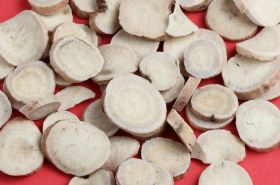
Identifying Features
The root is cylindrical, straight or slightly curved, with flat ends. It measures 5–18 cm in length and 1–2.5 cm in diameter. Its surface is whitish or light reddish-brown, smooth or slightly wrinkled, with visible rootlet scars. The interior is firm, difficult to break, and shows a radiating pattern when cut. It has a faint aroma and a mildly bitter, sour taste.
How to Use White Peony Root
Dosage: 6–15g per day, as recommended.
Preparation: Harvested in summer or fall, the roots are cleaned, trimmed, and boiled in water before peeling. They are then dried under the sun.
Benefits and Primary Uses
Key Benefits:
- Nourishes blood and regulates menstruation.
- Preserves yin energy and reduces sweating.
- Soothes liver discomfort and alleviates pain.
- Helps stabilize liver yang.
Primary Uses: Commonly used to treat pale complexion due to blood deficiency, irregular menstruation, spontaneous sweating, night sweats, chest or abdominal pain, limb cramps, and headaches or dizziness.
Herbal Combinations
For women’s chest pain: Combine Xiang Fu (Cyperus), Rou Gui (Cinnamon), Yan Hu Suo (Corydalis), and Bai Shao. Grind into powder and take 2 grams with hot water. (Source: Zhu’s Effective Medical Prescriptions)
Precautions
Do not use Bai Shao in combination with Li Lu (Veratrum).
Traditional References
1. Shen Nong's Classic of Materia Medica: “Relieves abdominal pain caused by pathogenic qi, improves circulation, and eliminates blood stagnation.”
2. Additional Records: “Supports smooth blood flow, clears water retention, and treats bladder-related discomfort.”
3. Ri Hua Zi’s Materia Medica: “Effective for women’s health, postpartum recovery, and relieving blood-related conditions.”
Safety Tips
Always consult a qualified practitioner before using Bai Shao, especially during pregnancy or when taking other medications. It is essential to ensure proper dosage and compatibility with your health condition.
3-Second Self-Test + 30-Second Self-Care
Self-Test: Are you experiencing irregular menstrual cycles or frequent night sweats? If yes, Bai Shao may be worth considering.
Self-Care: Immediately consult a Traditional Chinese Medicine (TCM) practitioner to determine if Bai Shao is suitable for you. Pair it with a balanced diet rich in iron and vitamin C to further support blood health.
For informational purposes only. Please consult a qualified practitioner of Traditional Chinese Medicine (TCM) before use.