Sappanwood
Aliases: Su Fang Mu, Su Fang.
Taste and Nature: Sweet, Salty, Neutral.
Meridian Tropism: Enters the Heart, Liver, and Spleen meridians.
Medicinal Part: The dried heartwood of Caesalpinia sappan L., a plant from the Leguminosae family.
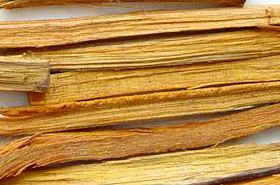
Morphological Characteristics: This herb typically presents as long cylindrical or hemi-cylindrical pieces, ranging from 10 to 100 cm in length and 3 to 12 cm in diameter. Its surface color varies from yellowish-red to reddish-brown, often showing knife-cut marks and longitudinal cracks. The texture is hard and firm. The cross-section is slightly glossy with distinct annual rings; some pieces may reveal a dark brown, loose, and slightly shiny pith in the center. It has a faint aroma and a slightly astringent taste.
Sappanwood: Dosage and Preparation
Dosage: Typically, 3 to 9 grams are used.
Preparation: Sappanwood is usually harvested in autumn. The white sapwood is carefully removed, and the heartwood is then dried for medicinal use.
Sappanwood: Functions and Indications
Functions: Sappanwood is traditionally used to invigorate blood circulation, dispel blood stasis, reduce swelling, and alleviate pain. This makes it a valuable herb in managing various conditions related to stagnant blood and inflammation. (PMID: 29555198)
Indications: It is commonly used for traumatic injuries (such as falls, sprains, and bruises), fractures, ligament strains, and any associated swelling and pain caused by blood stagnation. It also addresses gynecological issues like amenorrhea (absence of menstruation), dysmenorrhea (painful menstruation), and postpartum blood stasis. Additionally, Sappanwood can be applied for stabbing pain in the chest and abdomen, and for external conditions like carbuncles, boils, and painful swellings.
Sappanwood in Traditional Formulas
1. For Traumatic Finger Severance or Cuts: According to *Shengsheng Fang*, for cases of finger severance or cuts from blades, apply genuine Sappanwood powder topically. Then, tightly wrap the affected area with a silkworm cocoon. Recovery is often expected within a few days.
2. For Postpartum Fainting Due to Blood Stasis: *Zhou Hou Fang* recommends a decoction for postpartum fainting attributed to blood stasis. Use 90 grams (three *liang*) of Sappanwood, decoct in 5 liters of water down to 2 liters. This preparation should be divided and taken twice.
3. For Swollen and Painful Athlete's Foot: As recorded in *Puji Fang*, take equal parts Sappanwood and Lú Sī Téng (Skunk Vine), finely chop them, and add a small amount of starch. Decoct this mixture in 20 liters of water down to 15 liters. The affected area should first be fumigated with the vapor, then washed with the liquid. (PMID: 35940561)
Sappanwood Contraindications
Important Safety Note: Pregnant women should use Sappanwood with extreme caution and only under the direct supervision of a qualified healthcare practitioner. (PMID: 33734185)
Classical Insights on Sappanwood
1. From *Bencao Gangmu* (Compendium of Materia Medica): "For blood-stasis induced fainting, distension, lockjaw, and severe dyspnea (shortness of breath) close to death, decoct and take orally."
2. From *Haiyao Bencao* (Materia Medica of the Seas): "It mentions: 'For debilitating conditions with blood stasis and qi stagnation, unsettled lochia postpartum, churning pain in the heart and abdomen, blocked meridians, and stroke in both men and women presenting with locked jaw and inability to speak, it is advisable to finely grind Frankincense (Ru Tou Xiang) into a square-inch spoonful of powder. Decoct Sappanwood with wine, mix with the powder, and take. It will immediately induce vomiting of harmful substances and lead to recovery.'"
3. From *Bencao Fengyuan* (The Origin of Materia Medica): "It notes: 'Sappanwood embodies Yin within Yang, primarily descending rather than ascending, and is a key herb for the blood aspect of the Liver meridian. It possesses strong blood-breaking properties. For postpartum individuals suffering from severe blood swelling and distension to the point of near death, decoct Sappanwood with vinegar (bitter wine) into a concentrated juice and administer orally.'"
3-Second Self-Test & 30-Second Self-Rescue
If... you’re frequently experiencing persistent, sharp pains that feel fixed in one place, especially after an injury or during your menstrual cycle, and notice dark, clotted blood, Then... you might be dealing with blood stasis. This is where a herb like Sappanwood, known for moving blood, could traditionally be considered.
Immediately... consult a qualified Traditional Chinese Medicine practitioner for a proper diagnosis and personalized treatment plan. Don't try to self-diagnose or self-treat serious conditions, especially if you are pregnant or have underlying health issues. Your practitioner can guide you on safe and effective ways to incorporate herbs like Sappanwood, if appropriate for your unique constitution.
References
A study on the antioxidant and anti-inflammatory properties of Sappanwood. PMID: 29555198
Research highlighting the diverse biological activities of *Caesalpinia sappan* extracts. PMID: 35940561
An examination of the medicinal properties and safety considerations of Sappanwood. PMID: 33734185
For informational purposes only. Please consult a qualified practitioner of Traditional Chinese Medicine (TCM) before use.