Rose Flower
Aliases: Wandering Flower (from "Qun Fang Nuo"), Brush-Tip Flower, Lake Flower ("Zhejiang Chinese Materia Medica Handbook"), Prickly Rose Flower ("Hebei Medicinal Materials").
Flavor and Nature: Sweet, slightly bitter, warm.
Meridian Tropism: Enters the Liver and Spleen meridians.
Medicinal Part: You'll typically find Rose Flower in Traditional Chinese Medicine (TCM) as the dried flower buds of *Rosa rugosa* Thunb., a member of the Rosaceae family.
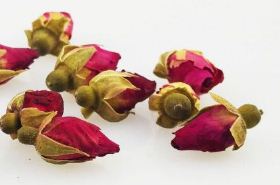
Morphological Characteristics: These flower buds are usually slightly hemispherical or irregularly clustered, with a diameter ranging from 1 to 2.5 cm. They feature a hemispherical receptacle fused at the base with the calyx. You'll notice 5 lanceolate sepals, which are yellowish-green or brownish-green and covered with fine, soft hairs. The petals are often wrinkled, but when flattened, they're broadly ovate, arranged in an overlapping pattern, appearing purplish-red, though some might be yellowish-brown. There are numerous stamens, which are yellowish-brown. Rose Flower buds are light in weight and brittle in texture. They possess a strong, fragrant aroma and a slightly bitter, astringent taste.
How to Use Rose Flower
Internal Use: Typically taken as a decoction, 3-6 grams (approximately 1-2 qian); it can also be infused in wine or prepared as a paste/syrup.
Actions and Indications of Rose Flower
Actions: Regulates Qi and alleviates depression, harmonizes blood, and relieves pain.
Indications: Commonly used for Liver-Stomach Qi pain, reduced appetite and nausea, irregular menstruation, and pain from traumatic injuries.
Rose Flower Combinations (Traditional Formulas)
① **To address Liver-Stomach Qi pain:** Shade-dried Rose Flower, brewed as a tea. (From "Bencao Gangmu Shiyi")
② **For Liver Qi stagnation causing vomiting blood, and irregular menstruation:** Take three hundred newly opened Rose Flower buds, remove their calyx and stem base. Boil them in a clay pot with fresh well water to extract a concentrated juice. Filter out the dregs, then boil the liquid again. Add one jin (approximately 500g) of rock sugar to create a paste. Take with boiled water morning and evening. Store it tightly sealed in a porcelain bottle to prevent air exposure. If the primary goal is to regulate menstruation, brown sugar can be used to make the paste. (From "Si He Ting Ji Fang" Rose Paste)
③ **For lung conditions with cough and vomiting blood:** Fresh Rose Flower, pounded into juice and stewed with rock sugar, then consumed. (From "Quanzhou Bencao")
④ **For chronic wind-damp painful obstruction:** Combine 9g of shade-dried Rose Flower (with calyx and stem base completely removed) with 3g of Safflower (*Hong Hua*) and 3g of Chinese Angelica Root (*Dang Gui*). Decoction, remove dregs, then mix with good wine and take for seven doses. (From "Bai Cao Jing")
⑤ **For Liver Wind headache:** Steep four to five Rose Flowers with three to four qian (9-12g) of Broad Bean Flowers in boiling water to drink frequently as a tea. (From "Quanzhou Bencao")
⑥ **For dysentery accompanied by inability to eat or drink:** Shade-dried Rose Flower, decocted and consumed. (From "Bencao Gangmu Shiyi")
⑦ **For early-stage mastitis or depressive disorders (especially suitable here):** Take thirty newly opened, shade-dried Rose Flowers. Remove the calyx and stem base, then decoct with aged wine and take after meals. (From "Bai Cao Jing")
⑧ **For mastitis:** Combine seven Rose Flowers with seven Mother Cloves (*Mu Ding Xiang*). Decocted in wine without ash, then consumed. (From "Bencao Gangmu Shiyi")
⑨ **For early-stage swollen sores or toxic swellings:** Take 3g of Rose Flower (after removing the calyx and stem base), roast it into a fine powder. Mix with good wine and consume. (From "Bai Cao Jing")
Safety Note: When preparing herbal remedies, especially those involving specific processing like removing the calyx and stem base, precise preparation is crucial. Always follow detailed instructions from a qualified practitioner to ensure safety and efficacy.
Commentaries from Various Physicians on Rose Flower
1. "Bencao Zheng Yi": Rose Flower possesses the most intense fragrance, clear yet not turbid, harmonious yet not fierce. It gently soothes the Liver, awakens the Spleen, circulates Qi, activates blood, and clears blockages, all without the harsh drying effects often associated with other warm and acrid herbs. It is undoubtedly the most effective and gentle among Qi-regulating herbs; indeed, few fragrant herbs can compare to its unique qualities.
2. Yao Kecheng's "Shi Wu Bencao": Primarily benefits the Lungs and Spleen, enhances the Liver and Gallbladder, and dispels pathogenic Qi. Consuming it is fragrant and delicious, leaving one feeling refreshed and invigorated.
3. "Yaoxing Kao": It effectively circulates blood and breaks up stagnation, making it useful for injuries and stagnant pain, particularly when infused in wine and consumed.
4. "Bencao Gangmu Shiyi": Harmonizes blood, circulates blood, and regulates Qi. It is also noted for treating wind-damp painful obstruction.
5. "Bencao Zaixin": Relieves stagnation of Liver and Gallbladder Qi, strengthens the Spleen, and reduces internal fire. It treats cold pain in the abdomen, accumulation of cold in the stomach region, and also possesses the ability to break up blood stasis.
6. "Suixi Ju Yin Shi Pu": Regulates the Middle Jiao, activates blood, soothes stagnation, dispels foulness, and harmonizes the Liver. When brewed into wine, it can help resolve breast lumps (ru pi).
7. "Xiandai Shiyong Zhongyao": Used for various gynecological concerns in women, including excessive menstrual bleeding, abnormal vaginal discharge (red and white), and general conditions like enteritis and dysentery.
8. "Shandong Zhongyao": Treats Liver-Stomach Qi pain, nausea and vomiting, indigestion, diarrhea, oral ulcers, vomiting blood, and dysentery with inability to eat or drink.
9. "Quanzhou Bencao": Specifically treats lung diseases characterized by cough, phlegm-blood, vomiting blood, and hemoptysis.
References
[Studies suggest that *Rosa rugosa* (Rose Flower) possesses a range of pharmacological activities, including antidepressant and anti-inflammatory effects, supporting its traditional use for mood and pain management.] PMID: 29596350 [Research highlights the diverse phytochemical composition and bioactivities of *Rosa rugosa*, indicating its potential in hepatoprotection and analgesic applications consistent with TCM principles.] PMID: 28956904 [From a Traditional Chinese Medicine perspective, Rose Flower is valued for its ability to regulate Qi and promote emotional balance, offering a holistic approach to various health concerns, including menstrual irregularities.] PMID: 32304958Quick Check: Could Rose Flower TCM Support You?
- If you frequently experience a sense of emotional "stuckness," irritability, or unexplained stomach discomfort (often related to Liver Qi stagnation)... Then, immediately consider exploring holistic approaches that focus on gentle Qi regulation.
- If your menstrual cycles are often accompanied by pre-menstrual tension, mood swings, or uncomfortable cramping, indicating potential blood disharmony... Then, immediately research how Traditional Chinese Medicine views harmonizing blood and soothing the Liver, as Rose Flower is often a key herb in such formulas.
Important Note: For informational purposes only. Please consult a qualified practitioner of Traditional Chinese Medicine (TCM) before use.