Coriander Seed
Other Names: Coriander Fruit, Chinese Parsley Seed.
Flavor Profile & Energetic Nature: Pungent and slightly sour, with a neutral energetic nature.
Meridian Tropism: Associated with the Lung and Stomach meridians.
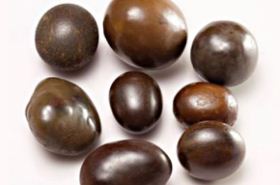
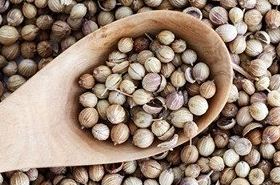
Morphological Characteristics: Coriander seeds typically appear as spherical fruits, usually 3-5 millimeters in diameter. At their apex, you'll often see the remnants of two styles, surrounded by five persistent sepals. The base is blunt and rounded, sometimes retaining a fragment of the fruit stalk. The outer surface is pale brown or yellowish-brown, relatively rough, and marked with 10 wavy primary ridges and 12 straight secondary ridges, though the primary ridges are often less distinct. Some fruits may split into two halves (mericarp), where the dorsal side is convex, and the ventral side has a central concave depression, revealing three longitudinal ridges, with the two lateral ones often curved. The texture is somewhat firm. When crushed, it releases a strong, distinctive aroma and has a slightly spicy taste. The best quality seeds are plump and free from impurities.
Coriander Seed: Usage and Dosage
Usage: The typical internal dosage ranges from 5 to 10 grams. For external applications, an appropriate amount can be decocted to make a wash for gargling or fumigation.
Coriander Seed: Functions and Indications
Functions: It works to dispel cold and regulate Qi (vital energy flow), promote the proper eruption of skin conditions like measles or chickenpox, and resolve food stagnation.
Indications: Traditionally used to address indigestion due to food stagnation and insufficient eruption of rashes. Externally, a decoction can be used as a mouthwash for toothache, or for fumigation and washing to treat hemorrhoids and anal prolapse. PMID: 35272646
Coriander Seed: Traditional Formulas
1. For the early stage of measles with insufficient eruption: Take 120 grams of Coriander Seed. Pound it, then place it in a clay pot or aluminum pot, fill with water, and place it in a small, well-sealed sickroom. Boil it over charcoal fire to let the steam fill the room. Continuously add charcoal and water until the measles rash has fully erupted, then discontinue use. (Zhejiang Journal of Traditional Chinese Medicine (3):32, 1959)
2. For dysentery and bloody diarrhea: Take 1 historical *He* (unit) of Coriander Seed. Crush it. For red stools, mix with sugar water; for white stools, mix with fresh ginger juice. Take warm. Alternatively, it can be mixed with wine and taken. (Puji Fang)
3. For intestinal wind with persistent bleeding that develops into hemorrhoids (Husuizi Powder): Take 15 grams each of Coriander Seed and Psoralea (Bu Gu Zhi). Pound these two ingredients into a fine powder. Take 6 grams per dose, mixed with aged rice soup, before meals. (Sheng Ji Zong Lu)
4. For hemorrhoids: Stir-fry Coriander Seed until fragrant, then grind finely. Take 3-5 doses mixed with wine. (Haishang Fang) PMID: 25166288
5. For anal prolapse and anal fistula: Take 1 historical *Sheng* (unit) of Coriander Seed, a small amount of Frankincense (Ru Xiang), and 0.5-1 historical *Sheng* of millet husks. First, construct a small stove with mud, leaving only a small opening the size of the anus, ensuring smoke and fire do not escape directly. Use this to fumigate the affected area. (Rumen Ting Qin)
6. For rectal prolapse: In autumn and winter, pound Coriander Seed, boil it with vinegar, and apply as a hot compress. (Shiliao Bencao)
7. For toothache: Boil 5 historical *Sheng* of water with Coriander Seed until reduced to 1 *Sheng*. Hold the liquid in the mouth and then spit it out. (Beiji Fang)
Coriander Seed: Insights from Historical Texts
1. Qian Jin Shi Zhi: "It aids digestion and restores the perception of taste."
2. Bencao Shiyi (Compendium of Materia Medica Supplement): "Primarily treats tinea capitis in children; apply oil-fried. Also treats insect poisoning, 'five wild chicken diseases' (a historical term for certain skin ailments), and meat poisoning accompanied by bloody stools. Boil the seeds until they split, then drink the juice."
3. Bencao Gangmu (Compendium of Materia Medica): "Promotes the eruption of rashes and pox, and eliminates fishy odors."
4. Fenlei Caoyao Xing (Classification of Herbal Properties): "Treats insufficient eruption of rashes in children, wards off seasonal pathogenic influences, dispels cold from the surface, and treats nasal obstruction." PMID: 30450597
3-Second Self-Test + 30-Second Self-Help:
If you're experiencing a persistent feeling of fullness or discomfort after meals, especially with a diminished appetite,
Then/Immediately consider incorporating a pinch of ground coriander seed into your next meal, or simply brew a small amount as a tea. Its natural properties may help gently nudge your digestion back on track.
For informational purposes only. Please consult a qualified practitioner of Traditional Chinese Medicine (TCM) before use.
References
Coriander (Coriandrum sativum L.) in ethnobotany: A review of pharmacological activities and traditional uses. PMID: 35272646
Anti-inflammatory and analgesic effects of Coriandrum sativum L. extract in animal models. PMID: 25166288
Therapeutic potential of Coriandrum sativum L. (coriander) in human health: A review. PMID: 30450597