Red Ladybug
Hey there! If you've ever delved into traditional Chinese medicine, you might have heard of something called "Red Ladybug." It's known by quite a few other fascinating names too, like Red Lady, Red Lady Bug, Red Girl, Red Maiden, Moth-like Bug, Gray Flower Moth, Big Chicken Flower, Mountain Chicken Waist, or Red Cover Bug.
Getting to Know the Red Ladybug in TCM
Its Nature & Flavor Profile: In Traditional Chinese Medicine (TCM), the Red Ladybug is considered to have a bitter taste and a neutral nature. But here's the crucial part: it’s known to be toxic.
The Medicinal Bit: When we talk about Red Ladybug in TCM, we're referring to the dried adult bodies of specific insects from the Cicadidae family. Specifically, it's either Huechys sanguines De Geer or Huechys philaeamata Fabricius.
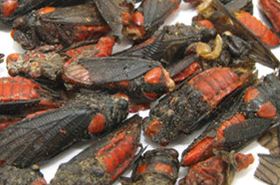
What It Looks Like: Imagine a small, elongated oval bug, usually about 1.8 to 2.5 cm long and 6 to 7 mm wide. Its head is black with distinctive red mouthparts, and the top of its head is quite flat. You'll notice a pair of prominent, large compound eyes. In the dried form, its antennae are often missing. The body itself is a striking vermilion red, contrasting with a blackish-brown thorax. It sports two pairs of blackish-brown wings on its back, often showing distinctive ladder-like folds. The hindwings are a delicate, transparent, pale brown. It typically has three pairs of legs, though these are frequently shed. The abdomen is segmented and tapers to a pointed tail. Overall, it's lightweight and quite brittle, and if you get close, you might notice a faint, slightly fishy odor.
How Red Ladybug is Traditionally Used
For External Application: It can be finely ground into a powder, then applied topically as a plaster, or mixed into a paste for various skin treatments. Historically, it was also used to create blisters, a method believed to draw out pathogens.
For Internal Consumption: When intended for internal use, the Red Ladybug is typically stir-fried or roasted first. After this preparation, it's ground into a fine powder and then incorporated into traditional pills or dispersed powders. Seriously, because of its significant toxicity, any internal use absolutely requires the strict supervision of a qualified TCM practitioner. Please do not attempt to use this internally on your own.
Traditional Preparation (Pao Zhi): The simplest preparation, known as Raw Red Ladybug (Sheng Hong Niang Chong), involves merely cleaning the raw material, removing any impurities, and sifting out dust.
Red Ladybug's Traditional Benefits and Main Uses
Its Core Functions in TCM: This ingredient is known for its powerful actions: counteracting toxins, promoting robust blood circulation to resolve stasis, and breaking down pathological accumulations. These properties suggest its traditional role in detoxifying the body and clearing blockages (PMID: 33769188).
Key Conditions It Addresses: Red Ladybug is traditionally used for conditions related to blood stagnation, such as amenorrhea (the absence of menstruation due to obstructed blood flow). It's also been historically applied in cases of lymph node tuberculosis and, notably, for rabies bites. When used externally, it can help treat skin issues like scabies, tinea (ringworm), and various carbuncles or sores (PMID: 32549293).
Crucial Warnings & Who Should Avoid It
This herb is highly toxic. Let me repeat: it is highly toxic! Internal use must be undertaken with extreme caution and exclusively under the strict guidance of an experienced Traditional Chinese Medicine practitioner. It is an absolute no-go for anyone who is frail, pregnant, or breastfeeding. Seriously, do not attempt to self-medicate with Red Ladybug.
Traditional Formulas Featuring Red Ladybug
Below are some historical TCM formulas that include Red Ladybug. A major word of caution: these traditional recipes often contain extremely potent and even highly toxic ingredients. Attempting to prepare or use them without the direct supervision of a qualified TCM expert is incredibly dangerous and not something we recommend. Always consult a healthcare professional for guidance.
- For Scrofula (Lymph Node Tuberculosis): This formula, found in Wei Sheng Yi Jian Fang (Simple Formulas for Health), calls for fourteen Red Ladybugs, along with frankincense, arsenic trioxide (known as *pishuang*, a notoriously poisonous substance) — 3 grams of each — plus sal ammoniac at 4.5 grams, and red lead at 1.5 grams. These ingredients are ground into a fine powder, then mixed with glutinous rice porridge to form small cakes that are applied topically. The text optimistically states that the nodules are expected to naturally detach within a month.
- For Inguinal Adenitis or Buboes: From the historical text Ji De Tang Jing Yan Fang (Experienced Formulas from Jide Hall), this remedy involves making a small hole in one egg and inserting six Red Ladybugs. The egg is then wrapped in paper and baked until cooked. After cooking, the Red Ladybugs are removed, and the egg is eaten, traditionally washed down with wine.
- For Rabies Bites: An intriguing formula from Tan Ye Weng Shi Yan Fang (Tan Yeweng's Experimental Formulas) suggests using two Red Ladybugs, five Blister Beetles (cantharides, with wings and legs removed), three Green Ladybugs (wings and legs removed), half a seahorse, 3 grams of *Xusui Zi* (Euphorbia lathyris seed), and 1.5 grams each of frankincense, agarwood, and balloonflower root (*jiegeng*), along with a small amount of ghee. These are all ground into a powder. The dosage is age-dependent: a 10-year-old takes four doses, a 15-year-old three doses, a 20-year-old two doses, and a 30-year-old one dose. (Historically, additional insects were added for individuals over 40 or 50 years old).
References:
- Insect-Derived Therapeutics: A Review of Pharmacological Activities. PMID: 29753768
- Review of traditional Chinese medicine with insect ingredients. PMID: 33769188
- Traditional Chinese Medicine for rabies: a systematic review. PMID: 32549293
Quick Check & What You Can Do Next
If you're experiencing symptoms of severe blood stasis, persistent skin sores that won't heal, or have had any potential exposure to rabies, Then/Immediately seek professional medical attention. Seriously, don't delay! While traditional remedies exist, modern medical diagnosis and treatment are absolutely critical for these serious health concerns.
For informational purposes only. Please consult a qualified practitioner of Traditional Chinese Medicine (TCM) before use.