Job's Tears (Coix Seed): A Traditional Chinese Medicine Perspective
Often referred to as Coix Seed, Job's Tears is a widely recognized herb in Traditional Chinese Medicine (TCM).
Aliases:
Coix Seed, Pearl Barley.
Nature and Flavor:
Sweet, bland, and cool in nature.
Channel Tropism:
Enters the Spleen, Stomach, and Lung meridians.
Medicinal Part:
The dried mature kernels of Coix lacryma-jobi L. var. mayuen (Roman.) Stapf, a plant belonging to the Poaceae (grass) family.
Morphological Characteristics:
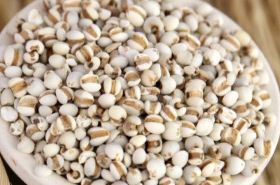
This herb typically presents as wide ovoid or long elliptical kernels, measuring 4-8mm in length and 3-6mm in width. The surface is milky white and smooth, occasionally retaining some yellowish-brown seed coat. One end is blunt and rounded, while the other is wider and slightly concave, featuring a pale brown dot-like hilum. The dorsal side is convex, and the ventral side has a relatively wide and deep longitudinal groove. It is firm in texture with a white, powdery cross-section. It has a faint aroma and a slightly sweet taste.
Dosage and Preparation of Job's Tears
Dosage:
Typically 9-30g.
Preparation:
- Raw Job's Tears: Simply remove impurities.
- Bran-fried Job's Tears: Take clean Job's Tears and stir-fry them with bran until they turn slightly yellow. This processing method often modifies its properties, making it more effective in strengthening the Spleen.
Functions and Indications of Job's Tears
Functions:
Promotes urination and resolves dampness, strengthens the Spleen and stops diarrhea, dispels painful obstruction (Bi syndrome), promotes the discharge of pus, clears toxins, and disperses nodules.
Indications:
Job's Tears is traditionally used for conditions such as edema, damp-related swelling of the lower limbs (like athlete's foot or beriberi), difficult urination, diarrhea due to Spleen deficiency, damp-Bi syndrome characterized by spasms and contractures, lung abscesses, intestinal abscesses; warts, and certain types of tumors/cancers. PMID: 30678224
Formulations and Combinations with Job's Tears
Job's Tears is a valuable herb frequently incorporated into various classic TCM formulas:
- From Wen Bing Tiao Bian (Treatise on Warm-Febrile Diseases): Used with White Cardamom (Bai Dou Kou), Apricot Kernel (Xing Ren), Bamboo Leaf (Zhu Ye), Akebia Stem (Tong Cao), Talc (Hua Shi), Pinellia (Ban Xia), and Magnolia Bark (Hou Po). This combination is for early-stage warm-febrile diseases presenting with headache, aversion to cold, heavy and painful body, a white tongue coating without thirst, chest stuffiness, loss of appetite, and fever in the afternoon.
- From He Ji Ju Fang (Formulas from the Imperial Pharmacy): When combined with Ginseng (Ren Shen), Poria (Fu Ling), and Atractylodes (Bai Zhu) in formulations like Shen Ling Bai Zhu San (Ginseng and Poria with Atractylodes Macrocephala Powder), it effectively drains Spleen dampness and strengthens the Spleen to stop diarrhea. PMID: 24578877
- From Qian Jin Fang (Prescriptions Worth a Thousand Gold): Used with Reed Rhizome (Wei Jing), Winter Melon Seed (Dong Gua Ren), and Peach Kernel (Tao Ren) in formulas like Wei Jing Tang (Reed Stem Decoction), it treats lung abscesses with chest pain and coughing up purulent phlegm. PMID: 32820521
Contraindications of Job's Tears
Caution: Pregnant women should use Job's Tears with extreme caution. Always consult a qualified Traditional Chinese Medicine practitioner or your primary healthcare provider before using Job's Tears, especially if you are pregnant, nursing, have underlying health conditions, or are taking other medications.
Traditional Discussions on Job's Tears
- From Ben Cao Gang Mu (Compendium of Materia Medica): "Job's Tears is a Yangming channel herb, capable of strengthening the Spleen and benefiting the Stomach. Following the principle of 'when the child is weak, nourish the mother,' it is used for lung atrophy and lung abscesses. Diseases of the tendons and bones fundamentally involve treating the Yangming channels, hence its use for contractures, muscle stiffness, and wind-damp painful obstruction. Since Earth (Spleen) can generate water and eliminate dampness, it is also used for diarrhea and edema."
- From Ben Cao Jing Shu (Commentary on the Classic of Materia Medica): "Its drying nature dispels dampness, its sweet flavor enters and supplements the Spleen, and its bland flavor promotes dampness excretion. Therefore, it treats muscle contractures and stiffness, inability to flex and extend, as well as wind-damp painful obstruction. It removes pathogenic qi from tendons and bones causing numbness, benefits the intestines and stomach, resolves edema, and improves appetite."
- From Ben Cao Xin Bian (New Compendium of Materia Medica): "It is exceptionally good at promoting urination without depleting the body's true Yin energy. It is most suitable for those with severe dampness accumulated in the lower body."
Quick Check-in: Could You Benefit from Job's Tears?
If you often feel heavy, sluggish, experience frequent bloating or loose stools, or find your joints feeling stiff and achy, especially in damp weather...
Then/Immediately: You might be experiencing a buildup of dampness according to TCM principles. Consider incorporating dampness-resolving foods like Job's Tears (barley), adzuki beans, or winter melon into your diet. For a simple remedy, try brewing a tea with a tablespoon of Job's Tears and a slice of fresh ginger – it's a gentle way to support your body's natural balance. If these symptoms persist or worsen, please consult a qualified TCM practitioner or your primary care physician for personalized advice and diagnosis.
References
- [Antitumor and immunomodulatory effects of Coix lacryma-jobi] PMID: 30678224
- [Herbal medicine for irritable bowel syndrome: A systematic review and meta-analysis of randomized controlled trials] PMID: 24578877
- [Traditional Chinese Medicine for Lung Abscess: A Review] PMID: 32820521
For informational purposes only. Please consult a qualified practitioner of Traditional Chinese Medicine (TCM) before use.