Qian Niu Zi
Also Known As: Morning Glory Seed, Black Ugly (Hei Chou), White Ugly (Bai Chou), Two Ugly (Er Chou), Trumpet Flower Seed (Laba Huazi).
Taste and Nature: Bitter, Cold; Toxic.
Meridian Tropism: It primarily acts on the Lung, Kidney, and Large Intestine meridians, influencing their functions in the body.
Medicinal Part: This herb consists of the dried mature seeds from the plants *Pharbitis nil* (L.) Choisy or *Pharbitis purpurea* (L.) Voigt, both members of the Convolvulaceae family.
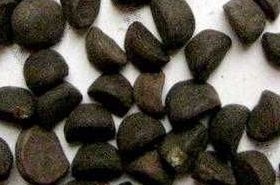
Morphological Characteristics: Qian Niu Zi seeds resemble orange segments, typically 4-8mm long and 3-5mm wide. Their surface can be grayish-black or pale yellowish-white. A shallow longitudinal groove runs along the dorsal side, while a slightly concave, dot-like hilum is present at the lower end of the ventral ridge. These seeds are hard in texture. When cut transversely, you'll see yellowish or yellowish-green cotyledons that are shriveled and folded, exhibiting a slightly oily sheen. They are odorless but have a pungent, bitter taste, often accompanied by a numbing sensation. Given its inherent toxicity, always handle this herb with care and under professional guidance.
Dosage and Preparation of Qian Niu Zi
Dosage: Typically, 3-6g. However, due to its toxicity, precise dosage must be determined by a qualified Traditional Chinese Medicine practitioner.
Preparation: The plants are harvested in late autumn when the fruits are mature but before their shells crack open. They are then dried, and the seeds are threshed and impurities removed. Before use, the seeds are typically crushed.
Functions and Indications of Qian Niu Zi
Functions: Qian Niu Zi is primarily used to promote urination and bowel movements, dispel phlegm and drain fluid retention, eliminate parasites, and resolve internal accumulations.
Indications: It's commonly indicated for conditions like general body edema and swelling, difficulty with both urination and defecation, accumulation of phlegm and retained fluids leading to symptoms like reversed flow of Qi (energy) and asthma-like coughing, abdominal pain due to parasitic infections, and specific conditions such as ascariasis (roundworm infection) and taeniasis (tapeworm infection). Herbal remedies, including those with diuretic and laxative properties like Qian Niu Zi, have been historically used in various cultures to manage fluid retention and promote gut health. [Review on the use of herbal medicine for diuretic and laxative effects] PMID: 28269785
Important Precautions for Qian Niu Zi
This herb is **strictly contraindicated for pregnant women**. Additionally, it should **not be used in combination with Croton Seed (Ba Dou) or Croton Frost (Ba Dou Shuang)**. As a potent herb with noted toxicity, it is crucial to use Qian Niu Zi only under the strict supervision and prescription of a licensed Traditional Chinese Medicine practitioner. Self-medication is strongly discouraged due to potential adverse effects and drug interactions. Consulting a professional ensures safe and appropriate use, especially for powerful herbs. [Emphasizing the importance of consulting TCM practitioners for safety and efficacy] PMID: 30424590
Traditional Combinations and Formulas with Qian Niu Zi
Historically, Qian Niu Zi has been integrated into various TCM formulas to address specific health concerns:
- For Edema: A fine powder of Qian Niu Zi can be taken with water, about one square inch spoonful daily, until urination increases. (From Qian Jin Fang)
- For Fluid Retention and Swelling: A formula called Yugong San from Rumen Shi Qin combines four ounces of Qian Niu Zi powder with one ounce of stir-fried fennel, sometimes adding a little *mu xiang*. This fine powder is mixed with 1-2 *qian* of fresh ginger juice and taken before bed.
- For Abdominal Distension due to Water Qi: The Yiqi San from Xuanming Lun Fang uses equal parts of white and black Qian Niu Zi (two *qian* each). This powder is mixed with four ounces of barley flour to make pancakes. Consumed with a cup of tea before bed, it aims to reduce stagnant Qi.
- For Pediatric Abdominal Distension, Water Retention Swelling, Bladder Heat, and Scanty Reddish Urine: One *qian* of raw, crushed Qian Niu Zi can be taken on an empty stomach with Qingpi Tang (tangerine peel decoction). Alternatively, reducing the dosage and adding half the amount of *mu xiang* to make pills for administration. (From Zheng Shi Xiao Er Fang)
- For Swelling of the Limbs: This formula from Ben Shi Fang uses half an ounce of prepared Magnolia Bark (Hou Po) and five ounces of stir-fried Qian Niu Zi, powdered to yield two ounces. Two *qian* of this fine powder is taken with a decoction of ginger and red dates.
- For Severe Pediatric Lung Distension with Asthma, Chest Heaving, Flared Nostrils, Restlessness, Cough, Hoarse Voice, and Phlegm Accumulation (known as "Horse Spleen Wind"): The Niuhuang Duoming San from Tian Shi's Baoying Ji includes one ounce each of partially raw and partially stir-fried white Qian Niu Zi, and partially raw and partially stir-fried black Qian Niu Zi, along with one ounce each of prepared Rhubarb (Chuan Dahuang) and Betel Nut (Bing Lang). This fine powder, two *qian* per dose for a three-year-old, is taken with cold rice water. If there's excessive phlegm, a small amount of "Ni Fen" (calomel) can be added, and honey can be added for taste at any time.
- For Beriberi with Leg Swelling and Pitting Edema: Qian Niu Zi is crushed and made into honey pills, about the size of small beans (five pills per dose). (From Bu Que Zhou Hou Fang)
- For All Types of Parasitic Accumulations: From Yong Lei Ling Fang, two ounces of stir-fried and powdered Qian Niu Zi are combined with one ounce of Betel Nut (Bing Lang) and fifty slightly stir-fried kernels of Quisqualis Fruit (Shijunzi Rou). This fine powder, two *qian* per dose, is taken with sugar water; children take half the dose.
- For Large Intestine Wind-Heat Constipation and Blockage: From Bencao Yanyi, one ounce of black Qian Niu Zi (lightly stir-fried and powdered to extract the inner powder) is combined with half an ounce of powdered peach kernels (Taoren). These are mixed with cooked honey to form pills the size of梧桐子 (Wutongzi seeds). Thirty to twenty pills are taken with warm water.
- For Cold Qi Stagnation, Lumbar Pain Preventing Bending and Stretching: The Qian Niu Wan from Yang Shi Jia Zang Fang uses two ounces of Corydalis Tuber (Yan Hu Suo), two ounces of stir-fried Psoralea Fruit (Po Gu Zhi), and three ounces of stir-fried black Qian Niu Zi. This fine powder is kneaded with roasted garlic paste into pills the size of梧桐子 (Wutongzi seeds). Thirty pills are taken before meals with a decoction of scallion roots and salt.
- For Kidney Qi Pain: Equal parts of stir-fried black and white Qian Niu Zi are powdered. Three *qian* of this powder is taken with sliced pig kidney, mixed with a hundred grains of fennel and fifty grains of Sichuan pepper. The mixture is wrapped and baked until cooked, then eaten on an empty stomach with wine. It is said to be effective in expelling noxious substances. (From Renzhai Zhizhi Fang)
- For Intestinal Abscess with Pus, Swelling, and Blockage: The formula from Zhang Sanfeng Xianzhuan Fang consists of three *qian* of Qian Niu Zi head powder, two *qian* of Rhubarb (Dahuang), two *qian* of calcined Pangolin Scales (Chuan Shan Jia), and one *qian* each of Frankincense (Ru Xiang) and Chinese Yam (Hanshan Yao - likely a typo for "淮山 Huai Shan" or similar general term for Chinese Yam). All are powdered. Three *qian* per dose, taken with plain hot water.
- For Syphilis and Scrofula (lymph node swelling): From Quanzhou Bencao, five to six *qian* of white Qian Niu Zi kernels are decocted in water for internal consumption.
- For Wind-Heat Induced Red Eyes: From Quanzhou Bencao, powdered black Qian Niu Ren (Qian Niu Zi kernels) is mixed with scallion white decoction and applied externally to the affected area.
Historical Perspectives and Interpretations of Qian Niu Zi
① **Li Gao:** "Qian Niu Zi... In *Bencao Mingyi Xuzhu*, it is stated that its bitter and cold taste removes dampness and promotes urination, treating beriberi with leg swelling. Based on what is said, its taste, nature, and indications are all mistaken. How can this be clarified? Whenever Qian Niu is used in medicine, a small dose affects the bowels, a large dose expels water. This is a herb that drains Qi. If one tastes it, it has a pungent and spicy flavor. Chewing it for a while reveals a fierce and potent taste that lingers. How is this not pungent? The commentator of *Xuzhu* claims it's bitter and cold; where is its bitterness and coldness? If it is considered a herb for draining dampness, one still misunderstands its true nature. Why? This substance can only drain damp-heat from the Qi level, not from the Blood level. Dampness is another name for water, which has form. If the Lung first receives dampness, then it is appropriate to use it. However, practitioners nowadays use it without considering the presence of dampness, just for indigestion, or to induce a bowel movement, or for heat, or as a regular digestive aid, always including Qian Niu. Is this not a mistake? Little do they know that Qian Niu is pungent and fierce, draining vital Qi, even more so than other pungent herbs, due to its intensely pungent and powerful nature. I will reiterate: if the illness is due to excessive dampness, where Qi cannot transform, leading to difficulty with urination and defecation, then it is appropriate to use it. When dampness is removed, Qi can circulate freely, which is what is meant by 'when the Five Zang organs have pathogens, they balance each other out.'"
② ***Tang Ye Ben Cao***: "Qian Niu, when guided by Qi-regulating herbs, enters the Qi level; when guided by Da Huang (Rhubarb), it enters the Blood level."
③ ***Bencao Gang Mu***: "Since the Song Dynasty, people in the north commonly used Qian Niu for quick relief. Later, Liu Shouzhen and Zhang Zihe promoted its general use as a purgative. Li Shizhen witnessed these events and therefore passionately refuted such practices in his writings. Qian Niu has extraordinary efficacy in treating water retention in the Lungs, characterized by panting, fullness, and swelling, as well as stagnation in the lower Jiao, causing swelling in the waist and back, and wind-type or Qi-type constipation in the large intestine. However, if the illness is in the Blood level, or if the Spleen and Stomach are weak with fullness, it should not be used for temporary relief or taken regularly, as it can secretly injure the original Qi. A lady from the imperial family, nearly sixty years old, suffered from chronic constipation her entire life, having a bowel movement only every ten days, which was more difficult than childbirth. Taking blood-nourishing and moistening herbs caused discomfort and blockage; taking purgative herbs like sodium sulfate and rhubarb had no effect. This persisted for over thirty years. Li Shizhen diagnosed her as plump, indulging in rich foods, and prone to melancholic thoughts, regularly spitting out a bowl of sour phlegm, which brought relief. She also suffered from various fire-related ailments. This indicated stagnation of Qi in the Triple Jiao, with ascent but no descent, where all body fluids transformed into phlegm and retained fluids, unable to nourish the intestines below; it was not merely blood dryness. Moistening agents caused retention, while sodium sulfate and rhubarb only entered the Blood level and could not move Qi, both being obstructed by phlegm, hence ineffective. So, Li Shizhen prescribed Qian Niu powder combined with soap pod paste to form pills, and upon taking them, her bowels moved smoothly. From then on, whenever she felt constipated, one dose would clear it, without affecting her appetite, and she felt refreshed. This is because Qian Niu can move Qi, unblock the Triple Jiao; when Qi flows smoothly, phlegm and retained fluids are dispelled, and the upper and lower body become unblocked. My nephew Liu Qiao, who indulged in alcohol and women, suffered from severe abdominal distension and pain in the lower abdomen, with inability to urinate or defecate, unable to sit or lie down, crying and groaning for seven days and nights. Physicians' purgatives were ineffective. He sent for me. I thought this was evil damp-heat affecting the seminal pathways, causing blockage in the passages, with obstruction of both urination and defecation. The illness was not in the large intestine or bladder. I then prescribed a decoction containing Chinaberry Fruit (Lian Shi), Fennel (Hui Xiang), Pangolin Scales (Chuan Shan Jia), and a double dose of Qian Niu. After one dose, his condition improved, and after three doses, he recovered. Qian Niu can reach the right Kidney's Mingmen (Life Gate) and move through the seminal pathways, which people generally don't know. Only Li Dongyuan understood this; hence, in his Tian Zhen Dan for lower Jiao Yang deficiency, he used Qian Niu (stir-fried black with salt water) as an adjunct to herbs like Agarwood (Chen Xiang), Eucommia Bark (Du Zhong), Psoralea Fruit (Po Gu Zhi), and Cinnamon Bark (Guan Gui), perfectly embodying the subtlety of combining tonifying and purging. This formula is found in *Yixue Faming*. Dongyuan also used Qian Niu as the chief herb in his Hai Jin Sha San for excessive Spleen dampness causing generalized edema, inability to lie down due to panting, and a drum-like abdomen. This shows that Dongyuan did not entirely abandon Qian Niu, but valued its judicious application." The intricate interactions of herbal components in TCM formulas are a testament to centuries of empirical observation. [Insights into complex herbal formulations in TCM] PMID: 27958569
④ ***Bencao Zheng***: "Qian Niu, ancient formulas mostly used it as powders or pills. For urgent situations, it can be decocted with other herbs, but it severely depletes Yuan Qi (original vital essence); therefore, weak individuals must avoid it."
⑤ ***Bencao Zheng Yi***: "Qian Niu excels at expelling damp-heat and promoting urination, also moving the bowels. Hence, *Bielu* describes it as bitter and cold. Later, Li Shizhen Dongyuan, observing its pungent and acrid taste, considered it pungent and hot. However, this herb is very slippery, and its primary function is purging and draining. If one chews it carefully, only its skin has a slightly pungent taste. Ancient and modern indications consistently use it for damp-heat, Qi stagnation, fullness, swelling, and difficulty with both urination and defecation. Thus, Dongyuan's assertion of it being pungent and hot, and Zhang Shiwan's agreement that it's pungent and warm, are both inaccurate. Its nature should be considered bitter and cold, as stated in *Bielu*. Furthermore, the acrid taste that irritates the throat and tongue, when carefully tasted, is also in the skin. What is referred to as 'toxic' likely relates to this. In ancient formulas, whenever powder was used, it was often specified to use 'head powder' (tou mo), precisely because its skin is viscous and tough, not easily ground finely. Using only 'head powder' means discarding the skin, thereby avoiding the pungent and acrid toxicity. This has a profound meaning. Observing *Bielu*'s indications, it specifically addresses Qi-level stagnation, fluid-dampness swelling, expelling wind, and promoting urination—all referring to excess conditions. The functions of this herb are fully encompassed here. Zhen Quan elaborated, saying it treats *xuanpi* (hard masses) and Qi lumps, facilitating urination and defecation. Dongyuan said it removes damp-heat from the Qi level and clears stagnation in the Triple Jiao; Li Shizhen said it dispels phlegm and retained fluids, clears large intestine Qi-type and wind-type constipation, and kills parasites. All these discussions are based on addressing stagnation and blockage. However, Zhen Quan also mentioned treating 'deficient swelling,' which is a mistake. *Rihua Bencao* mentioned treating 'lumbar pain,' which likely refers to lumbar discomfort caused by damp-heat obstruction, but it is vaguely stated and ultimately incorrect."
References
[General review on the use of herbal medicine for diuretic and laxative effects] PMID: 28269785
[Emphasizing the importance of consulting TCM practitioners for safety and efficacy] PMID: 30424590
[Insights into complex herbal formulations in Traditional Chinese Medicine] PMID: 27958569
Quick Self-Check & Self-Help Tips
3-Second Self-Check: If you're experiencing noticeable body swelling or significant difficulty with bowel movements that feels like a blockage (not just occasional constipation), and it's accompanied by a sense of heaviness or phlegm accumulation...
30-Second Self-Help: Then immediately consider consulting a qualified healthcare professional or a licensed Traditional Chinese Medicine practitioner. These symptoms, especially if persistent or severe, require professional diagnosis and guidance to rule out serious conditions and ensure appropriate, safe treatment. Do not attempt to self-medicate with potent herbs like Qian Niu Zi.
For informational purposes only. Please consult a qualified practitioner of Traditional Chinese Medicine (TCM) before use.