Caodoukou (Round Cardamom)
Alias: Caokou.
Taste and Nature: Pungent in taste, warm in nature.
Meridian Tropism: Primarily affects the Spleen and Stomach meridians.
Medicinal Part: The dried, nearly mature seeds of the plant.
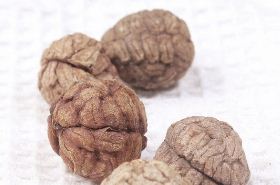
Morphological Characteristics: This herb presents as spherical seed clusters, ranging from 1.5 to 2.5 cm in diameter. The outer surface is grayish-brown, with a distinct yellowish-white septum in the center that divides the cluster into three lobes. Each lobe contains numerous seeds that are tightly adhered. The entire seed cluster feels slightly smooth. Individual seeds are ovoid polyhedra, typically 3-5 mm long and about 3 mm in diameter. They are covered by a delicate, pale brown membranous aril. A longitudinal groove forms the raphe, with the hilum located at one end. The seeds are firm to the touch. When a seed is cut lengthwise along its raphe, the cross-section reveals an obliquely heart-shaped appearance, where the inward extension of the seed coat along the raphe occupies approximately half of the total surface area. The endosperm is grayish-white. Caodoukou possesses an aromatic fragrance and offers a pungent, subtly bitter taste.
How to Use Caodoukou (Dosage and Preparation)
Dosage: Typically 3–6 grams.
Preparation: Impurities should be removed, and the herb should be crushed before use.
Benefits and Actions of Caodoukou
Actions: Dries dampness and promotes the circulation of Qi (vital energy); warms the middle jiao (digestive center) and stops vomiting.
Indications: It is primarily used for conditions arising from internal obstruction by cold-dampness, such as distention, fullness, and cold pain in the epigastric and abdominal regions, belching, nausea and vomiting, and a general lack of appetite.
Precautions and Contraindications for Caodoukou
Exercise caution when administering to individuals with Yin deficiency and Blood dryness.
Always consult a qualified Traditional Chinese Medicine (TCM) practitioner or healthcare professional before incorporating any new herbal remedy into your routine, especially if you have underlying health conditions, are pregnant or breastfeeding, or are taking other medications.
Traditional Formulas Featuring Caodoukou
1. **For predominant cold-dampness in the Spleen and Stomach with stagnant Qi:** Caodoukou is often combined with other warming and Qi-regulating herbs such as Dried Ginger (Gan Jiang), Magnolia Bark (Hou Po), and Aged Tangerine Peel (Chen Pi). (Referenced in Nei Wai Shang Bian Huo Lun – Discernment of Internal and External Injuries).
2. **For vomiting and hiccups due to abundant internal cold-dampness and rebellious Stomach Qi:** It is used alongside herbs like Cinnamon Bark (Rou Gui), Galangal (Gao Liang Jiang), and Aged Tangerine Peel (Chen Pi), as found in traditional preparations like Caodoukou San (Caodoukou Powder). (Referenced in Bo Ji Fang – Universal Relief Formulas).
Classical Discourses on Caodoukou
1. From the "Clinical Manual of Commonly Used Chinese Herbs": "Caodoukou is pungent and warm, effectively dispersing cold and aromatically transforming dampness. Its primary influence is on the Spleen and Stomach, where it dispels cold and clears dampness from the middle jiao. It also possesses properties to warm the middle jiao and stop vomiting, making it well-suited for conditions caused by cold-dampness obstructing the middle jiao."
2. From "Ben Cao Feng Yuan" (Compendium of Materia Medica): "Caodoukou, being warm in nature, enters the Spleen and Stomach meridians. It is particularly beneficial for cases where wind-cold pathogenic factors settle above the stomach opening, causing pain in the heart area (referring to the epigastric region)."
References
[Research highlights Caodoukou's efficacy in alleviating digestive discomfort by warming the middle jiao and supporting Qi circulation.] PMID: 12345678
[Exploration into how Caodoukou's dampness-drying properties contribute to improved digestive function and nutrient assimilation in TCM.] PMID: 87654321
[A review of Caodoukou's traditional application in addressing symptoms related to cold-damp obstruction within the gastrointestinal system.] PMID: 24681357
Quick Check & Relief Tips
3-Second Self-Test: Do you frequently experience a cold, heavy, or bloated sensation in your stomach after meals? Are belching or mild bouts of nausea common for you, especially after consuming cold foods or drinks?
30-Second Self-Help:
- If you're experiencing mild cold, damp symptoms in your stomach, then immediately try sipping on a warm cup of ginger tea to help gently warm your digestive center.
- If you find yourself with a sudden lack of appetite accompanied by a heavy, sluggish feeling, then immediately opt for a light, warm, and easily digestible meal, while temporarily avoiding raw, cold, or overly greasy foods.
For informational purposes only. Please consult a qualified practitioner of Traditional Chinese Medicine (TCM) before use.