Zhu Ling
Commonly Known As: Sze Ling, Fen Zhu Ling, Wild Boar's Dung, Ground Black Peach, Pig Poria, Pig Lingzhi, Boar's Droppings, Pig's Pouch.
Properties and Flavor: Sweet, bland, neutral.
Meridian Affinity: Enters the Kidney and Bladder meridians.
Medicinal Part: The dried sclerotium of the fungus Polyporus umbellatus (Pers.) Fries, belonging to the family Polyporaceae.
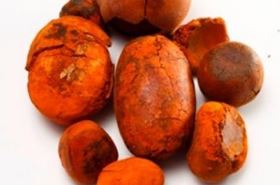
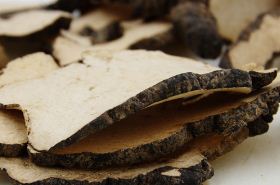
Morphological Characteristics: This herb appears as strips, sub-globular, or flattened blocks, sometimes branched, measuring 5-25 cm in length and 2-6 cm in diameter. Its surface is black, grayish-black, or brownish-black, often shriveled or with nodular protrusions. It is light in weight and hard in texture. The cross-section is off-white or yellowish-white, with a slightly granular appearance. It has a faint aroma and a bland taste.
Usage and Dosage of Zhu Ling
Usage: 6-12g.
Key Actions and Indications of Zhu Ling
Key Actions: Promotes urination and leaches out dampness.
Indications: Primarily used for difficulty in urination, edema (swelling), diarrhea, turbid urination, and vaginal discharge.
Contraindications of Zhu Ling
Avoid in cases without dampness accumulation.
- Yi Xue Qi Yuan (Medical Primer): "Zhu Ling is bland and permeable, excessively drying, which can deplete body fluids. Do not use in cases without dampness symptoms."
- Yi Xue Ru Men (Introduction to Medicine): "Contraindicated in cases with dampness symptoms accompanied by Kidney deficiency."
- De Pei Ben Cao (Materia Medica for Matching and Pairing): "Prohibited in cases of blurry vision or thirst without dampness."
Traditional Formulas and Combinations Featuring Zhu Ling
Here are some classical formulas and combinations that incorporate Zhu Ling:
- To treat floating pulse, fever, thirst with desire for water, and difficulty in urination: Zhu Ling (peeled), Poria (Fu Ling), Alisma (Ze Xie), Donkey-hide Gelatin (E Jiao), and Talc (Hua Shi), one liang each. Combine these five ingredients. First, boil the four ingredients (excluding E Jiao) in four sheng of water until two sheng remain. Remove the dregs, add E Jiao to dissolve, and take seven ge warm, three times a day. (From Shang Han Lun – Zhu Ling Tang)
- To treat swelling from the feet up to the abdomen during pregnancy, with difficulty in urination and slight thirst: Grind five liang of Zhu Ling into a powder. Take one fang cun bi with warm water, three times a day. (From Zi Mu Mi Lu)
- To treat persistent or newly contracted malaria: One liang of Zhu Ling, five qian of Poria (Fu Ling), four qian of Bupleurum (Chai Hu), three qian of Pinellia (Ban Xia), one qian of Licorice (Gan Cao), three slices of fresh Ginger (Sheng Jiang), and two Jujube fruits (Da Zao). Decoct in three bowls of water until one bowl remains. Take before the onset of symptoms. Re-decoct the dregs and take after the symptoms appear. (From Fang Mai Jia Bao)
- To treat cold-dampness in the intestines and stomach, leading to uncontrolled chronic diarrhea, lethargy, and loss of appetite: Half a liang of Zhu Ling (black outer layer removed), two pieces of Nutmeg (Rou Dou Kou, shelled and roasted), and one fen of Phellodendron bark (Huang Bai, rough outer layer removed and roasted). Grind these three ingredients into a fine powder. Form into pills the size of green beans with rice gruel. Take ten pills before meals with warm water. (From Sheng Ji Zong Lu – Zhu Ling Wan)
- To treat painful urination during pregnancy (Zi Lin): Five liang of Zhu Ling. Pound and sift into a powder. Take one fang cun bi with three ge of clear soup. Gradually increase to two bi per dose, five times a day (three during the day, two at night). If not effective after consumption, an inducing laxative such as Gan Sui San should be administered. (From Xiao Pin Fang)
- To treat seminal emission and turbid urine in vigorous young men: One liang of Pinellia (Ban Xia) and one liang of Zhu Ling. First, cut Pinellia into pieces the size of soybeans, and powder Zhu Ling. Stir-fry Pinellia until yellowish, but not scorched. Then, place it on the ground for half a day to remove its hot property. Grind Pinellia into a powder. Mix half of the Zhu Ling powder evenly with the Pinellia powder and roll into pills the size of parasol tree seeds. Then, use the remaining Zhu Ling powder to coat the pills to dry them. Store them in a non-oiled earthenware bottle. Take forty pills on an empty stomach with warm wine and salted water, or with cold wine between 3-5 PM. (From Ji Sheng Fang – Zhu Ling Wan)
- To treat vomiting with discomfort in the diaphragm, and desire for water: Zhu Ling, Poria (Fu Ling), and Atractylodes Macrocephala (Bai Zhu) in equal parts. Pound these three ingredients into a powder. Take one fang cun bi with water, three times a day. (From Jin Gui Yao Lue – Zhu Ling San)
- To treat thirst in Shang Han (Cold Damage disease): Use one liang each of Zhu Ling, Poria (Fu Ling), Alisma (Ze Xie), Talc (Hua Shi), and Donkey-hide Gelatin (E Jiao). Decoct in four sheng of water until two sheng remain. Take seven ge per dose, three times a day. This formula is called "Zhu Ling Tang."
- To treat generalized swelling and difficulty in urination: Grind five liang of Zhu Ling into a fine powder. Take one spoon per dose, with warm water. Three times a day.
- To treat swelling and thirst during pregnancy (swelling of the feet and abdomen, with difficulty in urination): The treatment method is the same as above.
Insights from Classical TCM Texts on Zhu Ling
- Ben Cao Yan Yi (Elaboration on Materia Medica): "Zhu Ling has a strong action in promoting water metabolism. Prolonged use can deplete Kidney Qi and impair vision."
- Yong Yao Xin Fa (Guide to Herb Application): "Zhu Ling is bitter to drain stagnation, sweet to support Yang, and bland to facilitate the orifices, thus it can eliminate dampness and promote urination."
- Ben Cao Gang Mu (Compendium of Materia Medica): "Zhu Ling is bland and permeable, its energy ascends and also descends, thus it can open the superficial channels and promote urination. It shares similar functions with Poria (Fu Ling), but is not as effective as Poria in tonifying formulas."
- Ben Cao Hui Yan (Collection of Materia Medica Discussions): "Zhu Ling leaches dampness, promotes water passages, and is an herb that separates Yin and Yang. This herb has a sweet, bland, and slightly bitter taste. Although bitterness descends, its sweet and bland properties also allow it to permeate and disperse, ascending then descending, and descending then ascending. Therefore, it is skilled at opening the superficial pores, separating the Yang Qi of the exterior and Yin Qi of the interior to promote urination. Hence, the ancients primarily used it for chronic malaria. Master Zhen's formula primarily treats great heat in Shang Han and warm epidemic diseases, capable of inducing sweating to expel pathogens – this is separating the Yang Qi of the exterior. Master Zhang's formula primarily treats abdominal fullness, swelling, acute pain, internal discomfort, malaria, dysentery, and malarial diarrhea – this is separating the Yin Qi of the interior. Zhang Zhongjing treated floating pulse, fever, thirst, and difficulty in urination in Taiyang disease with Wu Ling San to stop vomiting; for cold cough in winter, accompanied by alternating chills and fever resembling malaria, termed phlegm-wind, Wu Ling San was used to settle the cough. All three methods emphasize the ingenious use of Zhu Ling to open the superficial pores and separate Yin and Yang."
- Yao Pin Hua Yi (Transformation of Medicinal Properties): "Zhu Ling is bland, and blandness primarily leaches. It enters the Spleen to clear water passages, used to treat watery diarrhea, damp-type diarrhea, clear painful urination, eliminate dampness, reduce edema, and treat jaundice; it is uniquely swift in these actions, thus it is said to have similar effects to Amber (Hu Po). However, it cannot be the primary ingredient. It assists tonifying herbs to strengthen the Spleen, guides draining herbs to regulate the Spleen, aids warming herbs to warm the Spleen, and accompanies cooling herbs to clear the Spleen. For those with severe Spleen deficiency, it may deplete primordial Qi, so use with caution."
- Ben Cao Shu (Materia Medica Notes): "Classical texts state that for dampness in the Spleen and Stomach, Zhu Ling and Alisma (Ze Xie) must be used to separate it. According to Jie Gu, Zhu Ling, from Yang, promotes Yin, described as ascending with a slight descent, which is Yang. Alisma (Ze Xie), from Yin, reaches Yang, described as sinking and descending, which is Yin. These two herbs combine to separate Yin and Yang."
- Chang Sha Yao Jie (Explanation of Changsha Herbs): "Zhu Ling leaches dampness and drains water, even faster than Poria (Fu Ling). However, the nature of water, without the free flow of Earth and Wood, cannot move freely alone. Zhu Ling San's water-draining action has the drying effect of Atractylodes Macrocephala (Bai Zhu) on damp Earth. Zhu Ling Tang's water-draining action has the clearing effect of Donkey-hide Gelatin (E Jiao) on Wind-Wood. Wu Ling San's water-draining action has the drying effect of Atractylodes Macrocephala (Bai Zhu) on Earth, and the dispersing effect of Cinnamon Twig (Gui Zhi) on Wood. Ba Wei Di Huang Wan's water-draining action has the dispersing effect of Cinnamon Twig (Gui Zhi) on Wood, and the clearing effect of Rehmannia (Di Huang) on Wind. If one merely seeks benefit from herbs like Zhu Ling, Poria, Talc, and Alisma, it might be difficult to achieve remarkable effects alone."
- Ben Cao Qiu Zhen (Seeking Truth in Materia Medica): "Zhu Ling is used in all formulas like Si Ling San and Wu Ling San. Although its nature is similar to Alisma (Ze Xie), both enter the Bladder and Kidney meridians, clear heat, eliminate dampness, open the orifices, and promote urination. However, when water is eliminated, the Spleen becomes dry, and when water is fully drained, Qi is depleted. Although Alisma (Ze Xie) also promotes urination, its nature is also somewhat drying. Yet, its salty nature is predominant, still retaining some moisturizing quality. While Alisma treats fire, its nature also depletes Qi, but its moisturizing property can nourish Yin, still retaining some tonifying aspect. Therefore, Zhu Ling must be combined with Alisma (Ze Xie) to achieve balanced moistening and drying, avoiding adverse imbalances. As for Poria (Fu Ling), although it's a dampness-leaching agent, dampness can naturally be removed. However, Poria enters the Qi level and ascends, while Zhu Ling enters the Blood level and descends. Moreover, when combined with Alisma (Ze Xie) and other herbs for promoting urination, reducing swelling, treating malaria, and stopping dysentery, especially in cases of internal blockage by summer heat and damp-heat, it is invariably valued for its guiding and expelling effects. The ancients already stated that for clearing and promoting urination, nothing is as essential as this. Therefore, among Yin-nourishing herbs, only Alisma (Ze Xie) is used, not Zhu Ling, precisely for this reason. However, this herb exclusively directs water, easily depleting body fluids. Prolonged use often leads to impaired vision."
- Shennong Ben Cao Jing (The Divine Farmer's Classic of Materia Medica): "Primarily treats malaria, promotes water passages."
- Yao Xing Lun (Treatise on the Nature of Herbs): "Resolves great heat from Shang Han (Cold Damage disease) and warm epidemic diseases, induces sweating, treats swelling, abdominal fullness, and acute pain."
- Zhen Zhu Nang (Pearl Bag): "Leaches and drains, quenches thirst, also treats painful urination and swelling."
- Yi Xue Qi Yuan (Medical Primer): "Greatly dries and removes dampness. Zhu Zhi Mi Yao (Secrets of Treatment) states it removes palpitations."
- Yi Xue Ru Men (Introduction to Medicine): "Treats heatstroke and wasting-thirst disorder."
- Ben Cao Gang Mu (Compendium of Materia Medica): "Opens the superficial pores, treats painful urination, swelling, beriberi, turbid urination, vaginal discharge, painful urination during pregnancy, and difficulty in urination."
3-Second Self-Test + 30-Second Self-Help
If you frequently experience difficulty urinating, unexplained swelling (edema), persistent watery stools, or notice cloudy urine and excessive vaginal discharge, then these might be signs of dampness accumulation in your body. Immediately consider consulting a qualified Traditional Chinese Medicine (TCM) practitioner to explore if remedies like Zhu Ling, known for its dampness-draining properties, could offer a natural path to relief and balance.
References:
The diuretic and anti-inflammatory properties of Polyporus umbellatus (Zhu Ling) are supported by modern research. PMID: 28987057
Traditional uses of medicinal fungi, including Polyporus umbellatus, highlight its role in managing fluid retention and supporting kidney function. PMID: 24719602
Polysaccharides isolated from Polyporus umbellatus have demonstrated inhibitory effects on inflammation and kidney injury, aligning with its traditional applications. PMID: 29994625
For informational purposes only. Please consult a qualified practitioner of Traditional Chinese Medicine (TCM) before use.