Dried Persimmon Cakes (Shì Bǐng) in Traditional Chinese Medicine
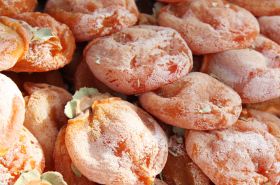
Dried persimmon cakes are a traditional snack made from fully ripened persimmons that have been peeled and slowly dried into soft, sweet disks. In Traditional Chinese Medicine (TCM), they’re more than just a treat – they’ve long been used to help moisten the lungs, gently tighten the intestines, and support the body in stopping certain types of bleeding.
Names, Nature, and TCM Properties
Other names: dried persimmon, persimmon flower, dried persimmon fruit.
Taste and nature (in TCM terms): sweet and slightly astringent, with a cooling character. In modern wellness language, this means it is considered soothing, lightly drying or tightening to tissues, and used more often for heat-related or inflamed conditions rather than for cold-type issues.
Organ focus in TCM: Heart, lungs, and stomach. In practice, this means dried persimmon cakes are traditionally used to support calm circulation, comfortable breathing, and digestive function.
What part is used: the fruit of the persimmon tree (a member of the ebony family) processed into cake-like discs. There are generally two types described in TCM texts: “white” persimmon cakes (with a white sugar-like bloom on the outside) and “black” persimmon cakes (darker, more heavily dried).
How Traditional Dried Persimmon Cakes Are Made
Traditional preparation is simple but time-intensive. Fully ripe persimmons are picked and carefully peeled. They are then laid out to dry in the sun by day and exposed to the night air, usually for about a month. After that, they’re stacked or placed inside a woven mat ring or basket and left for roughly another month, during which the fruit slowly flattens and concentrates into a soft, chewy cake. Over time, natural sugars migrate to the surface and form the characteristic white frost-like coating.
Typical Ways to Use Dried Persimmon Cakes in TCM
General usage: In TCM practice, dried persimmon cakes are used in three main ways:
- Eaten directly in appropriate amounts, chewed slowly.
- Boiled into a decoction (herbal tea) with other herbs.
- Lightly burned to ash while keeping the inner properties, then ground into a powder and added to other herbal formulas.
Because they are sweet and a bit sticky, classic TCM doctors usually recommend moderate amounts and pairing them thoughtfully with other herbs or foods, especially for people with weak digestion.
Main Traditional Benefits and Uses
In Traditional Chinese Medicine, dried persimmon cakes are said to:
- Moisten the lungs: Traditionally used when the lungs feel dry or irritated, to ease rough or dry cough and soothe the throat.
- Astringe the intestines: The mild astringent quality is used to help gently tighten loose bowels and reduce certain forms of chronic diarrhea.
- Help stop certain kinds of bleeding: Particularly small amounts of bleeding related to coughing, vomiting, urination, or bowel movements, when these are due to so-called “heat” or fragile vessels.
Traditional indications include:
- Coughing up blood or spitting blood.
- Vomiting blood.
- “Heat strangury” – painful, burning urination with blood (blood in the urine).
- “Intestinal wind” – a TCM term that often refers to chronic, sometimes painful loose stools or bleeding from fragile intestinal vessels.
- Bleeding hemorrhoids and anal fistula discharge.
- Dysentery-like diarrhea with mucus and blood.
These uses come from TCM theory and historical clinical experience, not from modern large-scale clinical trials. Modern research on persimmon fruit and its constituents (such as tannins and antioxidants) suggests potential benefits for vascular health and inflammation, but this is still an emerging field (PMID: 26292202).
Who Should Avoid Dried Persimmon Cakes?
In TCM, dried persimmon cakes are not recommended for certain body types or health patterns:
- People with weak, cold digestion: If you tend to feel cold, have a poor appetite, bloating, loose stools, or stomach discomfort especially after cold or raw foods, TCM would say your “spleen and stomach yang” are weak. Because dried persimmons are considered cooling and somewhat astringent, they may aggravate these symptoms.
- People with significant “dampness and phlegm” accumulation: If you often feel heavy, sluggish, have a thick greasy tongue coating, lots of mucus, or easy nausea, TCM warns that sweet and sticky foods like dried persimmon cakes can make this pattern worse.
If any of this sounds like you, it’s better to use dried persimmon cakes only under the guidance of a qualified TCM practitioner.
Traditional TCM Combinations and Home-Style Formulas
Important note: The following are historical TCM formulas recorded in classic texts. They are shared here to illustrate how dried persimmon cakes have traditionally been used. They are not modern clinical treatment plans. Do not try to self-treat serious issues like coughing blood, blood in urine, or rectal bleeding without medical supervision.
1. For phlegmy cough with streaks of blood
In a classic prescription from Danxi Zuan Yao, large greenish persimmon cakes from Qingzhou are steamed over rice until soft, then split open. A small amount of finely ground indigo naturalis (a deep blue herbal mineral pigment) is sprinkled inside. One cake is eaten before bedtime, with a warm mint (peppermint) tea used to wash it down.
Traditional intention: soothe irritated airways, cool and settle “heat” in the lungs, and calm minor bleeding associated with coughing.
2. For cough with phlegm
According to Materia Medica of Southern Yunnan, dried persimmons are burned until they turn to ash while preserving their inner character (a classic TCM roasting technique). The ashes are mixed with honey to form small pills. These pills are swallowed with hot water.
Traditional intention: gently transform phlegm, soothe cough, and use the astringent ash to calm irritation.
3. For painful, burning urination with blood (heat-type strangury)
In Compendium of Materia Medica, dried persimmons are combined with the pith from rush reeds (a light, cooling herb often used in urinary issues). They are decocted together in water, and the resulting tea is sipped throughout the day.
Traditional intention: cool “heat” in the urinary tract, relieve burning pain, and support the body in reducing blood in the urine.
4. For blood in the urine
The Experienced Formulas text records a recipe using white persimmon cakes boiled together with black soybeans and a pinch of salt. After boiling into a soup, a small amount of ink (from traditional ink preparation) is added, and the mixture is taken orally.
Traditional intention: nourish and stabilize the blood vessels, cool heat, and astringe bleeding. (Note: modern readers should not attempt to ingest ink or unknown substances; this is of historical interest only.)
5. For blood in the urine (another formula)
In the classic Shi Yi De Xiao Fang, dried persimmons are burned to ash, ground into a fine powder, and taken with rice water (the starchy liquid left after rinsing or lightly boiling rice).
Traditional intention: stabilize fragile vessels in the urinary tract and gently astringe bleeding.
6. For lower intestinal bleeding ("intestinal wind")
Jiang Nang Cuo Yao records a formula called “Persimmon Cake Pills.” Cottonseed kernels are fried until black and shelled (about 3 taels in the original measure), Chinese arborvitae leaves are fried to a dark color (4 taels), and pagoda tree flower buds are lightly stir-fried (1 tael). These ingredients are mixed and bound together with steamed, mashed persimmon cake to form pills. A typical dose is 4–5 qian (a historical weight) first thing in the morning, taken with hot water.
Traditional intention: support the blood vessels in the intestines, reduce persistent bleeding, and gently tighten loose bowels.
Classic TCM Commentary on Dried Persimmon Cakes
Many TCM texts describe dried persimmon cakes in detail. Here are some representative viewpoints translated into modern language.
1. Supplement to the Materia Medica (Ben Cao Shi Yi)
This text notes that sun-dried persimmons have a warming and nourishing effect. Eaten regularly, they are said to help fade facial blemishes and clear out long-standing “stagnant” blood in the abdomen. Fire-dried persimmons are recommended for people who feel a bitter taste in the mouth or nausea from taking medicine; eating a small amount is said to quickly relieve these reactions.
2. Ri Hua Zi Materia Medica
Here, dried persimmon cakes are recorded as soothing the voice and throat and helping to kill intestinal parasites.
3. Jia You Materia Medica
This text says dried persimmons “thicken” or strengthen the intestines and stomach, help tighten excessive discharge from the middle burner (digestive tract), strengthen the vital digestive energy, and help resolve old, stagnant blood.
4. Daily Use Materia Medica
According to this manual, dried persimmon cakes help astringe the intestines and stop diarrhea, kill small intestinal parasites, and moisten the throat and voice. They are noted for helping children with autumn-time dysentery or chronic loose stools.
5. Compendium of Materia Medica (Ben Cao Gang Mu)
This famous work highlights “white persimmon cakes” as useful for reflux-like symptoms (food or acid coming back up), coughing up blood, blood in the urine, intestinal thinning and bleeding, and bleeding from hemorrhoids or anal fistulas.
6. Ben Cao Tong Xuan
This text states that dried persimmons can ease stomach heat and thirst, moisten the heart and lungs, help dissolve phlegm, and support the body in clearing blood from the urine and stopping blood in the stool.
Modern Science Snapshot
While these traditional uses come from TCM theory, modern researchers have started looking at persimmon fruit and its components. Studies suggest that persimmons contain tannins, flavonoids, and carotenoids, which may have antioxidant, anti-inflammatory, and vascular-protective effects (PMID: 26292202). Some animal studies suggest persimmon extracts may help support healthy cholesterol and blood pressure, which indirectly supports vascular health (PMID: 24054214). In addition, the cooling and astringent nature described in TCM loosely aligns with modern observations that tannin-rich foods can tighten tissues and influence fluid balance in the gut (PMID: 28125036).
However, most of this work uses extracts, not traditional dried persimmon cakes as eaten in daily life. Dosage, preparation method, and individual health conditions all matter, which is why TCM guidance is important.
Safety Tips and Practical Cautions
- Go easy on quantity: Because of their sugar and tannin content, large amounts of dried persimmon cakes can cause digestive discomfort, constipation, or, in rare cases, persimmon bezoars (solid masses in the stomach), especially in people with weak digestion.
- Watch your blood sugar: Dried persimmon cakes are naturally high in sugar. If you have diabetes, insulin resistance, or need to manage blood sugar closely, treat them like other dried fruits and monitor your response carefully.
- Mind cold-type digestion: If you easily get bloating, loose stools, or abdominal cold sensations, the cooling nature of dried persimmon may not suit you, especially in large quantities or on an empty stomach.
- Check for allergies and interactions: If you have known fruit allergies, start with a very small amount. If you take prescription medications (especially for blood thinning, blood pressure, or diabetes), consult your healthcare provider and a qualified TCM practitioner before using dried persimmon cakes therapeutically.
- Not a stand-alone treatment for serious bleeding: Issues like coughing blood, blood in urine, or rectal bleeding can be signs of serious illness. Dried persimmon cakes should never replace medical evaluation.
3-Second Self-Test + 30-Second Self-Care
3-second self-test: If you sometimes have a dry, scratchy throat or mild dry cough in cool, dry weather, or you occasionally get loose stools after greasy food but no serious medical diagnosis, then you might be the kind of person TCM doctors would cautiously consider using dried persimmon cakes for.
30-second self-care: If you occasionally feel a little throat dryness after talking all day, then immediately sip a cup of warm water, and, if you tolerate dried fruits well, you can slowly chew a small piece (about the size of a large coin) of a high-quality dried persimmon cake after a meal—not on an empty stomach—while paying attention to how your body responds; if you notice any bloating, discomfort, or unusual symptoms, then immediately stop and check in with a qualified TCM practitioner or your healthcare provider before continuing.
For informational purposes only. Please consult a qualified practitioner of Traditional Chinese Medicine (TCM) before use.
References
- Nutritional and phytochemical profile of persimmon and potential health benefits (PMID: 26292202)
- Effects of persimmon leaf and fruit components on cardiovascular risk factors (PMID: 24054214)
- Dietary tannins and gastrointestinal function (PMID: 28125036)
- Huangdi Neijing (Yellow Emperor's Inner Canon) – foundational TCM theory text