Leech (Shuizhi)
Known in Traditional Chinese Medicine (TCM) as Shuizhi (水蛭), the common leech is more than just a creature from murky waters. This fascinating organism has a long history in ancient healing practices, revered for its unique properties in invigorating blood circulation and resolving stubborn stagnation.
Alternate Names: Historically, it has also been referred to as Zhǐ Qú, Zhì Zhǎng, and Qí in various ancient texts.
Nature and Flavor: In TCM, Leech is categorized by its salty and bitter flavors and a neutral energetic temperature.
Meridian Tropism: It is believed to primarily influence the Liver Meridian.
Medicinal Part: The therapeutic part of the leech is its dried whole body. Specifically, this includes leeches from the Hirudinidae family, such as *Whitmania pigra Whitman*, *Hirudo nipponica Whitman*, or *Whitmania acranutata Whitman*.
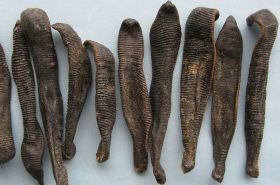
Morphological Characteristics: When prepared by scalding, the dried leech typically appears as an irregularly flattened block or a flattened cylindrical shape, often slightly bulging. Its surface ranges from a brownish-yellow to a dark brown, sometimes with a small amount of white talcum powder adhering to it. The cross-section is porous and somewhat loose, varying in color from grayish-white to a scorched yellow, and it emits a faintly fishy odor.
Dosage and Administration of Leech
Administration: For internal use, leeches are commonly prepared in a decoction, with a typical dosage ranging from 1.5 to 3 grams. When ground into a fine powder, the dosage is usually between 0.3 to 0.5 grams. It's generally recommended for use in pills, various powdered formulas (san), or as a finely ground powder for better absorption and efficacy. In some traditional applications, fresh, live leeches can be carefully applied to local areas of blood stasis and swelling to draw blood and help resolve stagnation.
Processing: Leeches are typically captured during the summer and autumn seasons. They are then swiftly killed using boiling water before being sun-dried or dried at a low temperature for preservation.
Actions and Indications of Leech
Actions: Leech is renowned in TCM for its powerful ability to break up blood stasis, promote menstrual flow, disperse stagnant blood, and resolve various masses and accumulations.
Indications: Historically, it's been indicated for conditions such as amenorrhea (absence of menstruation) caused by severe blood stasis, abdominal masses and lumps (known in TCM as 'yin jia pi kuai'), hemiplegia (paralysis on one side of the body) resulting from a stroke, and traumatic injuries like sprains, contusions, and falls that lead to significant bruising and internal stagnation.
Traditional Combinations of Leech
1. For Persistent Bleeding: From the *Qian Jin Fang (Prescriptions Worth a Thousand Gold)*: Leech is stir-fried until crisp, then ground into a fine powder. Approximately one Qian (about 3-4 grams) is taken with wine, twice daily. The remedy is believed to be effective once the "noxious blood" or severe blood stasis is resolved.
2. For Blocked Menstruation: From the *Sheng Hui Fang (Holy Benevolence Formulas)*: This formula combines one dried otter gall, one dried dog gall, one Fen (approx. 0.3-0.5 grams) each of cinnabar and Sichuan peppercorn (stir-fried to remove moisture and husks), along with ten stir-fried yellow leeches. These ingredients are ground into a powder, then formed into small pills, about the size of a mung bean, using vinegar paste. Five pills are taken before meals, three times a day, with Angelica sinensis (Danggui) wine.
Contraindications of Leech
Leech is absolutely contraindicated for pregnant women and individuals experiencing excessive menstrual bleeding, due to its potent blood-invigorating and blood-breaking properties.
Related Discussions on Leech
1. From the *Bencao Gangmu (Compendium of Materia Medica)*: "For persistent bleeding, use fried powder [of leech] with wine."
2. From the *Shennong Benjing (The Divine Farmer's Materia Medica Classic)*: "Dispels noxious blood and blood stasis, treats amenorrhea, breaks up blood masses and accumulations, addresses infertility, and promotes urination."
3. From the *Yaoxing Lun (Treatise on the Nature of Medicinals)*: "Treats amenorrhea in women and addresses conditions that could lead to 'blood depletion syndrome' (chronic blood deficiency and debilitating fatigue)."
References:
Leech-derived hirudin exhibits anticoagulant effects and potential for therapeutic use in cardiovascular diseases. PMID: 28549557
Traditional and modern applications of medical leeches and their components in cardiovascular disease therapy. PMID: 33261644
A comprehensive review of traditional leech therapy in various medical conditions, including pain and inflammation. PMID: 29555627
Quick Self-Test & Action:
3-Second Self-Test: Do you experience persistent unexplained aches, dark menstrual blood with clots, or a feeling of internal stagnation that just won't budge?
30-Second Self-Help: If you answered yes to any of these, then immediately consider discussing your symptoms with a qualified Traditional Chinese Medicine practitioner. They can help explore tailored remedies and ascertain if therapies addressing blood stagnation might be suitable for you.
For informational purposes only. Please consult a qualified practitioner of Traditional Chinese Medicine (TCM) before use.