Orange Seed
Also known as: Juzi Ren (Orange Kernel), Juzi He (Orange Pit), Jumi (Orange Rice/Fragments)
Flavor and Nature: Bitter in flavor, neutral in nature.
Meridian Tropism: Enters the Liver and Kidney meridians.
Medicinal Part: The dried, mature seed of the plant.
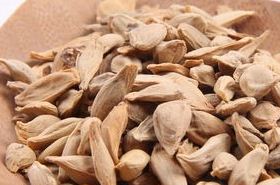
Morphological Characteristics: This herb is slightly ovoid, measuring 0.8–1.5 cm in length and 0.4–0.75 cm in diameter. Its surface is pale yellowish-white or pale grayish-white and smooth, with a distinct longitudinal ridge on one side. One end is blunt and rounded, while the other tapers into a small stalk-like projection. The outer seed coat is thin and tough, while the inner seed coat is delicate and pale brown. It contains two yellowish-green, oily cotyledons. It has a slight aroma and a bitter taste.
Usage and Dosage of Orange Seed
Dosage: Typically 3–9g.
Preparation Methods:
- Orange Seed: Remove impurities, wash thoroughly, and dry. Crush before use.
- Salt-processed Orange Seed (Yan Ju He): Take clean Orange Seeds, stir-fry them with saltwater until dry. Crush before use.
Efficacy and Actions of Orange Seed
Actions: Regulates Qi (vital energy), disperses stagnation, and alleviates pain.
Indications: Traditionally used for hernia pain, testicular swelling and pain, mastitis, and breast lumps.
Contraindications for Orange Seed
Use with caution in individuals with constitutional weakness.
Traditional Formulas Featuring Orange Seed
- For four types of Tui disorders, characterized by swollen testicles of varying sizes; or hardened like stone; or causing colicky pain radiating to the navel and abdomen, even leading to severe scrotal swelling; or forming boils and toxic sores, with mild cases producing yellowish discharge, and severe cases forming carbuncles and ulcerating: Orange Seed (stir-fried), Sargassum (washed), Kelp (washed), Laminaria (washed), Szechuan Chinaberry Fruit (flesh removed, stir-fried), Peach Kernel (stir-fried with bran) — 30g each; Magnolia Bark (peeled, stir-fried with ginger juice), Akebia Stem, Immature Bitter Orange (stir-fried with bran), Corydalis Tuber (stir-fried, peeled), Cinnamon Bark (not exposed to fire), Costus Root (not exposed to fire) — 15g each. Grind into a fine powder, then form into pills with wine paste, roughly the size of Firmiana seeds. Take 70 pills per dose on an empty stomach with warm saltwater or wine. For severe deficiency and cold, add Prepared Aconite Root 30g; for chronic hard swelling that doesn't resolve, add Natrii Sulfas 6g (cooked with vinegar), to be added later. (From Jisheng Fang, "Ju He Wan" - Orange Seed Pills)
- For initial onset of mastitis with ulceration: Orange Seed (lightly stir-fried), 15g. Decoct with yellow wine, remove dregs, and take warm. For those unable to drink alcohol, decoct with water and add a small amount of yellow wine. (From Guanghua Medicine Magazine (3)6:53, 1935)
- For lower back pain: Orange Seed and Eucommia Bark, 60g each. Stir-fry and grind into a powder. Take 6g per dose with salt wine. (From Jian Bian Dan Fang - Simple Prescriptions)
- For rosacea with red nose (Jiu Zha Feng): Orange Seed (finely ground) into a powder. Take 3g per dose, grind with one walnut kernel, and mix with warm wine to take. Continue until improvement is noted. (From Bencao Yan Yi - Expanded Materia Medica)
Historical Commentaries on Orange Seed
- From Bencao Jing Shu (Commentary on the Classic of Materia Medica): Orange Seed, first mentioned in Rihua Zi Bencao, is bitter and warm in flavor, and descends Qi. Therefore, it can enter the Kidney and Bladder meridians, eliminating diseases caused by cold. It is frequently used in formulas for hernia.
- From Bencao Hui Yan (Compendium of Materia Medica): Orange Seed is a herb that soothes the Liver, disperses rebellious Qi, and treats cold hernia. ...Rihua Zi Bencao states it treats "floating Qi" in the bladder, swollen and painful "Yin hernia" (inguinal/scrotal hernia), where the scrotum might be cold as ice, hard as stone, and feel as heavy as dozens of kilograms. Take several liang (ounces) of Orange Seed, grind into a powder, and take 3g before each meal in the morning, noon, and evening. ...Furthermore, for women's abdominal masses and hernias (jia shan), colicky lower abdominal pain, heavy and sluggish waist and hips, rebellious Qi causing urinary dribbling or abnormal vaginal discharge, take 30g decocted in plain water for immediate relief. This is attributed to its bitter and warm nature entering the Liver to effectively soothe rebellious Qi.
- From Bencao Gang Mu (Compendium of Materia Medica): Orange Seed enters the Foot Jueyin (Liver) meridian, sharing similar functions with Green Tangerine Peel (Qing Pi). Therefore, it treats lower back pain and hernia disorders affecting the lower body, not merely by its resemblance to a kernel (i.e., its shape).
References
The therapeutic potential of Traditional Chinese Medicine in managing conditions like abdominal wall hernia has been explored in various studies, supporting its historical use in such applications. PMID: 29555620
Furthermore, research has investigated the efficacy and safety of Traditional Chinese Medicine for mastitis, aligning with Orange Seed's traditional indications for breast-related issues. PMID: 27909307
The rich phytochemical composition and diverse biological activities of Citrus reticulata (from which Orange Seed is derived) underpin its use in traditional medicine. PMID: 35456488
Quick Self-Check & Self-Care Tip
If you're experiencing persistent, dull pain or a feeling of heaviness in your lower abdomen or testicles, or notice any unusual breast tenderness or lumps, then it might be related to Qi stagnation or cold accumulation, conditions Orange Seed traditionally addresses.
Immediately consult a qualified Traditional Chinese Medicine practitioner for a proper diagnosis and personalized treatment plan. Early assessment is key to effective care!
For informational purposes only. Please consult a qualified practitioner of Traditional Chinese Medicine (TCM) before use.