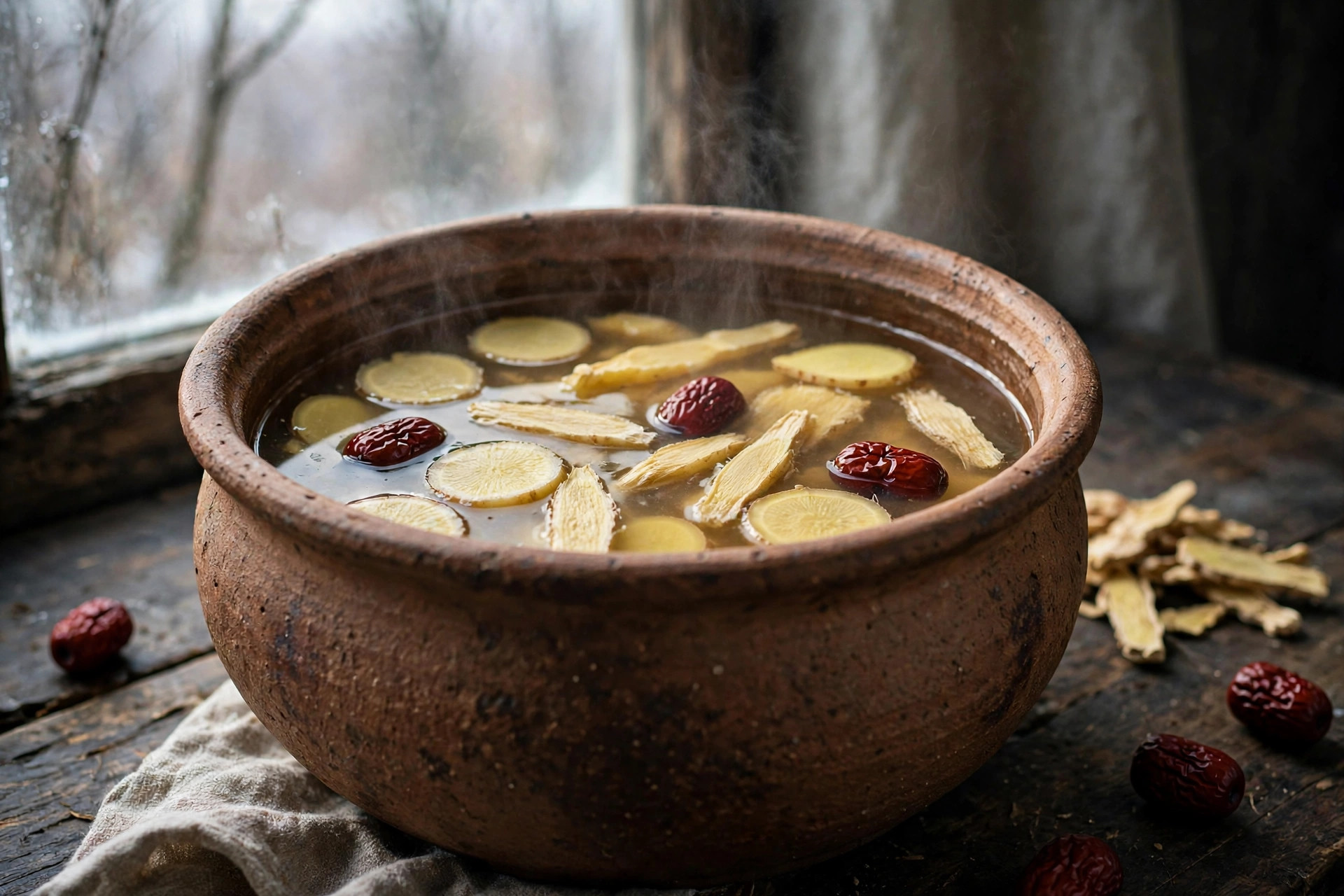
On the first cold weekend of winter, many Chinese families put a pot on the stove and leave it there for two hours. Inside is a whole chicken, a handful of pale yellow root slices, ginger, and red dates. The soup that comes out is clear, golden, and faintly sweet. Its name is huangqi chicken soup — 黄芪炖鸡汤 — and in China it is one of the best-known winter tonics.
This article is a practical guide, not a sales pitch. You will get the exact recipe, where to buy the root, and how to tell good slices from bad ones. More importantly, you will get the part most articles skip: who should not drink it. A tonic is only a tonic for the right person.
What Is Huangqi?
Huangqi (黄芪, huángqí) is the dried root of Astragalus membranaceus, a plant in the legume family. In Chinese herbal shops it is sold as pale yellow slices, each about the length of a finger, with a faintly sweet smell. It is one of the most commonly used herbs in China, and also one of the most ordinary: it is food as much as it is medicine.
In traditional Chinese medicine, huangqi is described as sweet in taste and slightly warm in nature. The traditional account says it tonifies qi (补气), raises yang (升阳), firms the body's surface (固表), stops spontaneous sweating (止汗), and helps move water to reduce swelling (利水消肿). In plain language, the traditional view is that it supports people who feel weak, tire easily, catch colds often, and sweat without exerting themselves. These are descriptions from the traditional framework, not findings from clinical trials.
Modern research tells a different, more careful story. Laboratory studies have found that astragalus root contains polysaccharides, saponins (astragalosides), and flavonoids, and that these compounds can affect immune cells in test tubes and in animals. Small human studies have looked at fatigue, heart function, and kidney health. The honest summary is that the evidence is young: interesting signals, no solid proof that eating astragalus soup will prevent colds or strengthen immunity in healthy people. This article treats the soup as what it is — a nourishing winter meal with a long cultural history — not as a proven treatment for anything.
The Recipe
This serves four people. The whole process takes about two hours, most of it unattended.
You need: - 15–30 grams of dried huangqi slices (about a small handful; start with 15 grams if this is your first time) - 1 whole chicken, about 1.2–1.5 kg, or 500–750 grams of bone-in chicken pieces - 3–5 slices of fresh ginger - 6–8 red dates (hongzao, 红枣), pitted if you prefer - 2–2.5 litres of water - Salt, to taste at the end
Steps: 1. Rinse the huangqi slices briefly and soak them in cold water for 15 minutes. 2. Blanch the chicken in boiling water for 2–3 minutes, then rinse. This keeps the soup clear instead of cloudy. 3. Put everything except the salt in a pot with the water. Bring it to a boil, skim off any foam, then turn the heat down low. 4. Simmer, covered, for 1.5–2 hours. The chicken should be tender enough to fall off the bone. 5. Add salt at the end, and serve hot. Eat the chicken with the soup; the huangqi slices themselves are usually not eaten, though some people do.
A slow cooker works too: 3–4 hours on low, same ingredients. Do not add the salt until the end in either case — salt early makes the meat tough and the soup cloudy.
Where to buy huangqi, and how to pick it: Chinese grocery stores usually stock it in the dried herbs section, and it is also sold online, including on Amazon, as "dried astragalus root slices." Good slices are thick, pale yellow, and smell faintly sweet. Avoid slices that are stark white with a sharp chemical smell — they may have been treated with sulfur. If the shop sells whole roots, that is fine too; slice them yourself or ask the shop to cut them.
Who It's For — and Who Should Skip It
This is the part that matters most, so take it slowly.
It suits people who, in the traditional framework, show signs of qi deficiency: people who tire easily, speak in a low voice, sweat with little effort, and catch colds often. In practice, that usually means healthy adults who feel run down in winter and want a warming, protein-rich meal. If that sounds like you, one or two bowls a week through the cold months is a reasonable rhythm.
It does not suit everyone. Skip it, or ask a doctor first, if any of the following applies to you:
- You have a cold, the flu, or a fever right now. The traditional reasoning is that huangqi firms the body's surface — and during an acute infection, that is the opposite of what you want. The old saying is that it "shuts the door and keeps the thief inside" (闭门留寇). Wait until you are fully recovered.
- You tend to run hot. If you often have a dry mouth, night sweats, a flushed face, or a feeling of heat in your palms and soles, huangqi's warming nature can make those feelings worse.
- You are pregnant. There is not enough reliable data on astragalus in pregnancy, so the safe course is to ask your doctor rather than guess.
- You take immunosuppressant drugs. Astragalus can stimulate immune activity, which may work against medicines designed to suppress it — for example, drugs taken after an organ transplant or for autoimmune conditions.
- You take blood pressure or blood sugar medicine. Astragalus may lower blood pressure and blood sugar, so it can add to the effect of those drugs. Check with your doctor or pharmacist.
- Children. A small amount in family soup is a common practice in China, but the right amount for a child depends on age and weight. Ask a pediatrician or a qualified practitioner rather than scaling the adult recipe down by guesswork.
None of this makes the soup dangerous in general — it is an everyday food in China, eaten by millions of people every winter. It makes the soup specific. The difference between a tonic and a mistake is knowing which side of the line you are on.
How Often, and How It Fits the Season
In China, this soup belongs to winter, and winter has a rhythm. Families make it once or twice a week when the weather turns cold, not every day. That rhythm makes sense: huangqi is warming, and a warming food taken daily for months can leave you with a dry mouth, restless sleep, or a feeling of heat that was not there before. One or two bowls a week is plenty.
It also fits a larger pattern. Winter is the season when Chinese food culture turns toward long cooking — soups, stews, and braises that warm the house as well as the body. If you read our article on Lidong, the day winter begins, you will recognize the same logic: the food changes because the season changes. Soup is winter's answer to dumplings' question.
For the rest of the year, the same 15 minutes of daily practice applies in a different form. Our beginner's guide to Ba Duan Jin covers the gentle movement set that pairs well with a winter routine: slow movement in the morning, warm soup in the evening.
Common Questions
Can I drink it every day? You can, but there is no reason to. Once or twice a week through winter gives you everything the soup has to offer. If you find yourself craving it daily, that is usually a sign you are cold or tired, not a sign you need more huangqi — put on a sweater, eat a full meal, and get some sleep.
Can I use a different meat? Pork ribs are a common substitute, and some families use duck. Chicken is the classic choice because it is mild and easy to digest. Avoid very fatty cuts; the soup should be clear and light, not greasy.
What if I cannot find huangqi? Then make plain chicken soup with ginger and red dates. It will still be a good winter soup. Do not substitute another herb at random — the rest of this article's guidance is specific to huangqi.
Does it really boost immunity? No honest source can promise that. What can be said is that it is a protein-rich, warming meal eaten for centuries in winter, and that modern research on astragalus is still at an early stage. If your goal is fewer colds, the boring advice still wins: sleep, fresh air, and washing your hands.
A Final Word
Huangqi chicken soup is a good example of what Chinese food culture does best: it takes an ordinary meal and gives it a season, a method, and a set of rules about who it is for. The recipe is simple. The judgment around it is the interesting part — and now you have it.
Make it once, on a cold evening, and pay attention to how you feel the next morning. That is the only test that matters. And if you are unsure whether it suits you, ask a doctor or a qualified Chinese medicine practitioner before making it a habit. A soup should never need a second opinion, but your health sometimes does.
If this kind of food-first approach appeals to you, Huangdi Neijing: A Modern Introduction explains the classical foundations behind it — eating with the seasons, and living with the year rather than against it — in clear, beginner-friendly language (Huangdi Neijing: A Modern Introduction).
This article is for general information and cultural education. It is not medical advice. If you have a health condition or take medication, consult a clinician before adding herbal foods to your diet.