This article goes live at eight in the morning on Saturday, November 7. Here is the first thing to get straight: winter has not begun yet. Lidong (立冬), the Start of Winter, arrives tonight — at 5:52 p.m. Beijing time, when the sun reaches 225 degrees of ecliptic longitude. So this is an article about a day that is still, at breakfast time, a few hours away from its own beginning. That timing is not a footnote. It is the whole point of the day: Lidong is a turning point, and this year we get to watch the turn happen in the evening.
Lidong is the nineteenth of the twenty-four solar terms (二十四节气), the traditional Chinese calendar of the sun's movement through the year. Each term marks a step in the seasons, and Lidong is the first step of winter — one of the four seasonal beginnings, alongside the starts of spring, summer, and autumn. In 2016, UNESCO added the twenty-four solar terms to its Representative List of the Intangible Cultural Heritage of Humanity, recognizing a system that farmers and families have used for more than two thousand years. A solar term is not a weather forecast. It is a marker on the calendar, fixed by the sky: the sun reaches a certain point, and the season is said to turn.
A Turning Point, Not a Weather Report
The first thing Lidong teaches is the difference between a calendar and a thermometer. The term arrives at a precise astronomical moment — tonight at 5:52 p.m. — but the cold does not arrive on schedule. The coldest days of the year are still weeks away, and a warm afternoon on November 7 would not make the calendar wrong. Lidong says the light has turned and the year has crossed into its final season, not that you will shiver tomorrow.
In the classical picture, winter is the season of closing and storing. The Huangdi Neijing describes the three months of winter as a time of bì cáng (闭藏) — closing up and storing away — when living things draw inward and rest. That is a description of a rhythm, not a set of instructions. It is why the day carries a feeling of preparation rather than celebration: something is ending, something is being put away, and the household turns its attention to the months ahead. In imperial times, the court marked the day with a rite of welcoming winter, the emperor leading officials to the northern suburbs of the capital. The rite is long gone, but the instinct behind it is still easy to recognize: when a season turns, people want to mark it.
One framing note before we go further: everything below describes the traditional framework and folk custom. Food customs are presented as cultural practices, not as medical advice. Nothing here treats a dumpling as medicine, and nothing here is a substitute for professional care.
Why Dumplings in the North
A quick note for readers new to China: when Chinese people say "the north," they mean the broad wheat country north of the Qinling Mountains and the Huai River — cold, dry winters, wheat fields instead of rice paddies, and dumplings and noodles instead of rice bowls. The south is rice country. That north–south divide runs through almost everything on the table, and Lidong shows it clearly.
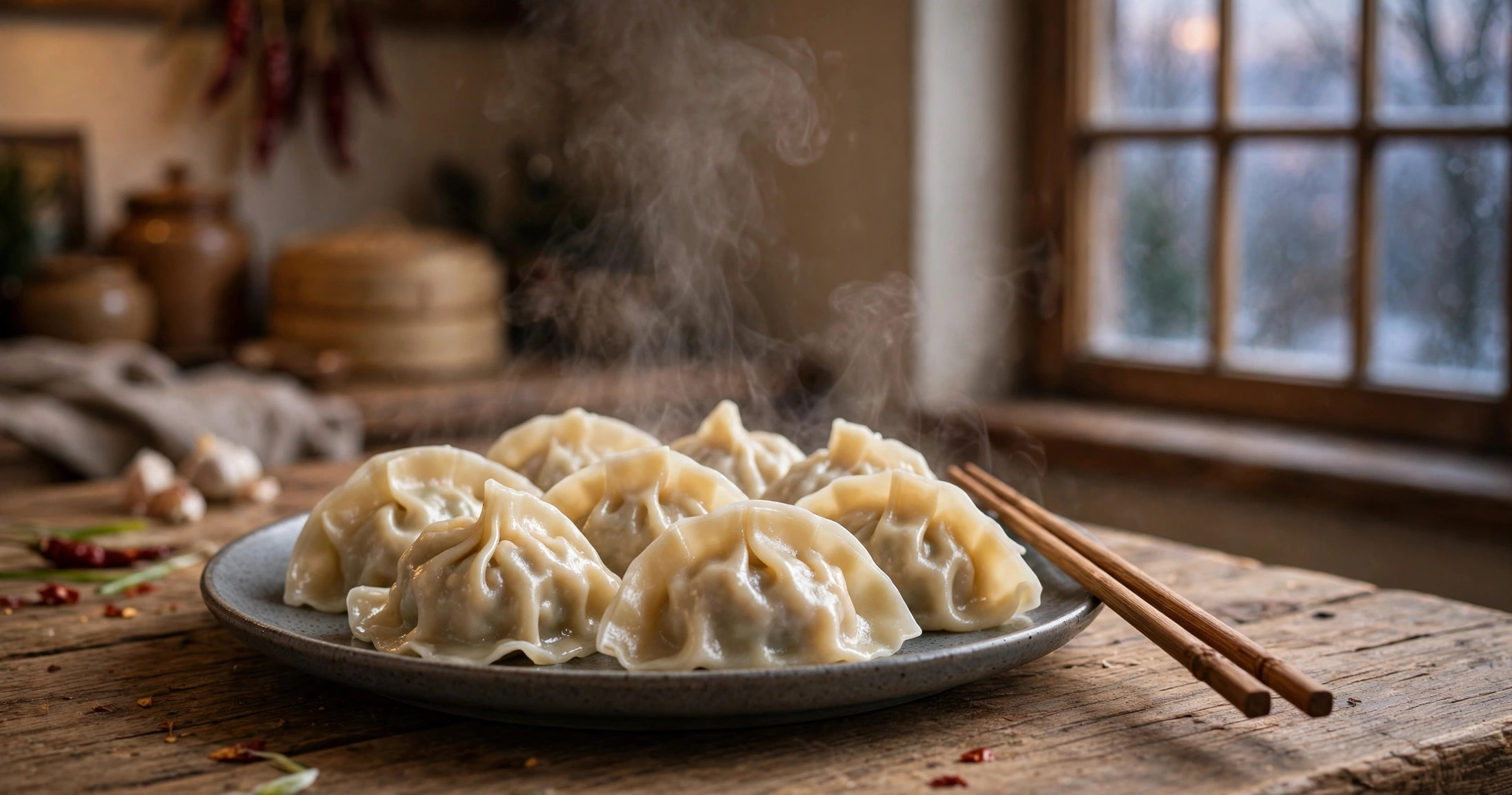
In northern China, Lidong has one dish above all others: dumplings (jiǎozi, 饺子). On this day, families gather to make them, and the saying goes: "If you don't hold a bowl of dumplings on Lidong, no one will care if your ears freeze off" — Lìdōng bù duān jiǎozi wǎn, dòng diào ěrduo méi rén guǎn (立冬不端饺子碗,冻掉耳朵没人管). It is a joke, and like most jokes about food, it is also a reminder: eat well today, look after each other, the cold is coming.
The practical reasons are easy to see. Dumplings are hot, filling, and made by hand, which means they are also a reason for the family to sit down together and work. Rolling wrappers, mixing filling, pinching the edges shut — the meal takes an afternoon, and that is part of the point. In the north, where November is already properly cold, a steaming plate of dumplings is comfort that needs no explanation. There is also a second saying for the day: Lìdōng bǔ dōng, bǔ zuǐ kōng (立冬补冬,补嘴空) — "On Lidong, nourish for winter, and fill the empty mouth." The day is for eating well, in company, before the long season sets in.
Shape matters too. A dumpling is a small half-moon of dough, pinched shut along a curved edge. People have always noticed that it looks a little like an ear — and that resemblance is the doorway to the day's most famous story.
The Doctor, the Ears, and the Legend
The story belongs to Zhang Zhongjing (张仲景), a physician of the Eastern Han dynasty and the author of the Shanghan Lun (Treatise on Cold Damage, 伤寒论), one of the founding texts of Chinese medicine. The legend says that when he returned to his hometown in winter, he found poor villagers with ears frostbitten in the cold. So he made a food called jiāo'ěr (娇耳), "tender ears": small dough wrappers filled with mutton, chili, and warming herbs, boiled in broth and served hot, broth and all. The villagers ate them, their ears recovered, and the dish became the dumpling.
That is a legend, not a historical record, and it should be read as one. Historians treat it as folklore, and there is a detail worth knowing: the story is most often told about the winter solstice, not Lidong. Northern families have borrowed it for Lidong too, because the two days share the same logic — cold, ears, and a hot bite shaped like the thing it is meant to protect. The legend survives because it is a good story about a doctor who fed people, not because it proves anything about dumplings. It tells you what the custom means to the people who keep it: food as care, offered at the moment the cold arrives.
Dumplings and the Changing Point
There is a second reason dumplings belong to this day, and it is a piece of wordplay. The word for dumpling, jiǎozi (饺子), sounds like jiāozi (交子) — "the meeting point," the moment when one thing changes into another. Lidong is exactly such a meeting point: the day autumn meets winter and hands the year over. Eating dumplings at a jiāo moment is a small pun acted out with food, a way of marking the crossing by eating something named for it.
That is why dumplings appear at more than one turning point in the year. They are also the food of New Year's Eve, when one year meets the next — another jiāo moment, another crossing. The wordplay is not a linguistic proof of where dumplings came from, and it should not be presented as one. It is a folk explanation, the kind of clever connection people love to make around a table. But it explains something real about the custom: the dish is not tied to winter because of what is inside it. It is tied to the day because of what the day is — a threshold, and a moment worth marking.
The Same Day, Different Tables
Not everyone eats dumplings on Lidong. The north keeps the dumpling custom, but the south marks the same day differently, under the name bǔ dōng (补冬) — "nourishing for winter." In Fujian and Taiwan, the signature dish is ginger duck (jiāngmǔ yā, 姜母鸭), duck slow-cooked with old ginger and sesame oil, a dish that comes from Quanzhou in Fujian. Families also make sesame oil chicken (máyóu jī, 麻油鸡). In the south, Lidong is a day for chicken, duck, and fish, cooked slowly and eaten together — the same instinct as the north, expressed with different ingredients.
In Chaoshan, in eastern Guangdong, the day has a lighter custom: sugarcane. There is an old saying there, Lìdōng shí zhè chǐ bù tòng (立冬食蔗齿不痛) — "Eat sugarcane on Lidong, and your teeth won't ache." The sugarcane is just coming ripe, sweet and full of juice, and people eat it as a crisp, refreshing counterpoint to the heavy dishes of the day. The saying is folk wisdom, not dentistry, but it shows how local the day is: the same solar term, the same turning point, and every region answers it with whatever its own fields and kitchens provide.
Tradition and Modern Evidence, Kept Apart
It helps to keep two things separate: what tradition says about Lidong food, and what modern evidence says. They are not the same kind of claim, and mixing them up is how a food custom turns into a false health promise.
What tradition says is warm and generous: Lidong food nourishes the body, guards against the cold, and protects the ears. Those are folk claims, carried by stories and sayings, and they belong to the culture of the day. What modern evidence says is narrower. There is no evidence that eating dumplings prevents frostbite, or that any Lidong dish warms the body in a special way beyond what any hot meal does. The warmth of dumplings is the warmth of hot food and of calories — wheat wrapper and filling, energy for a cold day — and a filling with plenty of vegetables makes a balanced bite. No single dish carries a special Lidong effect, and none of this is a reason to eat more than you want.
That separation is not a criticism of the custom. It is what lets the custom be what it is: a family meal, a piece of wordplay, a story about a doctor, and a way of marking the year's turn — valuable as culture and company, without needing to be medicine.
How to Mark the Day
If you want to mark Lidong this year, the simplest way is the traditional one: make dumplings, or share a hot meal with people you like. Rolling wrappers is the kind of work that goes better with company, and the day is built for it. If dumplings are not your food, the southern answer works just as well — a slow-cooked dish, eaten together, with no rush.
And if you want to notice the day itself, the moment to watch is this evening, at 5:52 p.m. That is when the term turns. Morning is for preparation; evening is for the arrival. You do not need to do anything at that hour. It is enough to know that the calendar crossed while you were eating dinner — the year quietly stepping from autumn into winter, on schedule, as it has for more than two thousand years.
A Marker on the Calendar
Lidong is a small day with a large idea behind it: the year has joints, and it is worth noticing when you pass one. The dumplings are not medicine and the stories are not history, but the custom has lasted because it does something simpler and harder to replace — it gathers people around a table at the exact moment the light changes, and gives them something warm to hold on to.
This article stays with Lidong day itself. For the broader habits of the season — food, movement, and sleep through the winter months — see Winter Wellness in Traditional Chinese Medicine.
If these ideas resonate, Huangdi Neijing: A Modern Introduction explains the classical foundations — the seasons, the body's rhythms, and the habit of living with the year rather than against it — in clear, beginner-friendly language (Huangdi Neijing: A Modern Introduction).
This article is for general wellness education and is not medical advice.