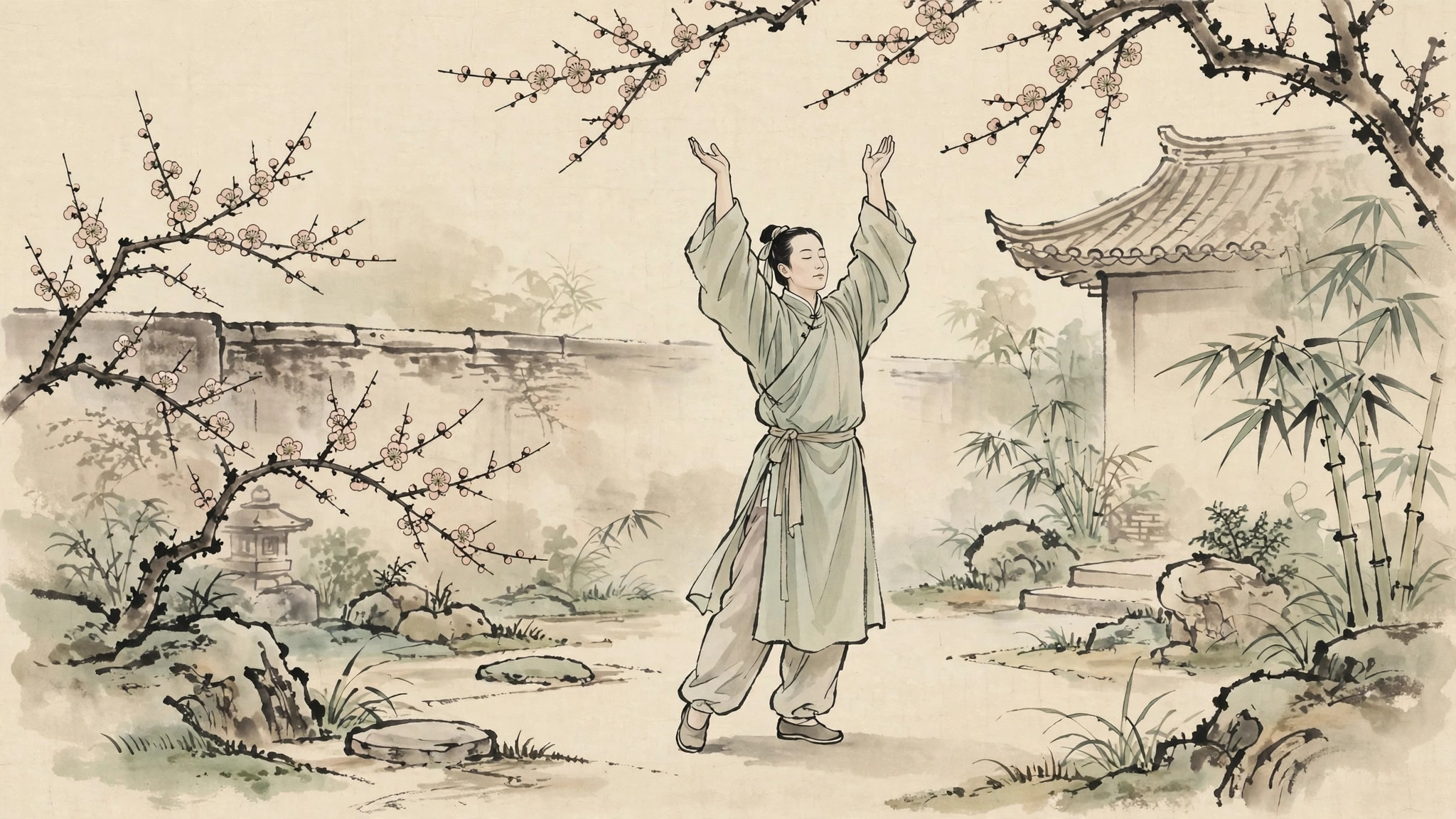
Ba Duan Jin (八段錦), "Eight Pieces of Brocade", is one of the best-known traditional Chinese exercise sets. It combines slow movements with relaxed breathing and is traditionally described as a way to keep the body supple and the mind calm.
The name is a small piece of poetry: duan means a section or a piece, and brocade is a rich, patterned silk. The eight movements are meant to flow one into the next like cloth unrolling — smooth, continuous, and without hurry. A full set takes about fifteen to twenty minutes and needs no equipment.
A short history
Versions of the Eight Brocades appear in Chinese sources from as early as the Song dynasty. Over the centuries many lineages developed their own variations, seated and standing.
The set is usually traced to the Northern Song dynasty (960–1127), about eight hundred years ago. By the Ming and Qing dynasties it was a familiar part of everyday health practice, taught in books, in families, and in martial arts schools.
In 2003, China's General Administration of Sport reworked the standing version into a standardised form and promoted it as one of eight national health qigong routines. That official version is the one most beginners meet today.
The eight traditional movements
-
Two Hands Hold up the Heavens (双手托天理三焦, Shuāngshǒu Tuō Tiān Lǐ Sānjiāo). Interlace your fingers, turn the palms up, and press slowly toward the sky while stretching the whole body tall. Traditionally it is said to open the chest and regulate the "triple burner" (san jiao), the traditional term for the body's three-part cavity system.
-
Drawing the Bow to Shoot the Eagle (左右开弓似射雕, Zuǒyòu Kāigōng Sì Shèdiāo). Step into a wide horse stance, then draw one arm back like pulling a bowstring while the other extends forward. It opens the shoulders and chest and gives the legs a steady, grounded workout.
-
Separate Heaven and Earth (调理脾胃须单举, Tiáolǐ Píwèi Xū Dānjǔ). One palm presses up toward the sky while the other presses down toward the earth, then switch sides. In traditional terms it is said to support the spleen and stomach — the organs Chinese medicine associates with digestion.
-
Wise Owl Gazes Backwards (五劳七伤往后瞧, Wǔláo Qīshāng Wǎnghòu Qiáo). Turn your head slowly to look behind you, first one side, then the other. It is a gentle stretch for the neck and upper back.
-
Sway the Head and Shake the Tail (摇头摆尾去心火, Yáotóu Bǎiwěi Qù Xīnhuǒ). In a low stance, sway the torso from side to side like a slow wave. The traditional name speaks of releasing "heart fire" — old language for restlessness and irritability, not a literal flame.
-
Two Hands Hold the Feet to Strengthen the Kidneys (两手攀足固肾腰, Liǎngshǒu Pānzú Gù Shènyāo). Bend forward and slide your hands down the backs of your legs toward your feet, then rise slowly. It stretches the hamstrings and lower back. "Kidneys" here means the traditional concept of the kidneys as a storehouse of vitality, not only the anatomical organ.
-
Clench the Fists and Glare Fiercely (攒拳怒目增气力, Zǎnquán Nùmù Zēng Qìlì). From a horse stance, punch forward with a clenched fist and a wide, focused gaze, alternating arms. The fierce name is misleading: the movement stays slow and controlled, and the "glare" is really about concentration.
-
Bouncing on the Toes (背后七颠百病消, Bèihòu Qīdiān Bǎibìng Xiāo). Rise up onto your toes, then let your heels drop gently back to the floor, repeating seven times. The traditional name says seven bounces "drive away a hundred ills" — a folk saying, not a medical claim.
How to practice
Posture comes first. Stand with feet about shoulder-width apart, knees soft and never locked, spine tall, shoulders dropped and relaxed, chin slightly tucked. The weight sits evenly across the feet, and the body stays upright while the arms do the work.
Breathe naturally, in through the nose. The usual rhythm is to breathe in as the body opens or rises, and breathe out as it closes or lowers — but the breath should follow the movement, not force it. If you find yourself holding your breath, slow down. Relaxed breathing is the point, not perfect breathing.
Beginners often do one set a day, and many people repeat the whole set a second time once the movements feel familiar. A little every day matters more than a long session once a week.
Learn the movements before you worry about doing them well. A qualified teacher, a class, or a reputable video can help you get the shapes right. Start with a small range of motion and let it grow over weeks. The set is meant to feel easy — if a movement feels like a strain, you are pushing too far.
Ba Duan Jin belongs to the qigong family, and it pairs naturally with Tai Chi. For a closer look at the wider family of practices, see our articles on what qigong is and Tai Chi.
What modern research says
Research on Ba Duan Jin is young but growing. The most cited summary is a 2017 meta-analysis of 19 randomised controlled trials, which reported that regular practice was associated with better quality of life, sleep quality, balance, handgrip strength, trunk flexibility, blood pressure, and resting heart rate. The same analysis found no clear effect on leg power, endurance, or lung function.
A 2018 review of 22 studies reached a similar picture: the practice looked promising as an additional, gentle form of rehabilitation, including for mood and thinking skills, but the authors called for more rigorous studies with longer follow-up before firm conclusions could be drawn. A 2024 meta-analysis of 17 small trials, all conducted in China, reported similar directions for blood pressure and cholesterol, but the trials were small and all from one country, so the results should be read with care.
Ba Duan Jin also came to wider attention in early 2020, when it was used in Wuhan's temporary "Fangcang" hospitals as part of rehabilitation for people recovering from COVID-19. In one small trial of 120 patients, practice alongside usual care was linked with less anxiety. A later narrative review of 12 studies described similar uses, while noting that more clinical studies are needed.
The honest summary is this: Ba Duan Jin looks like a genuinely useful form of gentle exercise, and the early evidence points in a positive direction. It is not a treatment for any condition, and the research is not yet strong enough to support specific health promises.
Practicing safely
Move slowly, breathe naturally, and never stretch into pain. If you have a health condition, speak to a qualified professional before starting any new exercise routine.
A few details help. Keep the knees tracking over the toes in the horse stance, and never let them collapse inward. Let the heel drop in the final movement be a soft tap, not a jolt. If you feel dizzy, short of breath, or any chest discomfort, stop and rest; if symptoms persist, seek medical care promptly. People who are pregnant, recovering from surgery, or living with joint problems should check with a clinician first and adapt the movements as advised. This overview is educational, not medical advice.
If these ideas resonate, Huangdi Neijing: A Modern Introduction explains the classical foundations behind practices like this one in clear, beginner-friendly language (Huangdi Neijing: A Modern Introduction).
This article is for general wellness education and is not medical advice.
References
- Zou L, Sasaki JE, Wang H, et al. A Systematic Review and Meta-Analysis of Baduanjin Qigong for Health Benefits: Randomized Controlled Trials. Evid Based Complement Alternat Med. 2017;2017:4548706. doi:10.1155/2017/4548706.
- Zou L, Pan Z, Yeung A, et al. A Review Study on the Beneficial Effects of Baduanjin. J Altern Complement Med. 2018;24(4):324–335. doi:10.1089/acm.2017.0241.
- Zhu Z, Pan X, Zhong F, et al. What can we learn from the Baduanjin rehabilitation as COVID-19 treatment? A narrative review. Nurs Open. 2023;10(5). https://pmc.ncbi.nlm.nih.gov/articles/PMC9880712/
- National Center for Complementary and Integrative Health. Qigong: What You Need To Know. https://www.nccih.nih.gov/health/qigong-what-you-need-to-know