If your skin feels tight, your throat a little scratchy, and your lips keep cracking as October arrives, you are experiencing exactly what Chinese tradition calls autumn dryness (秋燥 qiū zào). For thousands of years, people in China have adjusted their eating to answer this season — not with supplements or complicated regimens, but with simple, familiar foods that "moisten" the body.
This way of eating is gentle, seasonal, and easy to try. It doesn't ask you to buy anything exotic or give up foods you love. It simply suggests that autumn calls for a different emphasis at the table: more soothing, hydrating foods, and a little less of what dries you out.
Why Autumn Means "Dryness"
Chinese tradition divides the year by more than temperature. Each season is linked to a natural quality, an organ system, and a phase of the Five Phases (五行 wǔ xíng) — the framework that describes how the world changes through cycles.
Autumn belongs to the Metal phase (金 jīn) and corresponds to the Lung (肺 fèi) system. To understand this, it helps to know that the Lung in Chinese medicine is not just the physical organ. It is understood as a functional system that governs breathing and is closely connected to the skin, the nose, and the throat. You can read more about how these systems are understood in the Five Zang organs, mapped as functions.
Dryness is autumn's signature quality. As summer's humidity fades, the air holds less moisture — and the body, which exchanges air and water with its surroundings all day long, feels it first in the places that meet the outside world: the throat, the nose, the lungs, and the skin. Autumn dryness is simply the traditional name for this seasonal shift and the discomfort that can come with it.
This is why the Five Phases and their seasonal rhythms matter in the kitchen as well as the clinic. Eating with the season is one of the oldest forms of preventive care in the Chinese tradition — adjusting daily habits before problems appear, a principle explored further in treat before illness.
The Principle of "Moistening" (润 rùn)
The traditional response to autumn dryness is summed up in one word: rùn (润), "to moisten." Rather than fighting dryness with force, you nourish moisture from the inside — through foods that are traditionally considered moistening, soothing, and gentle on the body's fluids.
A few notes on how this works in practice:
- Moistening is a food quality, not a nutrient claim. It describes how a food is traditionally understood to feel in the body — soothing rather than drying, softening rather than irritating.
- It is paired with flavor. Autumn traditionally favors mildly sweet (甘 gān) and slightly sour (酸 suān) flavors, while going easier on the pungent, spicy (辛 xīn) flavors that are said to disperse and dry. If the Five Flavors are new to you, this guide to the five flavors explains the logic.
- Cooking method matters. Steaming, slow simmering, and gentle stewing are autumn's methods. They add moisture rather than driving it off, the way deep-frying and roasting at high heat can.
The beautiful part is that many classic moistening foods are simply good seasonal produce. You don't need a special diet — you need to lean into what's already in season.
Seven Classic Moistening Foods
Here are the foods the Chinese tradition reaches for most often in autumn. You may already know several of them.
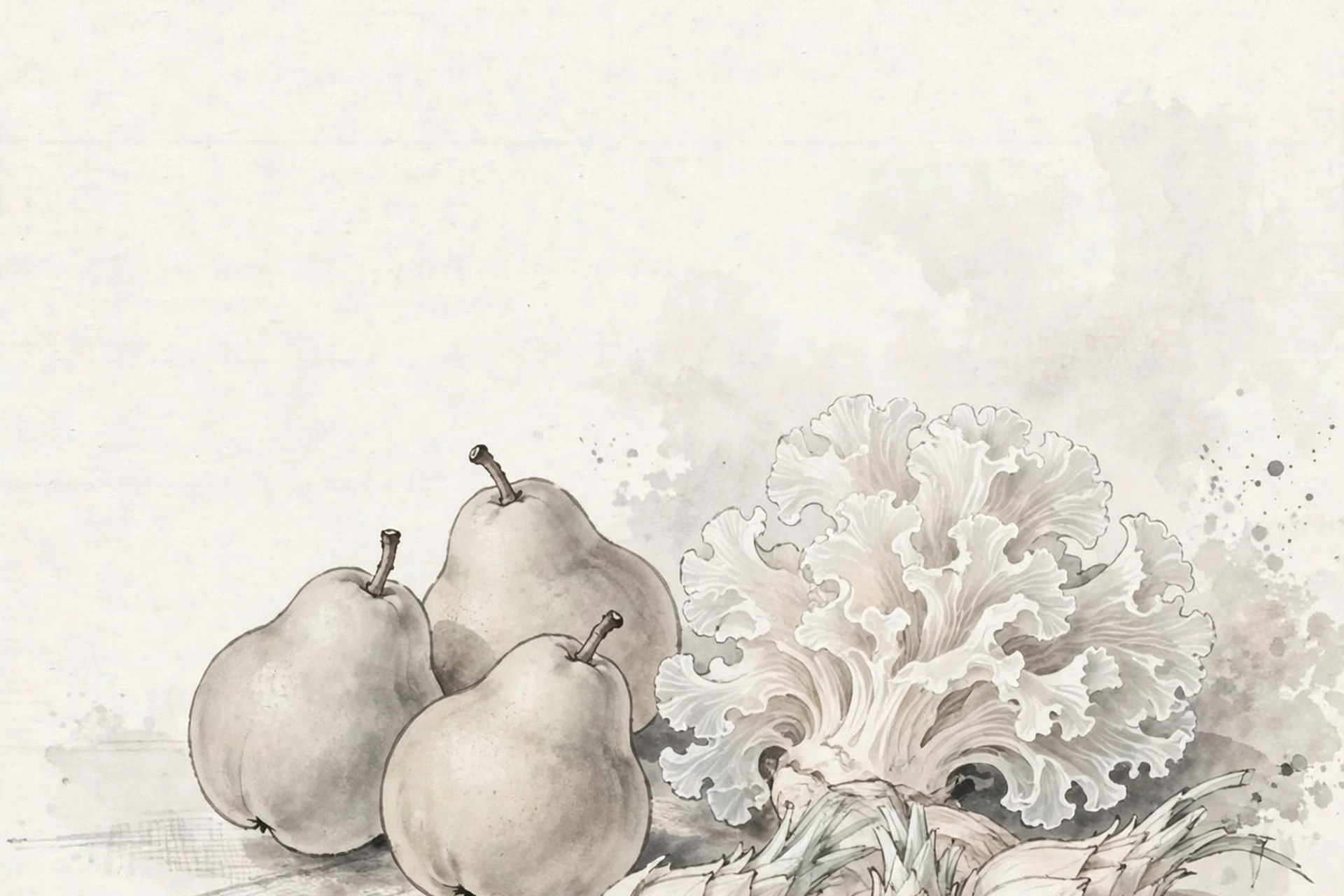
1. Pear (梨 lí) The emblem of autumn eating. Pears are juicy, mildly sweet, and traditionally considered the single best fruit for easing a dry throat and cough from dryness. They are usually cooked rather than eaten raw in autumn — sliced and simmered into a soup or poached with a little honey.
2. Lily bulb (百合 bǎihé) The pale, layered bulb of the lily plant — not the flower. It has a delicate, slightly sweet taste and is traditionally valued for moistening the lungs and calming restlessness. It often appears alongside pear in autumn soups and sweet congees.
3. Silver ear / white fungus (银耳 yín'ěr) A translucent, frilly fungus that turns silky and almost gelatinous when simmered. It is a classic in sweet soups, prized for its moistening, soothing quality. If you find it dried in an Asian grocery store, it looks intimidating — but soaked and simmered, it becomes one of autumn's most comforting ingredients.
4. Honey (蜂蜜 fēngmì) Perhaps the oldest moistening food in the tradition. A spoonful in warm (not hot) water or tea is the simplest autumn remedy there is. Tradition holds that honey moistens dryness and soothes the throat — which is exactly when most people reach for it anyway.
5. Sesame (芝麻 zhīma) Both black and white sesame seeds, and the paste and oil made from them, are traditionally considered nourishing and moistening — good for dry skin and dry digestion. Sesame appears in autumn in porridges, warm drinks, and drizzled over vegetables.
6. Lotus root (莲藕 lián'ǒu) Crisp, pale, and full of water, lotus root is at its best in autumn. Sliced and simmered in soups or stir-fried gently, it is traditionally regarded as a food that supports the body's fluids while being light and easy to digest.
7. Yam / Chinese yam (山药 shānyào) Not the orange sweet potato — the long, pale root sold in Asian markets, sometimes called nagaimo in Japanese stores. Mild, slightly slippery when cooked, and traditionally considered a gentle strengthener of digestion. It is a natural fit for autumn congees.
What to Ease Off
Moistening is only half the picture. Autumn eating also means easing off the foods and habits that add to dryness:
- Excessively spicy food. A little warmth is fine, but heavy chili, strong spices, and pungent seasonings are traditionally thought to disperse moisture — the opposite of what autumn needs.
- Fried and greasy foods. Deep-frying is considered a drying cooking method, and rich, greasy food can feel heavy when digestion is already adjusting to the season.
- Excess alcohol and very salty snacks. Both are traditionally associated with drying the body's fluids.
- Too many raw, cold foods. As the weather cools, the tradition favors warm, cooked food that is easier on digestion.
None of this means forbidding anything. Think of it as a seasonal tilt: if 80 percent of your autumn plate is warm, moist, and gentle, the occasional spicy meal does no harm.
How to Try This: Three Simple Autumn Dishes
You don't need new skills to eat for autumn — just three easy ideas you can start this week.
Pear soup with lily bulb
Simmer one sliced pear (core removed) with a small handful of dried lily bulb (soaked 30 minutes first) in about 3 cups of water for 30–40 minutes, until everything is soft. Stir in a spoonful of honey off the heat. Drink warm. This is the single most classic autumn home remedy in China — a soup that tastes like comfort and is traditionally taken for a dry throat.
Congee with yam
Cook rice porridge (congee) as usual — 1 part rice to 6–8 parts water, simmered low for about an hour — and add diced yam for the last 30 minutes. A spoonful of sesame paste stirred in at the end makes it richer. Warm, soft, and deeply soothing on a cool October morning.
Warm sesame drink
Whisk 2 tablespoons of sesame paste (or tahini) into a cup of warm milk or oat milk with a teaspoon of honey. It takes two minutes, and it is the kind of small ritual that makes autumn feel cared for.
A Modern Perspective
Modern nutrition would describe much of this advice in familiar terms: hydrate well, eat seasonal fruits and vegetables, and get enough fiber — all of which support skin, digestion, and general comfort in dry weather. Pears, yams, and lotus root are simply good sources of water and fiber; honey and sesame are energy-dense foods best used in moderation.
The traditional language — "moistening," "dryness," the Lung system — is a different vocabulary for observations anyone can make: that autumn air dries the skin and throat, and that warm, watery, gentle foods feel better in October than heavy, fried, or fiercely spiced ones. Neither perspective needs to defeat the other. Together, they give you two good reasons to cook a pot of pear soup.
One Season, One Habit
Autumn in the Chinese tradition is a season of gathering in — of turning from summer's outward expansion toward something quieter and more inward. Eating for the season is the most practical expression of that idea: small, daily choices that keep you comfortable as the air dries and the light shortens.
Pick one dish. Make the pear soup, or try the sesame drink before bed. Notice how it feels. Seasonal eating was never about perfection; it was about paying attention.
If you'd like to understand the classical roots of these ideas — how the Lung system, the Metal phase, and seasonal living fit together — *Huangdi Neijing: A Modern Introduction* walks through them in plain, beginner-friendly language.
*This article is for general wellness education and is not medical advice.*