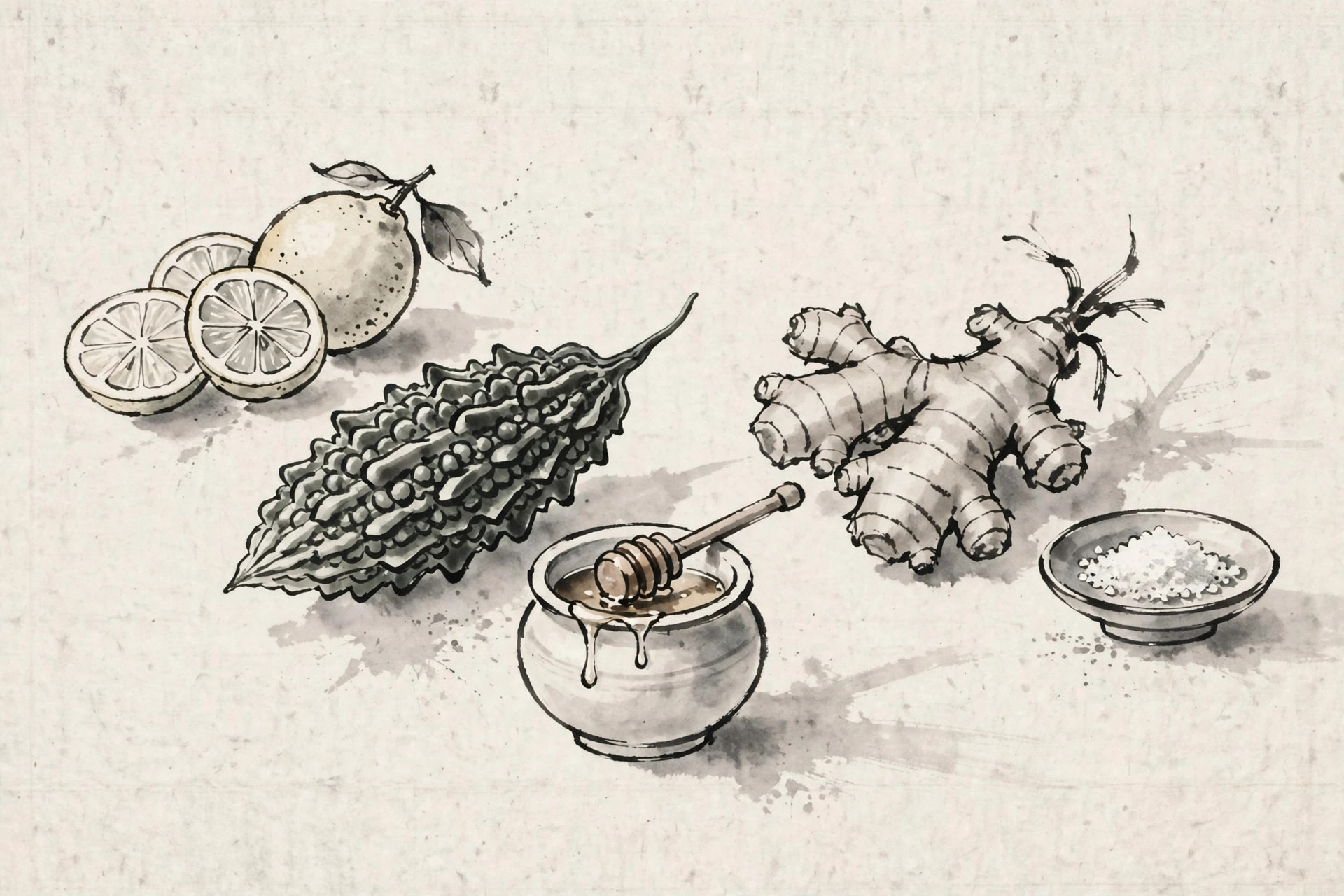
Take a bite of a lemon wedge and your whole face puckers. Sip strong black coffee and the bitterness steadies you. Taste honey and everything softens. In Traditional Chinese Medicine (TCM), these are not just passing sensations — they are clues about how a food behaves in the body.
The framework is called the five flavors (五味 wǔ wèi): sour, bitter, sweet, pungent, and salty. Note that "spicy-hot" is folded into pungent here, and "sweet" means something broader than sugar. Each flavor is traditionally understood to have its own action — a direction in which it nudges the body. Learning the five flavors is a bit like learning a small vocabulary: once you know the words, an ordinary meal starts to read differently.
The Five Flavors and What They Traditionally Do
Sour (酸 suān): Gathers and Holds
Sour is the flavor of contraction. Traditionally, it is said to astringe — to gather what is leaking or slipping away. Think of how a lemon wedge makes your mouth pucker; that puckering is a fair image of the flavor's action.
In everyday terms, sour foods and drinks are the ones you reach for when you want to "hold things together": a splash of vinegar in a dressing, pickled vegetables alongside a heavy dish, tart plums or hawthorn berries after a rich meal. In the classical framework, sour is also said to benefit the sinews and tendons, though that claim belongs to the old texts, not to a modern nutrition label.
Common sour foods: lemon and other citrus, vinegar, yogurt and kefir, sour cherries, hawthorn berries, green plums, tamarind.
Bitter (苦 kǔ): Drains and Dries
Bitter is the flavor of downward movement. It is traditionally considered to drain and to dry — to clear what feels overheated or congested, and to dry up dampness. It is no accident that so many "clearing" foods are bitter: dark leafy greens, bitter melon, strong black coffee, dark chocolate with a high cacao content.
Bitter also has a mental dimension in the old framework: it is associated with the Heart, and a small amount of bitter food or drink is said to settle a scattered mind. That is a traditional association, not a clinical finding — but many people do find that a cup of plain tea or a square of dark chocolate helps them feel composed again.
Common bitter foods: arugula and dandelion greens, bitter melon, grapefruit pith, coffee, green and black tea, dark chocolate, walnuts.
Sweet (甘 gān): Tonifies and Harmonizes
Sweet is the flavor of building up and soothing. In TCM the word 甘 (gān) covers not just candy-sweetness but the mellow sweetness of grains, root vegetables, and ripe fruit. Sweet foods are traditionally considered to tonify — to replenish energy — and to harmonize, meaning they relax tension and make a dish, or a day, feel gentler.
This is the flavor of comfort food in every culture: a bowl of rice, roasted sweet potato, a warm pear, a spoonful of honey. Modern nutrition would point out the obvious — these foods often supply steady energy — while the old framework would add that sweetness, in moderation, eases cramping and irritability.
One caution shared by both perspectives: the traditional texts warn that excess sweetness generates "dampness" — a heavy, sluggish feeling — and modern dietitians agree that too much refined sugar is unhelpful. The traditional sweet is the sweetness of whole foods, not of soda.
Common sweet foods: rice and oats, sweet potato and pumpkin, carrots, dates and figs, honey, milk, red beans.
Pungent (辛 xīn): Disperses and Moves
Pungent — the 辛 (xīn) flavor — covers ginger and garlic, scallion and onion, black pepper, chili, mustard, and even mint and basil. Its traditional action is to disperse: to push things outward and get them moving. That is why pungent foods famously open the nose, warm the hands and feet, and make you sweat.
This is the flavor you instinctively want at the first sign of a cold: ginger tea, garlic soup, a bowl of something peppery that makes your forehead glow. In the classical language, pungent moves qi (气) — the body's motive energy — and opens the surface of the body. Whatever the mechanism, many people notice that a pungent meal leaves them feeling unblocked and awake.
Common pungent foods: fresh ginger, garlic and onion, scallion, chili and black pepper, mustard, mint, basil, cinnamon.
Salty (咸 xián): Softens and Moistens
Salty is the flavor of softening. Traditionally, salt is said to soften hardness — to dissolve what is knotted or stuck — and to moisten what is dry. Think of how a pinch of salt melts into a soup, or how dried seaweed softens in hot water; the flavor's action follows the same image.
The traditional salty foods are mostly from the sea: sea salt, seaweed, kelp, shellfish, miso, soy sauce. A little salt makes flavors distinct and food satisfying; the classical warning concerns only excess, which is said to congeal rather than soften — a point on which blood-pressure researchers would agree.
Common salty foods: sea salt in moderation, seaweed and kelp, miso, naturally brewed soy sauce, shellfish.
Five Flavors, Five Organs, Five Phases
The flavors do not stand alone. In the classical system, each flavor corresponds to one of the five zang organs (五脏 wǔ zàng) and one of the Five Phases (五行 wǔ xíng):
| Flavor | Organ | Phase | |---|---|---| | Sour | Liver | Wood | | Bitter | Heart | Fire | | Sweet | Spleen | Earth | | Pungent | Lung | Metal | | Salty | Kidney | Water |
This is a system of resonances, not a plumbing diagram. Saying "sour enters the Liver" is the old way of saying that sour foods seem to have a special affinity with the functions grouped under the Liver — the smooth flow of energy and emotion, the health of the sinews. Think of it the way you think of a musical chord: the flavor, the organ, and the phase are notes that sound together.
If this way of grouping the body is new to you, the map of the five zang organs and the plain-language overview of the Five Phases will give you the background you need.
Why Balance Matters — and What Excess Traditionally Means
The central rule of the five flavors is simple: a little of each, regularly; a lot of any one, rarely. Each flavor in excess is traditionally said to disturb the very organ it normally supports:
- Too much sour may cramp the sinews and, in the old saying, obstruct the Liver's free flow.
- Too much bitter may drain excessively and upset digestion.
- Too much sweet may generate dampness — heaviness, bloating, a sluggish feeling.
- Too much pungent may scatter qi, leaving a person feeling wired or dried out.
- Too much salty may harden rather than soften, disturbing the balance of fluids.
None of this is a diagnosis, and none of it means a single meal did anything. These are patterns described in a dietary tradition over centuries — most useful as a way to notice your own habits. If your diet is ninety percent sweet and salty, the framework simply invites you to notice what is missing: where is the bitter? Where is the sour?
A Modern Perspective
Modern food science studies flavor through different instruments — taste buds, olfactory receptors, brain imaging — but it arrives at a compatible conclusion: variety matters. Sensory researchers have long observed that meals offering a range of tastes and aromas tend to be more satisfying, and that satisfaction is one of the natural brakes on overeating. A plate with sour, bitter, sweet, pungent, and salty notes gives the palate more "information" per bite, which may help you feel content with less.
There is also a simpler, practical resonance. Many bitter foods are vegetables; many pungent foods are herbs and spices rich in bioactive compounds; fermented sour foods add diversity to the diet. The five-flavor plate is, in effect, a mnemonic for dietary diversity — the same advice modern nutrition gives, dressed in older clothes.
Neither perspective needs to defeat the other. The traditional view asks, "What does this flavor do in the body?" The modern view asks, "What compounds and signals are involved?" A curious eater can hold both questions at once.
How to Use It: Building a Five-Flavor Plate
You do not need a new cuisine or special ingredients. Try this gentle experiment for one week:
1. Audit one meal a day. Pick lunch or dinner and name the flavors on the plate. Most Western meals are sweet plus salty plus pungent, with bitter and sour missing. Just noticing is the whole exercise at first. 2. Add the missing flavors in small doses. A squeeze of lemon (sour), a handful of arugula (bitter), a few slices of pickled ginger (sour-pungent). Small additions count; the tradition favors moderation over megadoses. 3. Cook with the full set. When you stir-fry, reach for ginger or garlic (pungent), a splash of vinegar (sour), a pinch of salt (salty), a few drops of honey (sweet), and finish with bitter greens on the side. One pan, five flavors. 4. Balance your cravings instead of fighting them. Craving something sour after a heavy, greasy meal? The old framework would say the body is asking for the astringent flavor to cut the richness. Keeping vinegar, citrus, or pickles on hand lets you answer that craving with food rather than willpower. 5. Watch the sweet. Let the sweet flavor come from whole foods — grains, roots, fruit — most of the time, and treat refined sugar as an occasional guest. This single shift does more for balance than any exotic ingredient.
Some people find that eating this way leaves them steadier through the afternoon — less of the spike-and-crash that a sweet-and-salty lunch can bring. That is a traditional observation, and your own experience is the only test that matters.
If you enjoy thinking of food as part of a larger health strategy, you may also like the classical idea of treating health before illness arrives — prevention by its oldest name, which starts, very practically, at the table.
A book for your shelf: The ideas above come from a medical tradition with two thousand years of written history. *Huangdi Neijing: A Modern Introduction* ([INTERNAL:huangdi-neijing-modern-introduction]) explains where concepts like the five flavors came from, in plain English for the modern reader.
*This article is for general wellness education and is not medical advice.*