# Suwen vs Lingshu: The Two Halves of the Huangdi Neijing
If you have started looking into the Huangdi Neijing — the foundational text of Traditional Chinese Medicine — you may have noticed that it is really two books in one binding. The first is called the Suwen (素问, usually translated as "Basic Questions"), and the second is called the Lingshu (灵枢, "Spiritual Pivot"). Together they make up the classic, and each contains 81 chapters. But they were not written as a single narrative, and they do not read the same way. Understanding what each half does is one of the most practical things a modern reader can learn before opening the text.
The Suwen: "How Does the Body Work?"
The Suwen is the part most people meet first, and for good reason: it is the theory book. Its chapters take the form of questions and answers — the Yellow Emperor asks, and his minister Qi Bo explains. What gets explained is the big picture of human life as understood in early China: how the body functions, how it relates to the seasons, how emotions and habits affect health, and how illness develops when the body's normal patterns break down.
The key ideas of the Suwen
Almost every central concept of Traditional Chinese Medicine appears here. The Suwen introduces yin and yang (阴阳, the paired opposites whose balance the classic treats as the basis of health), the Five Phases (五行, the five-way pattern of wood, fire, earth, metal, and water used to describe how things relate and change), and qi (气, the vital energy — see our introduction to qi for a full explanation). It describes the internal organs and their relationships, the way qi and blood move through the body, and the principles of seasonal living: sleep more in winter, move more in spring, adjust food and activity as the year turns. Much of the Suwen reads like philosophy applied to daily life, which is why its ideas show up constantly in articles about yin and yang, the Five Elements, and seasonal living.
The tone is explanatory rather than technical. The Suwen rarely tells a reader exactly what to do with a needle; instead it explains why the body behaves as it does. In the traditional view, this is the foundation: you study the principles first, and practical methods make sense only once the principles are understood. Modern medicine sees it as something like a physiology and pathology textbook mixed with natural philosophy — an attempt to build a complete model of health from observation and reasoning, using the concepts available in its time.
How the Suwen reads
Because the Suwen is organized as a series of conversations, it can be read chapter by chapter without losing the thread. The early chapters are the most famous and the most accessible: they cover the unity of humans and nature, the rhythm of the seasons, and the idea that health comes from living in step with those rhythms rather than from fighting symptoms. Later chapters grow more technical, discussing pulses, organ systems, and the mechanisms of specific disorders — but the same question-and-answer rhythm continues throughout.
One point worth knowing: the Suwen we have today is not in its original form. It was compiled, edited, and annotated by scholars over many centuries, most notably by Wang Bing in the Tang dynasty, who reorganized chapters, filled gaps, and added his own commentary. When you read the Suwen, you are reading a text with a long editorial history. That is normal for a work this old, but it explains why some chapters feel more polished than others and why scholars still debate which parts came first.
The Lingshu: "Where Do the Channels Run?"
The Lingshu is the other half of the classic, and it has a very different character. Where the Suwen asks why, the Lingshu focuses on where and how. Its 81 chapters describe the body's network of channels and collaterals (经络, the pathways along which qi and blood are said to flow), the points along them, and the use of needles to influence that flow. In the traditional framework, the Lingshu is the practical manual — the part a student of acupuncture would study most closely.
The key ideas of the Lingshu
The Lingshu gives the most detailed early account of the channel system: the twelve main channels and their pathways through the body, the eight extraordinary vessels, the collaterals, and the way each channel connects to particular organs and regions. It discusses the timing of qi movement through the channels (the idea that flow follows a daily rhythm), the symptoms that appear when a channel is blocked or weakened, and the techniques of needling — the angles, depths, and methods associated with different conditions.
The classic's approach to diagnosis appears here too. The Lingshu explains how a practitioner reads the body's signals — the pulse at the wrist, the complexion, the state of the tongue — to judge what is happening inside. In the traditional view, these observations matter because they reveal the movement of qi and blood, which is what the practitioner intends to influence. From a modern perspective, these chapters show an early attempt at systematic clinical observation: careful attention to outward signs as evidence of internal states, developed long before instruments like thermometers or blood tests existed.
How the Lingshu reads
For a general reader, the Lingshu is harder going than the Suwen. Long passages list points by name and describe pathways in painstaking anatomical language. Chapters that thrill an acupuncture student can feel repetitive to someone without that training. This does not mean the Lingshu has nothing for the casual reader — its opening chapters on the movement of qi and its discussions of spirit, emotion, and the mind-body connection are some of the most interesting in the whole classic. But as a reading experience, it demands more patience, and it makes more sense after the Suwen has supplied the theory behind it.
Like the Suwen, the Lingshu reached its present form through centuries of editing, and scholars have long debated how its chapters relate to those of the Suwen — whether some were once part of a different arrangement, and how the two halves came to be bound together. The details of that history are a subject for specialists. For the modern reader, what matters is simply that the two halves complement each other: one explains the system, the other works with it.
How the Two Halves Differ
The difference between the Suwen and the Lingshu can be summarized in three ways.
Scope. The Suwen covers almost everything: cosmology, season, diet, emotion, organs, pulses, and the philosophy of health. The Lingshu narrows in on the channel system and needling technique. If the Suwen is the whole landscape, the Lingshu is the detailed map of its roads.
Tone. The Suwen explains; the Lingshu instructs. The Suwen wants you to understand why the body works as it does, often through broad images and analogies. The Lingshu wants you to know exactly where a channel runs and how deep a needle should go. One is closer to philosophy, the other closer to a craft manual.
Audience. Traditionally, the Suwen was considered the starting point for any student of medicine, while the Lingshu was essential for those who would practice needling. That division still makes sense today: a reader interested in Chinese medicine's ideas about daily life will find far more in the Suwen; a reader curious about how acupuncture understands the body will need the Lingshu.
The two halves also overlap, and the overlap matters. The Suwen contains some discussion of channels; the Lingshu contains chapters on emotions, spirit, and the nature of life that are as philosophical as anything in the Suwen. The boundary between them was drawn by history, not by the nature of the ideas. Think of them less as two separate books and more as two emphases within one tradition.
Which Half Should You Read First?
For nearly every modern reader, the answer is the Suwen. Start with the chapters that explain the worldview: the early Suwen chapters on the seasons, on yin and yang, and on the correspondence between nature and the body. These are the chapters that shaped two thousand years of Chinese health culture, and they are the ones most accessible without specialized training. If you want guidance on approaching the text itself, see our guide to reading the Huangdi Neijing as a modern reader.
Approach the Lingshu second, and treat it as a reference rather than a novel. Read its opening chapters on the movement of qi and its passages on spirit and emotion; skim the long anatomical lists, and return to them only when a specific question sends you there. If you are studying acupuncture, the Lingshu will become essential eventually — but for the general reader, understanding the Suwen first makes every page of the Lingshu easier to follow.
A practical suggestion: read in translation with commentary, not alone. Both halves are dense, and both were written for a world that no longer exists. A good guide explains what the words meant to their original readers, flags where editors added material, and connects the ideas to the rest of the tradition — to what balance means in TCM or to why the classic still matters today — without pretending the text says things it does not.
How to Use It
You do not need to master either half to benefit from knowing the distinction. The simplest use of this knowledge is as a compass:
1. If a question is about ideas — what yin and yang are, why sleep matters, how food affects health — look to the Suwen. 2. If a question is about methods — where the channels run, how needling is supposed to work, how a practitioner reads the pulse — look to the Lingshu. 3. Read the Suwen first. Its chapters give you the vocabulary — qi, yin and yang, the Five Phases — that the Lingshu assumes you already know. 4. Treat the Lingshu as a reference. Nobody reads a manual the way they read a philosophy book. Dip in where curiosity takes you.
The Huangdi Neijing has survived for two thousand years not because it is easy, but because its questions are the ones every generation of readers asks: how does the body work, and how should we live? Knowing that the classic holds two answers — the Suwen's theory and the Lingshu's craft — is the first step toward reading it well.
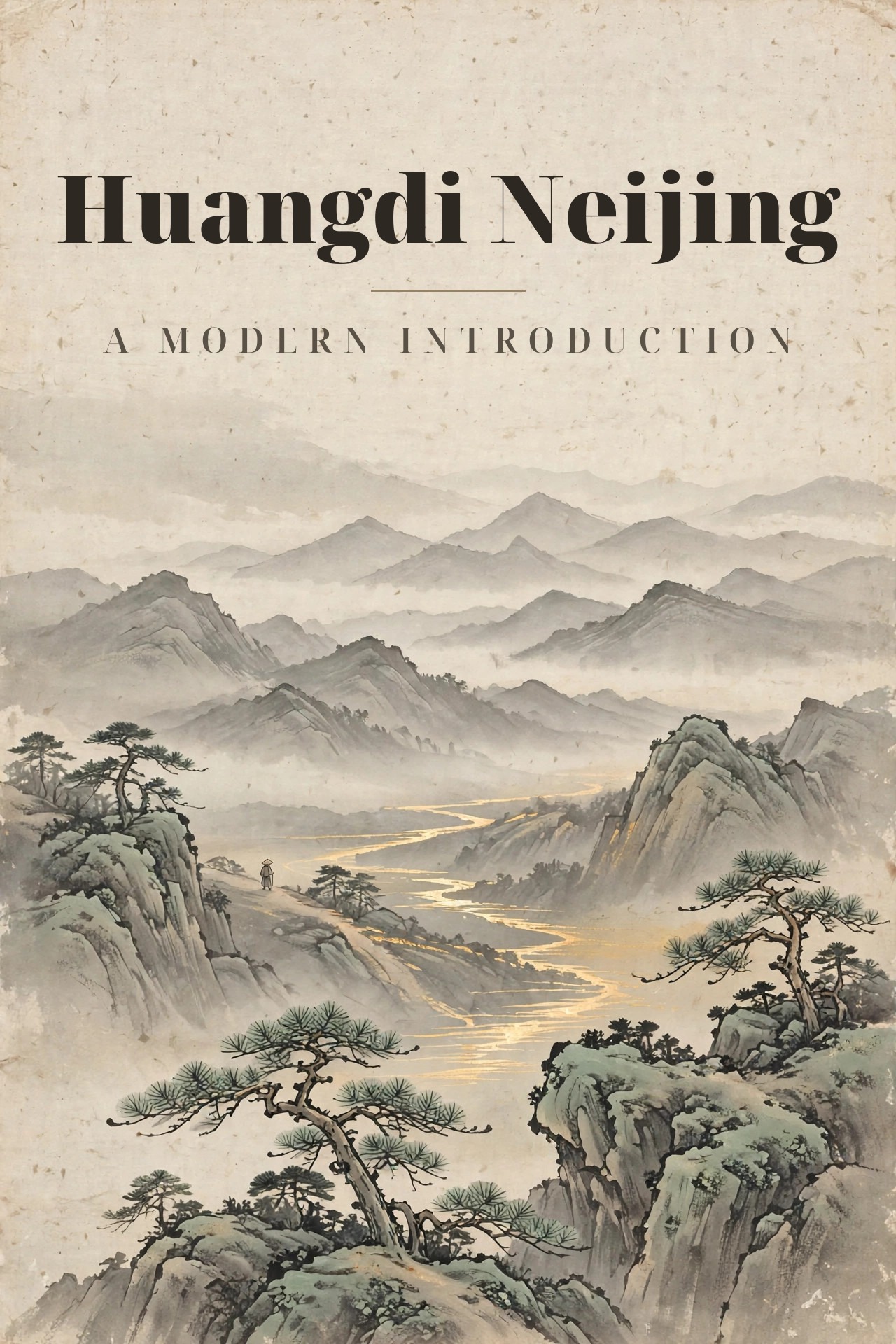
If you want to go deeper, Huangdi Neijing: A Modern Introduction walks through the classic chapter by chapter — 16 short chapters, 112 pages — with the original Chinese lines alongside plain-English explanations. → /books/huangdi-neijing-modern-introduction/