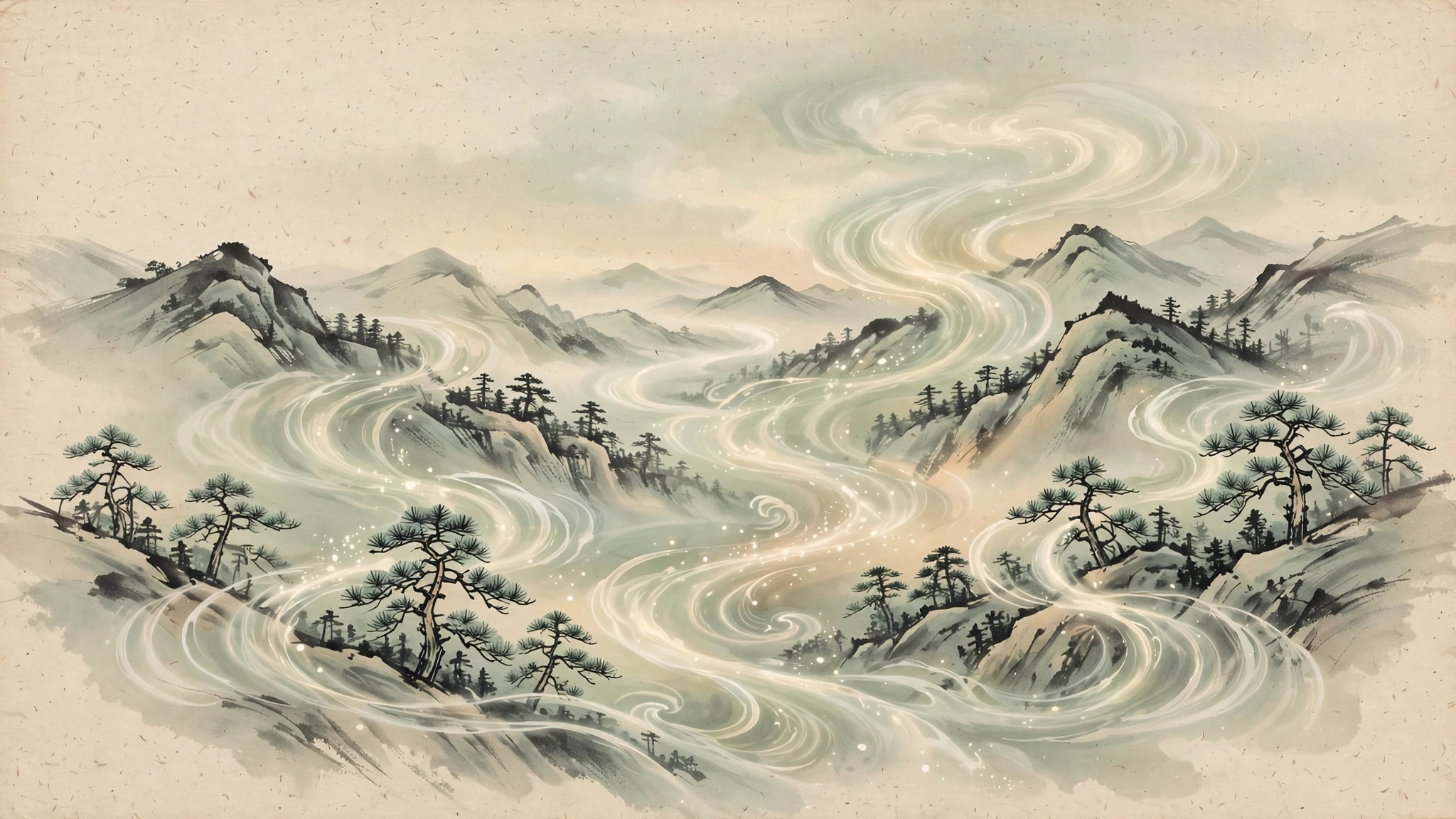
The word qi (氣) is one of the oldest and most central concepts in Chinese wellness traditions. In classical texts it is described as a kind of vital energy or life force that flows through the body and the natural world.
The character itself tells a story. 氣 combines the sign for steam rising above the sign for rice — vapour over grain. It is a picture of something invisible but real: the steam you can see above a bowl of hot rice, the breath you can feel but not hold.
What classical texts say
Early medical and philosophical works, including the Huangdi Neijing (Yellow Emperor's Inner Classic), describe qi as the substance that animates the body, powers movement, digestion and thought, and connects people to the rhythms of the seasons.
In early Chinese thought, qi was bigger than medicine. Philosophers described it as the basic material of the universe itself: everything — people, weather, mountains, seasons — was qi in different states, sometimes dense and still, sometimes thin and moving. Health meant staying in step with those rhythms; illness meant falling out of step.
The Huangdi Neijing puts it plainly: human beings live by the qi of heaven and earth and take shape according to the laws of the four seasons. Spring was a time for qi to rise and spread, summer for it to flourish, autumn for it to draw in, winter for it to store away.
The main kinds of qi
Classical medicine describes several kinds of qi, each with its own source and job. The four most widely taught are these.
Yuan qi (元氣), original or source qi, is the reserve a person is born with. Traditional texts say it is stored in the kidneys and drawn on slowly over a lifetime, like savings in a bank.
Zong qi (宗氣), gathering qi, is made in the chest from two ingredients: the air we breathe in and the essence of the food we eat. It powers breathing and the heartbeat, and it supports the voice.
Ying qi (營氣), nutritive qi, travels with the blood through the channels, nourishing the organs and tissues as it goes.
Wei qi (衛氣), defensive qi, circulates outside the channels, close to the surface of the body. Its job is protection: it warms the skin, opens and closes the pores, and stands guard against wind, cold, and other outside influences.
Different schools name other kinds as well, but these four are the standard set in most textbooks. They show something important about the idea: qi was never one vague force. It was a working vocabulary, a way of naming different jobs the body does.
What qi is said to do
Classical texts give qi five main functions, and they are worth knowing because they explain so much of the language that follows.
First, qi promotes: it moves things along — blood through the vessels, food through digestion, growth in children, and the steady work of the organs. Second, qi warms: it keeps the body at its working temperature, like a fire under a pot. Third, qi defends: it guards the surface of the body, the work of wei qi. Fourth, qi transforms: it turns food and drink into nourishment and waste, the whole process of digestion and metabolism in traditional terms. Fifth, qi holds: it keeps things in place — blood inside the vessels, organs where they belong, fluids from leaking away.
When all five jobs are going well, the body works smoothly. When one falters, the texts describe the result in qi language — food sitting undigested, cold hands and feet, catching every passing cold. These are traditional descriptions, not modern diagnoses.
Health and illness in qi terms
Traditionally, good health was described as a state of abundant, smoothly flowing qi, while illness was framed as qi that was deficient, blocked, or flowing in the wrong direction.
Two patterns appear again and again in the old books. Qi deficiency describes a body running low: tiredness, a weak voice, shortness of breath on light effort, and a general sense of having little in reserve. Qi stagnation describes a body that is stuck: a tense, blocked feeling, often around the chest or the sides of the body, and often linked in the texts to stress and strong emotions. A third pattern, rebellious qi, describes qi moving the wrong way — the classic example is the stomach's qi rising upward instead of settling down, which the texts link to nausea and hiccups.
These patterns are traditional descriptions, not modern medical diagnoses, and they do not replace one: a person who feels constantly tired should see a doctor. The qi framework can help describe the experience, but it cannot explain its cause on its own.
Qi in daily life
Because qi was understood as something that rises and falls with how we live, the old texts are full of practical advice about daily habits — and much of it still sounds familiar.
Breathing comes first. Slow, deep breathing was treated as the most direct way to work with qi, and it is the foundation of qigong and of practices like Ba Duan Jin. A few slow breaths, the texts suggest, can settle a racing mind and a tense chest.
Movement keeps qi flowing. Gentle, regular movement — walking, stretching, qigong, Tai Chi — was valued over sudden bursts of effort. The idea was that the body should move the way water moves: steadily, without forcing.
Food matters because zong qi is partly made from what we eat. The traditional advice was regular meals, warm food, and eating without rushing — habits that modern nutrition also supports, for different reasons.
Sleep restores qi. Night was the time for storing, and staying up late was described as spending the body's reserves. Again, the old language and the modern language agree on the habit, even if they explain it differently.
Emotions were treated as movements of qi. Anger was said to make qi rise, worry to knot it, grief to drain it, fear to scatter it. Strong emotions do change how the body feels, and the old texts were paying close attention to that.
How modern readers can approach it
Modern readers can treat qi as a useful traditional framework for talking about breath, posture, relaxation and daily energy. It is a historical and cultural concept, not a measurable substance, and nothing in this article is medical advice.
That last point deserves emphasis, because it is where honest writing about qi has to be careful. No instrument has ever detected qi as a physical form of energy. There is no laboratory test for "qi deficiency" or "qi stagnation." When scientists study practices built around qi — qigong, Tai Chi, acupuncture — they study them in physiological terms: balance, flexibility, stress hormones, heart-rate variability, and the effects of slow breathing on the nervous system. Those studies can show whether a practice helps, but they do not prove that qi exists as a substance.
The idea survives because it gives people a language for things they can feel: being rested or drained, tense or at ease. Qi is, at its simplest, a traditional way of naming the sense of being alive and well — and of noticing, early, when that sense starts to fade.
Where to go next
Breathing and gentle movement practices such as Ba Duan Jin were designed around this traditional idea. See our articles on movement and breathing for practical, beginner-friendly introductions. To see how qi is said to travel through the body, read how qi flows and circulates and what channels and collaterals are.
If you would like to meet the source itself, our book Huangdi Neijing: A Modern Introduction is a beginner-friendly guide to the classic where the idea of qi first took shape (Huangdi Neijing: A Modern Introduction).
This article is for general wellness education and is not medical advice.
References
- Unschuld PU, Tessenow H. Huang Di Nei Jing Su Wen: An Annotated Translation of Huang Di's Inner Classic – Basic Questions. 2 vols. Berkeley: University of California Press; 2011.
- National Center for Complementary and Integrative Health. Qigong: What You Need To Know. https://www.nccih.nih.gov/health/qigong-what-you-need-to-know