Most studies of herbal medicine and the liver end with the same unsatisfying sentence: the formula changed a molecular pathway, and the animals got better. That is a correlation, not an explanation. Did the pathway cause the improvement, or did both simply happen at the same time?
A study published in Biological Procedures Online on November 5, 2026, goes two steps further than most — and those extra steps are exactly why it is worth reading. Researchers at Zhenjiang Hospital of Traditional Chinese Medicine tested a traditional herbal formula called Huangjing Jiangzhi (HJJZ) granules against fatty liver disease in mice. Then they ran the experiment twice more: once with the key gene switched off, and once with the gene downstream of it switched back on. The benefit vanished when the gene vanished, and returned when the downstream gene returned.
The Disease and the Formula
Nonalcoholic fatty liver disease, or NAFLD, now affects roughly 30 percent of the global population. It ranges from simple fat accumulation in the liver to inflammation, fibrosis, cirrhosis, and in some cases liver cancer. There is no simple drug fix: management still rests mainly on weight loss, diet, and exercise, which is why interest in complementary approaches — including herbal formulas — remains high.
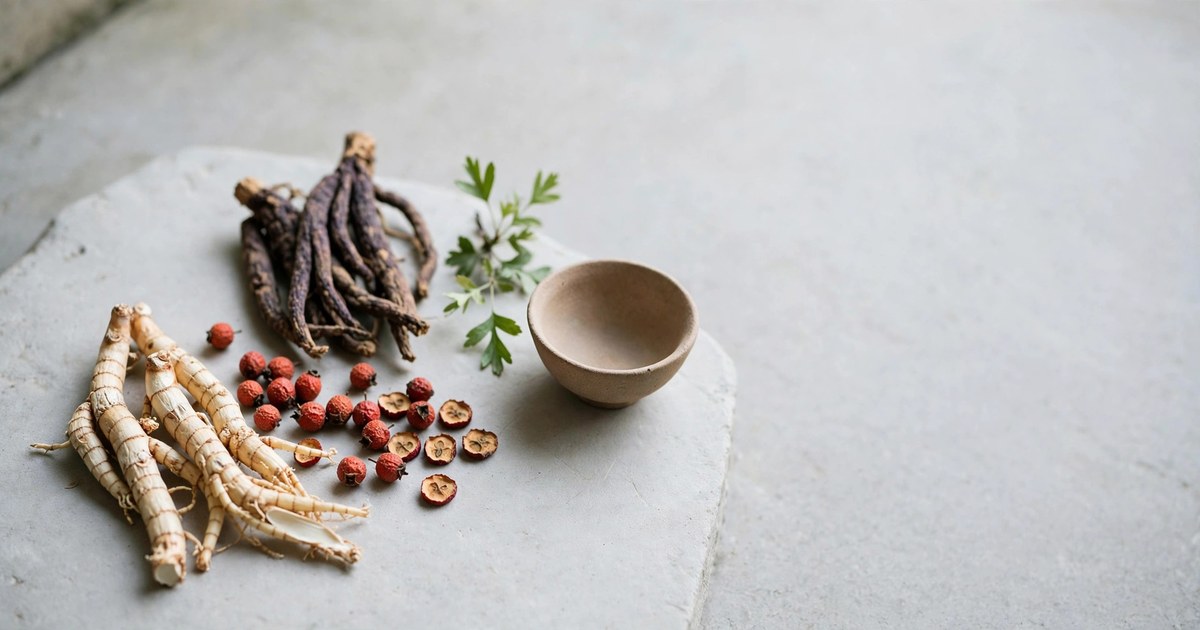
HJJZ granules are an eleven-herb hospital preparation, led by Huangjing (Rhizoma Polygonati, Solomon's seal rhizome) and including processed Heshouwu, hawthorn fruit (Shanzha), Danshen, turmeric root (Yujin), Japanese knotweed root (Huzhanggen), water plantain rhizome (Zexie), aged tangerine peel (Chenpi), processed Banxia, Poria (Fuling), and Fenbixie. The formula has been used clinically in China for lipid disorders, but how it worked at the molecular level had not been mapped.
The research team, led by Dongyu Xie and colleagues, set out to trace that mechanism. Their starting point was a cellular quality-control problem. When the liver is overloaded with fat, the endoplasmic reticulum — the cell's protein-folding workshop — becomes stressed. One branch of the stress response, the PERK-eIF2α-CHOP pathway, switches on and pushes liver cells toward death. A protein called DERL1 helps clear misfolded proteins out of the reticulum, easing that stress. And a transcription factor called FOXA1, already known to be depleted in fatty livers, sits upstream of DERL1. The question was whether the formula worked by restoring FOXA1, which would in turn switch DERL1 back on.
The Effect First
The team fed young male mice a high-fat diet for six weeks until fatty liver was established, then continued the diet for another six weeks while treating the animals with low, medium, or high doses of HJJZ granules, or with atorvastatin — a standard cholesterol-lowering drug — as a positive control.
The results were dose-dependent and consistent. Under the microscope, the fat droplets crowding the liver cells thinned out; blood markers of liver injury, ALT and AST, fell; triglycerides and cholesterol dropped in blood and liver tissue. At the highest dose, the effect was comparable to atorvastatin's. Fewer liver cells were dying, and the stress signals — DERL1, CHOP, and the activated forms of PERK and eIF2α — all moved back toward normal.
So far, this is a conventional herbal pharmacology paper: formula in, fat down, injury down, stress markers down. The interesting part is what happened next — and it happened in a dish, not in the animals.
Step One: Switch Off the Gene
If FOXA1 is merely a bystander — if the formula protects the liver directly and the FOXA1 changes are incidental — then removing FOXA1 should change nothing. The team tested exactly that.
Working with human liver cells (HepG2) exposed to oleic acid to mimic fat overload, they silenced FOXA1 using three independent short hairpin RNAs, confirming the knockdown at both the RNA and protein levels. In cells carrying a harmless control, the granules did what they had done in the mice: viability improved, cell death fell, the ER stress pathway quieted, and fat droplets, ALT, AST, triglycerides, and cholesterol all came down.
In FOXA1-deficient cells, every one of those benefits vanished. Viability fell, apoptosis rose, the stress pathway stayed activated, and the lipid and injury markers remained elevated. The authors state plainly that FOXA1 knockdown completely negated the formula's protective effects.
That is the "necessary" half of a causal claim: remove the proposed mediator, and the effect disappears.
Step Two: Switch the Downstream Gene Back On
Necessity alone is not enough. A skeptic could argue that knocking down a transcription factor damages the cell so broadly that nothing would work in it. So the team ran the mirror-image experiment: in FOXA1-knockdown cells, they overexpressed DERL1, the gene FOXA1 normally switches on.
The protection returned. Cell viability recovered, apoptosis diminished, the stress markers CHOP, phosphorylated PERK, and phosphorylated eIF2α were suppressed, and fat droplets, ALT, AST, triglycerides, and cholesterol all fell back toward control levels. Earlier, chromatin immunoprecipitation and reporter assays had shown that FOXA1 binds directly to the DERL1 promoter and drives its activity — so the rescue experiment closed the loop: FOXA1 switches on DERL1, and DERL1 is enough, on its own, to relieve the stress.
Why This Design Deserves Attention
Readers of this site's evidence reviews will know that "activates pathway X" has become one of the most overused phrases in traditional medicine research. Almost any herbal intervention shifts some molecular marker, and almost any shift can be narrated as a mechanism after the fact. The result is a literature full of correlations dressed as explanations.
This study is a useful antidote because it follows the logic a careful reader should demand:
- Show the effect first. The formula reduced liver fat and injury against a positive control (atorvastatin), with dose groups and standard histological and biochemical measures.
- Remove the mediator. Silencing FOXA1 abolished the effect — including the molecular signature, ER stress suppression.
- Restore the mediator. Overexpressing DERL1 restored the effect without any FOXA1.
- State what is still unknown. The specific active ingredients responsible have not been pinpointed — database screening found 574 candidates — and the work remains preclinical.
That four-step structure is worth remembering the next time you read a headline claiming a herb "heals the liver by activating" some gene. Ask whether the study did steps two and three, or stopped at step one. Most stop at step one. Readers who enjoyed the same logic applied to gut bacteria may remember our earlier piece on the formula that stopped working when the bacteria left — the design is the same, only the mediator is different.
What This Study Does Not Show
Honesty requires the limits, and the authors state them plainly. This was a mouse study plus cell experiments. It does not show that HJJZ granules treat fatty liver disease in people, prevent its progression, or replace lifestyle change or prescribed medication. No human trial of this mechanism exists yet, and the authors call for clinical validation before any patient-level claim could be made.
It also does not show which ingredient does the work. The formula contains eleven herbs and hundreds of candidate compounds; the study attributes the effect to the formula as a whole, not to a single molecule. And the cell experiments used HepG2 cells — a liver cancer cell line, not normal liver cells — which the authors acknowledge may partly explain differences between the dish and the animal. The formula tested was a hospital preparation made under controlled conditions, not a commercial product; its composition may differ from anything sold over the counter.
None of that diminishes the study's real contribution, which is methodological. It demonstrates, with unusual rigor for this field, how to test whether a proposed mechanism actually mediates an herbal formula's effect — and it raises the bar for the next paper that claims to have done the same.
If you take one practical idea from this paper, let it be a reading habit rather than a remedy: when a study says a traditional formula "works by activating" a gene or pathway, check whether the researchers switched that gene off and put it back. If they did both, and the effect followed the gene both ways, the claim is worth taking seriously. If they only measured the pathway and reported a change, you are looking at a correlation — interesting, but not yet an explanation.
Source: Xie D, Wu Y, Jiang J, Xu L, Sun X, Ouyang J, Xi B, Zhang D, Xie H. "Huangjing Jiangzhi Granules Ameliorate Nonalcoholic Fatty Liver Disease by Activating the FOXA1-DERL1 Regulatory Axis to Suppress Lipid Accumulation, Endoplasmic Reticulum Stress, and Apoptosis." Biological Procedures Online. 2026;28(1):40. DOI: 10.1186/s12575-026-00356-y.
If you are interested in how the classical Chinese medical tradition thinks about health more broadly — its ideas of balance, prevention, and the body's patterns — our book Huangdi Neijing: A Modern Introduction offers a beginner-friendly guide to the foundational text of TCM.
This article is for educational purposes only and is not medical advice. If you are concerned about fatty liver or liver health, please consult a qualified healthcare professional.