Most studies of herbal medicine and the gut microbiome end with the same unsatisfying sentence: the formula changed the bacteria, and the animals got better. That is a correlation, not an explanation. Did the bacteria cause the improvement, or did both simply happen at the same time?
A study published in Frontiers in Microbiology on October 27, 2026, goes one step further than most — and that extra step is exactly why it is worth reading. Researchers at Zhejiang Chinese Medical University tested a classical herbal formula called Chaihuang weikuining (CHWKN) against alcohol-induced stomach injury in rats. Then they did the experiment twice more: once with the gut bacteria removed, and once with bacteria transplanted from formula-treated animals into bacteria-depleted ones. The protection vanished when the bacteria vanished, and returned when the bacteria returned.
That is a causal test, not a correlation. And it is a useful template for how to read any claim that a herb "works through the microbiome."
The Formula and the Injury
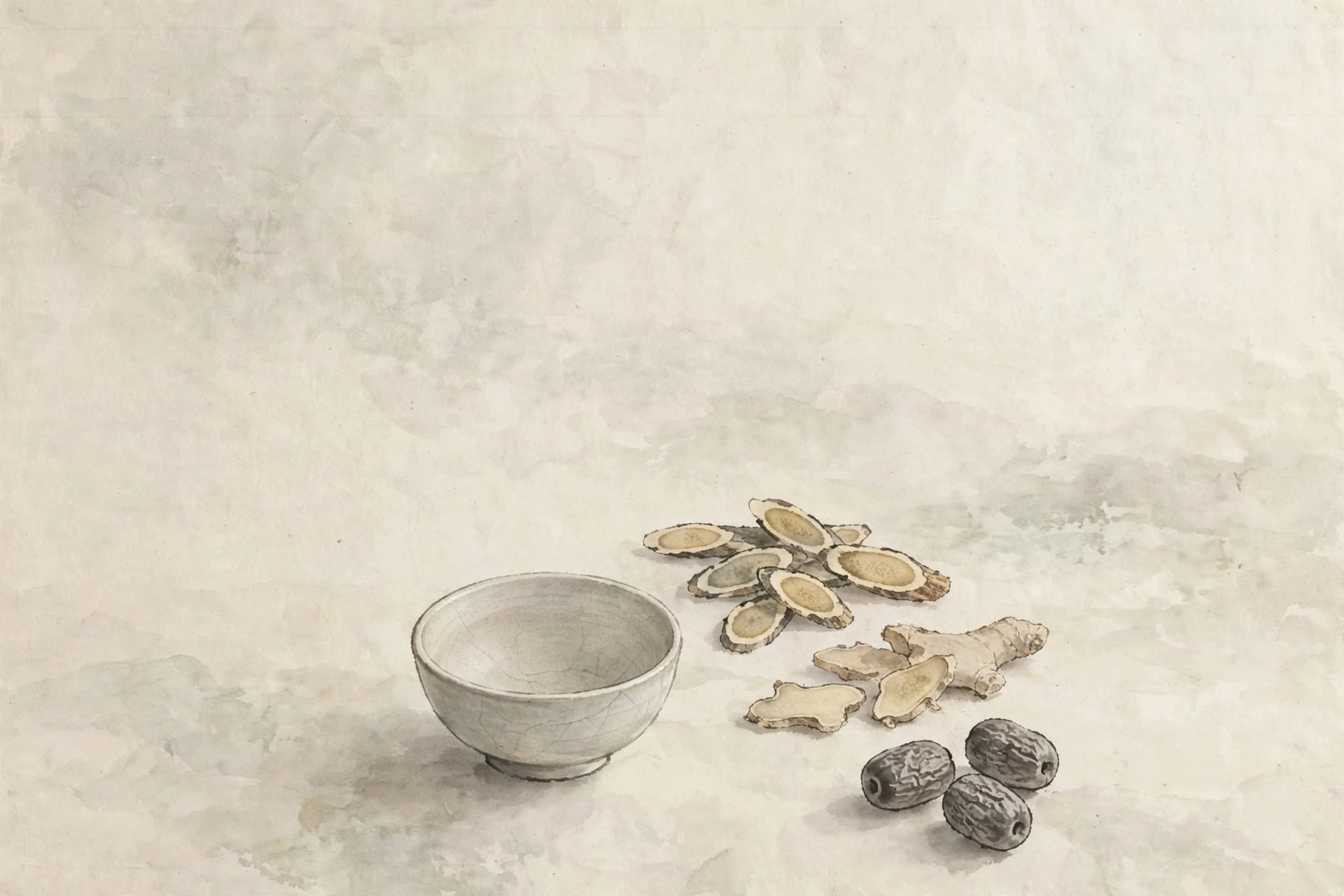
CHWKN is an eleven-ingredient formula — including astragalus (Astragalus membranaceus), bupleurum (Bupleurum chinense), Japanese knotweed (Polygonum cuspidatum), codonopsis, peony, licorice, cinnamon bark, ginger, jujube, nutgrass, and maltose — that has been used clinically in China for gastric disorders. The research team, led by A. Fu and colleagues, wanted to know whether its reputed stomach-protecting effect was real in a controlled setting, and if so, how it worked.
Their model was deliberately simple and harsh: male Sprague-Dawley rats received a single large dose of absolute ethanol (5 mL per kilogram) by stomach tube, a standard way to produce acute gastric mucosal injury. Ethanol rapidly damages the stomach lining through oxidative stress, breakdown of the mucosal barrier, and a surge of inflammatory signaling. It is a laboratory model of injury, not a simulation of an evening's drinking — and nothing in this study should be read as advice about alcohol.
For fourteen days afterward, rats received either a low or high dose of CHWKN (7.5 or 15 g/kg), or omeprazole (20 mg/kg), the standard anti-ulcer drug, as a positive control. The formula groups showed markedly less mucosal damage under the microscope, a lower ulcer index, and improved markers of gastric secretory function — higher pepsinogen I levels and a better pepsinogen I-to-II ratio, both signs of a healthier stomach lining. Inflammatory markers fell in parallel: interleukin-1β, interleukin-6, tumor necrosis factor-α, myeloperoxidase, and lipopolysaccharide (LPS, a pro-inflammatory bacterial endotoxin) all dropped, while the anti-inflammatory cytokine interleukin-10 rose. Expression of the genes Jak1 and Stat3 — components of the JAK1/STAT3 inflammatory signaling pathway — was suppressed.
So far, this is a conventional herbal pharmacology paper: formula in, damage down, inflammation down. The interesting part is what happened next.
Step One: Take the Bacteria Away
If the gut microbiome is merely a bystander — if the formula protects the stomach directly and the bacterial changes are incidental — then removing the bacteria should change nothing. The team tested exactly that.
A separate set of rats drank water containing a four-antibiotic cocktail (vancomycin, ampicillin, neomycin, and metronidazole) for two weeks, wiping out most of their gut bacteria, a reduction confirmed by quantitative PCR of the bacterial 16S rRNA gene. When these microbiota-depleted rats received ethanol and CHWKN, the formula's protection largely collapsed. Mucosal injury worsened, inflammatory infiltration increased, the improvements in pepsinogen markers shrank, the pro-inflammatory cytokines came back, interleukin-10 fell — and, crucially, the suppression of Jak1 and Stat3 expression was abolished.
In other words, without gut bacteria, the formula could no longer quiet the inflammatory pathway it had quieted before. That is the "necessary" half of a causal claim: remove the proposed mediator, and the effect disappears.
Step Two: Put the Bacteria Back
Necessity alone is not enough. A skeptic could argue that antibiotics themselves damaged the gut, or that a bacteria-free animal is simply too sick to respond to anything. So the team ran the mirror-image experiment: fecal microbiota transplantation (FMT).
Donor rats had been treated with ethanol alone, or with ethanol plus CHWKN, for fourteen days. Their fecal suspensions were then given by stomach tube every two days for fourteen days to antibiotic-treated recipient rats. Recipients that received microbiota from CHWKN-treated donors showed significantly better gastric mucosal integrity, restored secretory function, lower pro-inflammatory cytokines, higher interleukin-10, and suppressed Jak1 and Stat3 expression — compared with recipients that received microbiota from ethanol-only donors.
No formula was given to these recipients. The only thing transferred was the microbial community shaped by the formula — and that alone was sufficient to confer protection. That is the "sufficient" half of the causal claim: add back the proposed mediator, and the effect returns.
Sequencing added a compositional footnote. The formula did not change overall microbial richness (alpha diversity was unchanged), but it did reshape community structure (beta diversity separated clearly between groups). Ethanol enriched several bacterial families associated with dysbiosis; CHWKN partially reversed that shift, increasing potentially beneficial groups including Lactobacillus and Faecalibaculum while reducing the ethanol-driven expansion of Muribaculaceae. The authors are careful to note that 16S sequencing alone cannot identify which specific bacteria or metabolites do the work — that would require targeted depletion or reconstitution experiments that have not been done yet.
Why This Design Deserves Attention
Readers of this site's evidence reviews will know that "modulates the gut microbiota" has become one of the most overused phrases in traditional medicine research. Almost any dietary or herbal intervention shifts bacterial composition somewhat, and almost any shift can be narrated as beneficial after the fact. The result is a literature full of correlations dressed as mechanisms.
This study is a useful antidote because it follows the logic a careful reader should demand:
- Show the effect first. The formula protected the stomach lining and reduced inflammation against a positive control (omeprazole), with dose groups and standard histological and biochemical measures.
- Remove the mediator. Depleting the microbiota abolished the effect — including the molecular signature, JAK1/STAT3 suppression.
- Restore the mediator. Transplanting formula-shaped microbiota restored the effect without any formula.
- State what is still unknown. The specific bacteria and metabolites responsible are unidentified, and the molecular link between microbial changes and JAK1/STAT3 signaling remains to be mapped, ideally with metabolomics.
That four-step structure is worth remembering the next time you read a headline claiming a herb "heals the gut by rebalancing bacteria." Ask whether the study did steps two and three, or stopped at step one. Most stop at step one.
What This Study Does Not Show
Honesty requires the limits, and the authors state them plainly. This was a rat study using a single acute ethanol-injury model. It does not show that CHWKN treats human gastric ulcer, prevents alcohol-related stomach damage in people, or replaces drugs like omeprazole. Human gastric ulcer disease involves Helicobacter pylori infection, NSAID use, and chronic patterns of injury that a single ethanol dose does not reproduce. Pharmacokinetic, toxicological, and clinical studies would be needed before any human claim could be made — and none exist yet for this mechanism.
It also does not show that any particular bacterium, such as Lactobacillus, is responsible. The sequencing data are compatible with a Lactobacillus contribution — prior work has reported ulcer-healing effects for certain Lactobacillus strains — but the study itself attributes the effect to the reshaped community as a whole, not to a single species. And the formula used was a laboratory water extract prepared under controlled conditions, not a commercial product; its composition (roughly a quarter carbohydrates and derivatives, 15% amino acid derivatives, 11% flavonoids by LC-MS/MS analysis) may differ from anything sold over the counter.
None of that diminishes the study's real contribution, which is methodological. It demonstrates, with unusual rigor for this field, how to test whether gut bacteria mediate an herbal formula's effect — and it raises the bar for the next paper that claims to have done the same.
If you take one practical idea from this paper, let it be a reading habit rather than a remedy: when a study says a traditional formula "works through the microbiome," check whether the researchers removed the microbes and put them back. If they did both, and the effect followed the microbes both ways, the claim is worth taking seriously. If they only sequenced stool and reported a shift, you are looking at a correlation — interesting, but not yet an explanation.
Source: Fu A, Guo R, Wang K, Zhuge H, Ying G, Ma W, Ding Q, Li S, Bao J, Yu W. "Chaihuang weikuining protects against ethanol-induced gastric ulcer through modulation of gut microbiota and inhibition of JAK1/STAT3 signaling." Frontiers in Microbiology. 2026;17:1924725. DOI: 10.3389/fmicb.2026.1924725.
If you are interested in how the classical Chinese medical tradition thinks about health more broadly — its ideas of balance, prevention, and the body's patterns — our book Huangdi Neijing: A Modern Introduction offers a beginner-friendly guide to the foundational text of TCM.
This article is for educational purposes only and is not medical advice. If you are experiencing stomach pain or ulcer symptoms, please consult a qualified healthcare professional.