If you have ever seen an athlete walk onto the field with large, round purple circles across the shoulders, you have seen cupping. The marks look dramatic — like giant bruises, or the suction rings of an octopus. They are the calling card of a practice that has been part of traditional Chinese medicine (TCM) for more than two thousand years, and that most people outside China first meet through a photo, not a clinic.
This guide explains what cupping is, how a session works, why those marks appear, what modern research actually says, and who should stay away from it. No prior knowledge is needed.
What "Cupping" Means
The Chinese name is ba guan (拔罐). Ba means to pull, and guan means a cup or jar — so the name is a plain description of the method: cups are placed on the skin and made to pull.
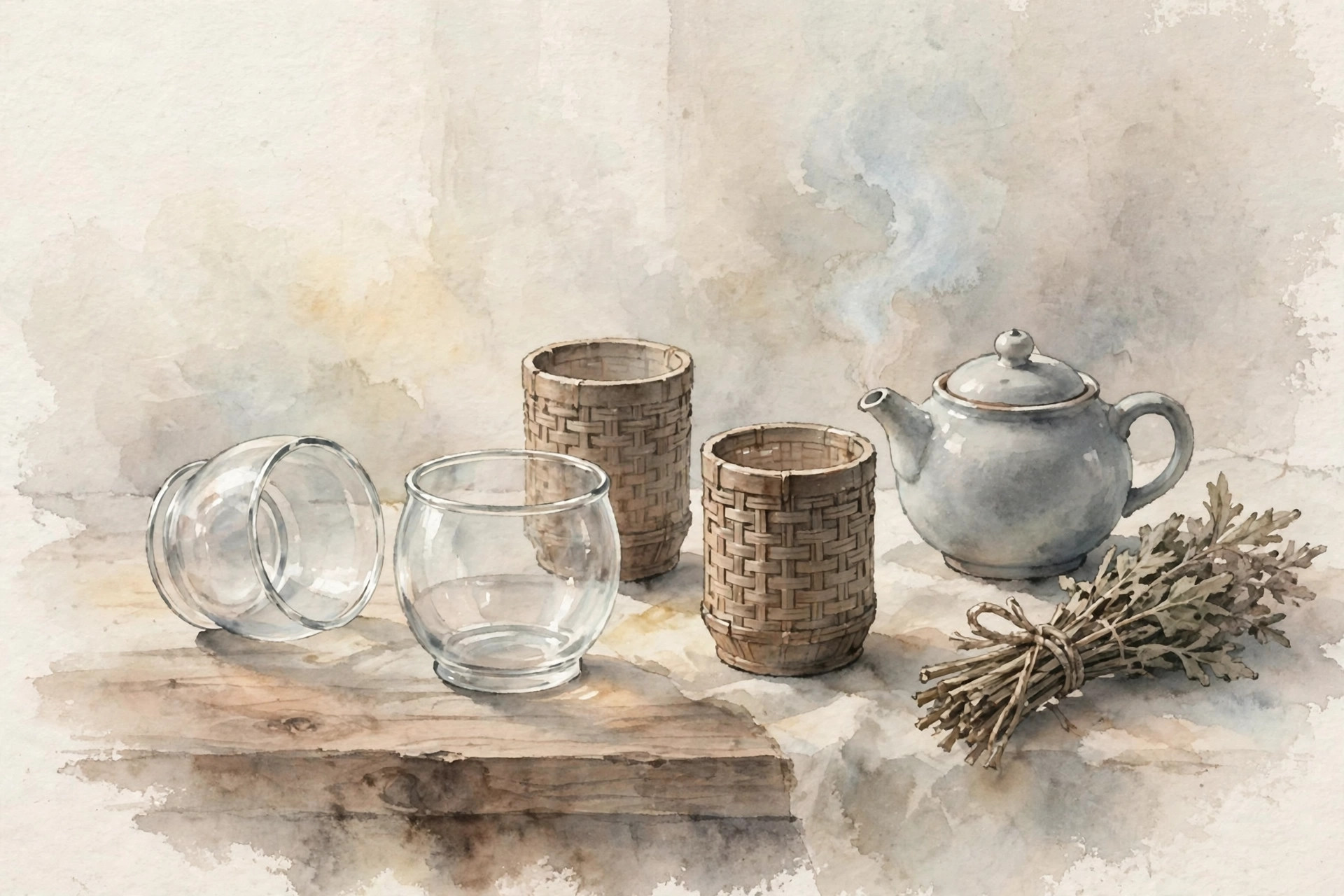
A practitioner sets a cup on the skin and creates suction inside it, so the skin and the tissue underneath are drawn gently upward into the cup. The cups themselves can be made of glass, bamboo, plastic, or soft silicone. The suction is made in different ways: a flame is briefly held inside a glass cup to heat the air, which contracts as it cools; a hand pump draws the air out; or a silicone cup is simply squeezed and released. The cups usually stay in place for about five to fifteen minutes, and a session often uses somewhere between four and ten cups.
In the traditional framework, the point of all this pulling is movement. TCM describes health as depending on the smooth flow of qi (气, vital energy) and blood through the channels (jing luo, 经络) that run through the body. When flow is blocked — by cold, by overwork, by an old injury — the traditional account says pain and stiffness follow. Cupping is understood as a way to draw out that stagnation, warm the channels, and get things moving again. That is the traditional explanation. What modern research makes of it is a different question, and we come to it below.
A Short History
Cupping is old, and it is not only Chinese. Similar suction practices appear in ancient Egyptian medical writings and in Greek medicine, where Hippocrates is said to have used cupping for internal disease. In China, the practice is described in Ge Hong's Handbook of Prescriptions for Emergencies in the fourth century, and it has been used in Chinese clinics ever since — for muscle pain, colds, and general stiffness, often alongside acupuncture and tui na.
For most of its history, cupping was an ordinary clinic treatment, not a headline. That changed in the summer of 2016, when swimmers at the Rio Olympics, most famously Michael Phelps, appeared with dark round marks on their shoulders. Within weeks, cupping went from a quiet clinic practice to a talking point in gyms and spas around the world.
The Main Types
Not all cupping is the same. Beginners meet four kinds most often:
Dry cupping (including fire cupping). This is the common form. Cups are placed on unbroken skin and left in place. When a flame is used to create the suction, it is called fire cupping — the flame never touches the skin; it only heats the air inside the cup for a second.
Wet cupping. The practitioner makes a few small cuts on the skin, then applies the cup so that a small amount of blood is drawn out. It is also known as hijama in Middle Eastern and Islamic medicine. Because it breaks the skin, hygiene matters far more here: sterile blades, gloves, and proper disposal are not optional.
Moving or sliding cupping. Oil is spread on the skin first, and the cups are slid slowly along a muscle instead of staying in one place. This feels closer to a massage, and it is the form most often used for a stiff back or shoulders.
Silicone cups. Soft, squeezable cups that need no flame or pump. They are the kind most often sold for home use, and the gentlest of the four — which is also why practitioners treat them as the lightest option, not a replacement for the real thing.
What a Session Feels Like
A first visit usually starts with a conversation. The practitioner asks what hurts, how long it has hurt, and about your general health — much like the opening of an acupuncture session, which often begins with looking at the tongue and feeling the pulse. They will also ask about medicines you take, especially blood thinners, and about skin conditions.
Then comes the treatment. You lie down, the skin is cleaned, and the cups go on — often on the back, shoulders, or legs. The first feeling is a firm tug, as if the skin is being pulled upward. Most people describe it as tight and strange rather than painful, and they get used to it within a minute or two. When the cups come off, the skin underneath is red, and the round marks are already there.
Afterwards, practitioners usually advise keeping the treated area warm and dry for a few hours and resting. Mild soreness for a day or two is common. A session usually lasts thirty to sixty minutes including the consultation.
Those Round Marks, Explained
The marks are the part everyone asks about, so they deserve a plain answer. The suction pulls blood into the tiny vessels just under the skin, and some of those vessels break. The result is a round patch of petechiae — the same kind of small red or purple spots that appear when a blood vessel breaks anywhere else. The marks are not bruises from being hit, and they are not burns. They usually fade within a week or two, though darker marks can take longer.
This is also the part most often misunderstood. Darker marks do not mean the treatment "worked better," and they do not mean more "toxins" came out. Traditional practitioners sometimes read the colour of the marks as a sign of how much stagnation was present, but that reading is part of the traditional framework, not a measurement. If you are seeing a regular doctor for anything, it is worth mentioning that you had cupping done, so the marks are not mistaken for something else.
What Does Modern Research Say?
Here is the honest summary, and it is less exciting than the marketing.
The U.S. National Center for Complementary and Integrative Health (NCCIH), in a summary last updated in 2018, says there has been some research on cupping, but most of it is of low quality, and that cupping may help reduce pain — but the evidence is not very strong. A 2011 overview of systematic reviews reached a similar conclusion: relatively clear evidence for only one use, pain, and even there doubts remained.
Later work has not changed the picture much. A 2020 pooled analysis of 18 trials with 1,172 people with chronic pain found large short-term effects on pain compared with no treatment — but no significant effect compared with sham cupping or with other active treatments. And a 2023 map of 14 meta-analyses covering five pain conditions found no high-quality evidence that cupping works for any of them, rating the methods of most of those meta-analyses as critically low or low.
Put together, the fair reading is this: cupping may help some people with some kinds of musculoskeletal pain in the short term, perhaps through the same kind of expectation and relaxation effects that accompany many hands-on treatments. But there is no good evidence that it treats disease, removes toxins, or does anything a sham version does not also do. It is a complementary practice, not a replacement for medical care.
Who Should Be Careful
Cupping is generally considered safe for most people when a trained practitioner does it, but it is not for everyone. The NCCIH and the Cleveland Clinic list the same cautions, and they are worth taking seriously:
- Do not have cupping if you are pregnant (or avoid the abdomen and lower back, depending on the stage), if you have a bleeding or clotting disorder, if you take blood thinners, or if you have severe anemia.
- Be careful if you have heart disease, a pacemaker, seizures, or fragile skin; if you are very old or very young; or if you have diabetes or reduced feeling in the skin.
- Do not cup over open wounds, sunburn, skin infections, rashes, or areas of eczema or psoriasis — cupping can make eczema and psoriasis worse.
- Wet cupping carries extra risk. Because it breaks the skin, it must be done with sterile equipment. Poor hygiene can cause skin infections and, in the worst cases, spread blood-borne infections. Never accept wet cupping from anyone who cannot show you sterile, single-use blades.
After cupping, call a doctor if you develop burns, blistering, extreme pain, fever, or signs of skin infection such as spreading redness, tenderness, or yellow discharge.
How to Choose a Practitioner
A few questions before you book will tell you most of what you need to know. Is the practitioner licensed or trained in acupuncture or traditional Chinese medicine, rather than someone who took a weekend course? Do they ask about your health history and medicines first? Do they explain which kind of cupping they plan to use, and why? For wet cupping, do they use single-use sterile blades and gloves, and can they show you? A good practitioner answers all of this plainly and is comfortable if you decide not to go ahead.
In many places a session costs about the same as a massage, and some acupuncture clinics include cupping as a small add-on to a regular visit. Insurance rarely covers it.
The Short Version
Cupping is a simple idea — suction cups that pull the skin upward — with a very long history and a very modern moment of fame. The traditional account says it moves qi and blood and clears stagnation; modern research says it may ease some pain in the short term, but the evidence is weak and it works no better than a sham version in the trials that test that. The round marks look alarming and are mostly harmless, fading in a week or two. And the safety rules are straightforward: no cupping over broken or infected skin, extra care if you bleed easily or take blood thinners, and sterile equipment whenever the skin is cut.
If you are curious, that is enough to walk into a clinic with your eyes open. Like tongue diagnosis, cupping is best understood as one piece of a larger system, not a miracle on its own.
If these ideas resonate, Huangdi Neijing: A Modern Introduction explains the classical foundations behind practices like this one in clear, beginner-friendly language (Huangdi Neijing: A Modern Introduction).