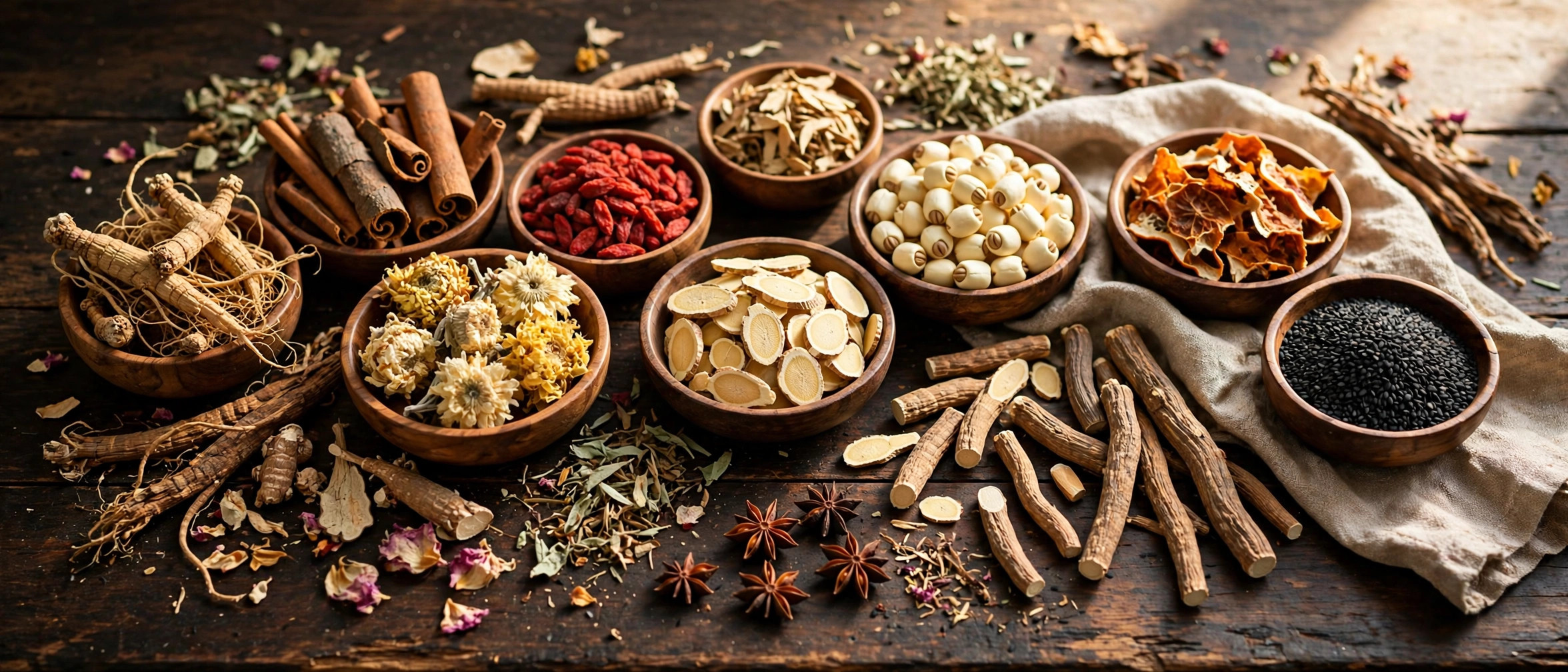
Walk into a traditional Chinese medicine (TCM) clinic and, alongside acupuncture, you will often find shelves of dried roots, bark, seeds, and flowers. Chinese herbal medicine is the use of these natural substances — usually combined into formulas — to support health. It is one of the oldest organized systems of plant medicine in the world, and also one of the most misunderstood. This guide explains what it is, how formulas work, what modern research says, and how to approach it safely.
A Medicine of Plants, Minerals, and Time
The written record of Chinese herbal medicine goes back more than two thousand years. The Shennong Bencao Jing (Divine Husbandman's Classic of Materia Medica), traditionally dated to the Han dynasty, described 365 substances and their uses. The most famous later work is the Bencao Gangmu (Compendium of Materia Medica), compiled by Li Shizhen and published in 1596. It recorded 1,892 substances and around 11,000 formulas, and it remained a standard reference for centuries.
This tradition is not only history. In the 1970s, Chinese scientist Tu Youyou studied ancient herbal texts and isolated artemisinin from the plant Artemisia annua (qinghao, 青蒿), a herb long used for fevers. Artemisinin became one of the world's most important antimalarial drugs, and Tu received the Nobel Prize in Physiology or Medicine in 2015. It is the clearest example of how a traditional remedy, tested with modern science, can become mainstream medicine — and also a reminder that most herbs have not gone through that test.
Single Herbs and Formulas
A key point beginners often miss: Chinese herbal medicine is mostly about formulas, not single herbs. A single herb is one substance — ginseng, ginger, licorice root. A formula is a combination of several herbs, put together for a particular purpose. Most treatment in a clinic uses formulas.
A classical formula is built with four roles, described as jun chen zuo shi (君臣佐使) — sovereign, minister, assistant, and courier. The sovereign herb does the main work. The minister supports it. The assistant handles secondary problems or softens harsh effects. The courier guides the formula to the right part of the body or harmonizes the mixture. A formula for a cold, for example, might combine herbs that warm the body, herbs that ease a cough, and herbs that protect digestion.
This is why buying a single herb off a shelf is not the same as receiving herbal treatment. A formula is tailored: the practitioner chooses the herbs, the proportions, and the preparation to match the person in front of them.
How a Practitioner Chooses a Formula
A TCM practitioner does not usually prescribe by disease name alone. Instead, they look for a pattern — the traditional term is bian zheng lun zhi (辨证论治), often translated as pattern differentiation. Two people with the same Western diagnosis may receive different formulas if their patterns differ: one may run hot and dry, the other cold and sluggish, in the language of the tradition.
The consultation looks familiar if you have read our guide to tongue diagnosis: the practitioner asks about sleep, appetite, digestion, energy, and mood, looks at the tongue, and feels the pulse. From this they choose a formula, and they often adjust it at later visits as the pattern changes.
Herbs come in several forms. The oldest is the decoction: raw herbs boiled in water and drunk as a tea. Modern clinics more often use granules (concentrated extracts mixed with hot water), pills, or powders — easier to take, though traditionalists argue that a freshly boiled decoction allows finer adjustment. What matters most is not the form but the quality of the herbs and the skill of the prescriber.
What the Evidence Says
The honest answer is: mixed, and it depends on the herb and the condition. Artemisinin is the success story. A number of individual formulas have been tested in randomized trials with encouraging results — for example, certain formulas for irritable bowel syndrome, eczema, and menopausal symptoms have shown benefits in published studies. But when reviewers at the Cochrane Collaboration pool the evidence for most formulas, they often conclude that the studies are too small, too short, or too poorly designed to give a firm answer.
Part of the problem is that a formula is hard to test the way a single drug is tested. A drug trial tests one molecule at a fixed dose. A herbal formula contains many active compounds, and practitioners adjust it from patient to patient — which makes standard trials awkward, though not impossible. Research quality has improved a great deal in the last twenty years, and large, well-designed trials are now appearing, including several covered on this site. Still, the fair summary is that the evidence is promising in places and thin in others, and no formula should be treated as proven until good trials say so.
Safety First
Herbs are natural, but natural does not mean harmless. Three safety points matter most.
First, interactions. Herbs can change how prescription medicines work. Some herbs affect blood clotting, blood pressure, blood sugar, or the liver. For example, licorice root, a common formula ingredient, can raise blood pressure when taken in large amounts over a long time. Always tell your doctor and your pharmacist about any herbs you take, especially if you use blood thinners, diabetes medicine, blood pressure medicine, or immunosuppressants.
Second, quality. The herb market has a real quality problem. Published reports have found some products contaminated with heavy metals or pesticides, and some adulterated with undeclared prescription drugs — painkillers or steroids mixed in to make a product seem effective. These are usually cheap products from unknown sellers, not medicines from a licensed practitioner. Buy from reputable, regulated sources, and be suspicious of any product that does not list its ingredients.
Third, pregnancy and children. Some herbs are traditionally avoided during pregnancy, and doses for children are different. A qualified practitioner will ask about these things before prescribing.
How It's Regulated
Regulation varies widely, and it shapes what you can buy. In China, herbal medicines are regulated as drugs and prescribed by licensed doctors. In the United States, most herbal products are sold as dietary supplements under a 1994 law, which means they are not approved by the Food and Drug Administration for treating disease, and manufacturers do not have to prove they work before selling them. In the United Kingdom and the European Union, traditional herbal products can carry a Traditional Herbal Registration, which requires evidence of traditional use and quality standards. In Australia, the Therapeutic Goods Administration regulates them. The practical lesson is simple: the same herb can be a regulated medicine in one country and an unregulated supplement in another, so check your local rules.
Reading Claims With a Clear Eye
Herbal products attract bold claims, and a few warning signs are worth knowing. Be cautious of any product that promises to fix a serious illness, that claims a secret formula, that lists no ingredients, or that is sold only through social media testimonials. A trustworthy practitioner or product will name the ingredients, explain what the formula is meant to do, and tell you what it cannot do.
The traditional framework behind herbal medicine — ideas like qi and the five elements — is a way of organizing centuries of observation. It is worth learning about on its own terms, and worth testing against modern evidence wherever that is possible. The two ways of knowing do not have to fight; the best herbal practice today tries to hold them together.
A Balanced View
Chinese herbal medicine is a vast, old system with real strengths and real limits. Its formulas are carefully constructed, its history includes genuine discoveries like artemisinin, and modern trials are slowly sorting out what works from what does not. At the same time, quality varies, interactions are real, and most formulas are not yet proven by the standards modern medicine requires. If you are curious, the safest path is a licensed practitioner, quality products, and an open conversation with your doctor — so that herbs become one part of your care, not a secret kept from it.
If these ideas resonate, Huangdi Neijing: A Modern Introduction explains the classical foundations — the seasons, the body's rhythms, and the habit of living with the year rather than against it — in clear, beginner-friendly language (Huangdi Neijing: A Modern Introduction).
This article is for general wellness education and is not medical advice.