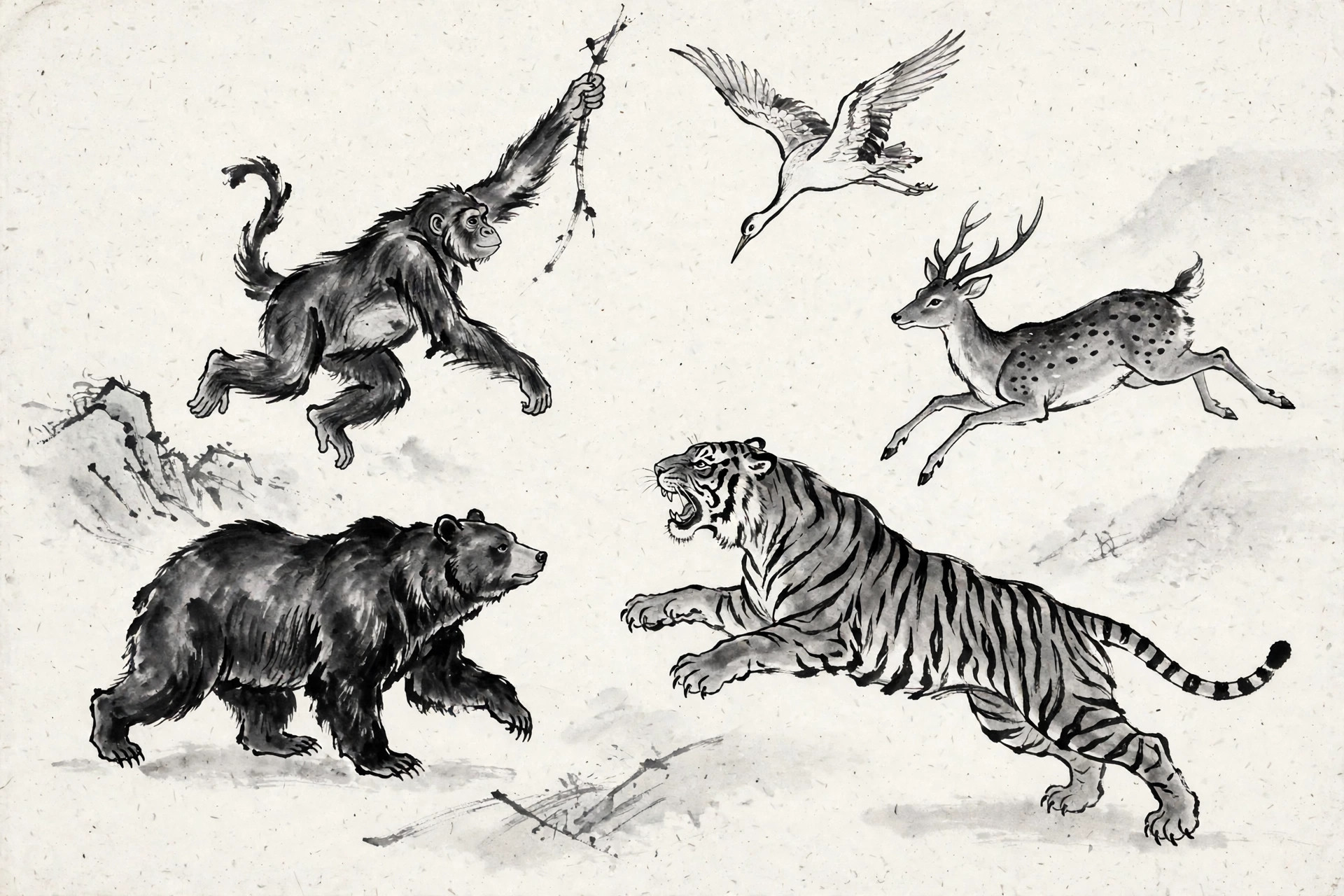
Imagine exercising by imitating a tiger — not with ferocity, but with the tiger's focused, spring-loaded strength. Then moving like a deer, all grace and quick turning. Then a bear, heavy and swaying. Then a monkey, bright and quick. Then a bird, spreading its wings into the air.
This is wu qin xi (五禽戏, wǔ qín xì), the Five Animal Frolics — one of the oldest movement practices in the Chinese tradition, and surely one of the most joyful. Where standing meditation asks you to be still, the Five Animal Frolics ask you to play: to borrow the qualities of five animals and try them on in your own body.
An Old Practice with a Famous Name
The Five Animal Frolics are traditionally attributed to Hua Tuo (华佗, Huà Tuó), a celebrated physician of China's Han dynasty, roughly two thousand years ago. Hua Tuo is a legendary figure in Chinese medicine — stories credit him with remarkable surgical and herbal skill — and tradition says he created these animal movements as a form of health exercise, teaching that the body, like a door hinge, stays supple through use.
A note of honesty is in order: we do not know exactly what Hua Tuo himself practiced. The movements taught today under the name wu qin xi are later reconstructions and regional variations, refined over many centuries. What has survived intact is the idea — that imitating animals is a natural, complete way to move the human body — and that idea is what this article is about.
Meet the Five Animals
Each animal lends the practice a distinct quality of movement. Together they cover the full vocabulary of the body: strength, grace, heaviness, agility, and lightness.
The Tiger (虎, hǔ): Strength
The tiger's movements are powerful and deliberate. Practitioners imitate the tiger's pounce — a coiled, springing forward motion — and its seizing gesture, the paws grasping and pulling back. In practice this becomes lunging steps, firm claw-like hand shapes, and a fierce, focused gaze. The feeling is one of contained power: strong but not tense, like a drawn bow. In the traditional five-phase reading of the body, the tiger is linked with the liver — the organ system associated with smooth, forceful movement and resolve. (These traditional associations are offered as cultural context, not medical claims.)
The Deer (鹿, lù): Grace
The deer's movements are light and full of turning. Practitioners imitate the deer stretching its neck to look around, turning the body swiftly, and stepping with quick, delicate footwork. The spine twists gently, the head turns, and the whole body changes direction the way a startled deer does — in one fluid motion. The quality here is alert grace: the body stays soft while the attention stays wide. In the traditional mapping, the deer is linked with the kidneys.
The Bear (熊, xióng): Heaviness
The bear brings weight and swaying. Practitioners rock side to side, shifting the full weight of the body from one leg to the other, sometimes with a lumbering step or a deep, rolling turn of the torso. Everything about the bear is slow and heavy — the deliberate opposite of the deer's quickness — and that is the point: learning to move the body's full mass with comfort and control. Traditionally, the bear is associated with the spleen and the digestive center.
The Monkey (猿, yuán): Agility
The monkey — in modern practice usually the hou (猴, hóu), the common monkey — is quick, bright, and playful. Practitioners imitate its reaching and picking gestures, its sudden changes of direction, its curious, darting gaze. The hands become lively, the steps quick and light, and a smile is practically required — the monkey does not permit solemnity. The traditional association here is with the heart and its connection to liveliness and spirit. (You can read more about the traditional view of emotions and the inner organs in our article on emotions and health in the Huangdi Neijing.)
The Bird (鸟, niǎo): Lightness
The bird — most often practiced as the crane (鹤, hè) — is all about spreading the wings and rising. Practitioners extend the arms wide like wings, lift onto the toes, and imitate the bird's light, balanced standing on one leg. The feeling is upward and expansive: the chest opens, the body lengthens, and for a moment you may feel taller than you are. Traditionally, the bird is linked with the lungs and the breath.
Embodied Play: What "Moving Like the Animal" Really Means
The quiet genius of wu qin xi is that it smuggles serious exercise inside play. When you imitate a tiger, you are not performing for an audience — you are borrowing a felt quality. What does strength feel like in the legs? What does lightness feel like in the arms? The animal is a doorway into sensations you might never explore in ordinary movement.
This works through what you might call embodied imagination: the image of the animal shapes the movement, and the movement deepens the image. Children do this instinctively. Wu qin xi suggests that adults may benefit from doing it on purpose. You do not need to look like a tiger. You need only, for a minute or two, to move *as though* you carried a little of the tiger's spring in your step.
How to Try This: A 10-Minute Five-Animal Sequence
Here is a simplified sequence you can try today. Give each animal about two minutes, moving at your own pace. Wear comfortable clothes and clear a little space.
1. Arrive (1 minute). Stand with feet shoulder-width apart. Take three slow breaths. Gently roll the shoulders, turn the head side to side, and shake out the hands. The body should feel awake and loose. 2. Tiger (2 minutes). Step forward into a comfortable lunge, one leg bent in front. Shape your hands into loose claws — fingers spread and slightly curved. "Pounce": shift your weight forward as the hands reach out and grasp, then pull back as though drawing something toward you. Alternate sides. Keep the gaze focused and the jaw relaxed. 3. Deer (2 minutes). Stand and turn: rotate the torso to one side, letting the head follow as though looking behind you, arms swinging loosely. Step lightly from foot to foot, changing direction every few turns. Imagine ears pricked forward, attention wide. Keep the movements quick but soft — never forceful. 4. Bear (2 minutes). Widen your stance. Slowly shift your entire weight onto the right leg, letting the left side hang heavy, then sway across to the left. Let the arms swing loosely with the sway. Turn the torso in a slow, rolling circle. Everything heavy, everything unhurried — feel the full mass of the body moving. 5. Monkey (2 minutes). Lighten up. Take quick, small steps, changing direction playfully. Reach up with one hand as though picking fruit, then the other. Let the gaze dart around — curious, bright. If you catch yourself being solemn, that is the monkey telling you to loosen up. 6. Bird (2 minutes). Stand tall. Extend both arms out to the sides like wings, palms down. Rise onto your toes, hold for a breath, and lower. Try balancing on one leg for a few breaths, arms spread wide — hold a wall or chair if you need to. Feel the chest open and the body lengthen upward. 7. Close (1 minute). Return to standing. Take three slow breaths, hands resting over the lower belly. Notice how the body feels now compared with the start — warmer, looser, more awake, perhaps.
That is a complete practice. As the movements become familiar, you can lengthen each animal's turn, string them together more fluidly, or simply spend your ten minutes with whichever animal your body seems to want that day.
The Modern View
Looked at without any traditional language at all, wu qin xi is gentle, full-body movement that asks a lot of the body in a friendly way. The lunging and weight-shifting of the tiger and bear challenge the legs and balance; the turning of the deer mobilizes the spine; the reaching of the monkey and the wing-spreading of the bird open the shoulders and chest; the one-legged bird stance trains steadiness. Coordination gets a workout too — each animal asks the arms, legs, torso, and gaze to do different things at once, which is more demanding, and more fun, than it sounds.
None of this requires believing anything in particular. A modern mover can enjoy the joint mobility, the balance work, and the sheer pleasure of the play, while a traditionally minded practitioner can read the same movements as nourishing the organ systems described in the classical texts. For a fuller picture of that traditional inner map, see our guide to the five zang organs as a functional map — and for the broader philosophy of staying well before illness arrives, treat before illness: the classical art of prevention.
A Note on Practice
Wu qin xi is low-impact and adaptable — every movement can be made smaller, slower, or done seated if needed. Still, move within a comfortable range: stop if anything hurts, keep the knees soft during lunges and never let them cave inward, and use a wall or chair for the one-legged bird stance until your balance is steady. This is play, not a test; the animal that suits you best is the one you enjoy.
The Five Animal Frolics have been passed down for the better part of two thousand years — not because they are complicated, but because they are not. Five animals, ten minutes, one body rediscovering how good it feels to move. If you would like to understand the classical ideas behind practices like this, our book *Huangdi Neijing: A Modern Introduction* explains them in clear, modern language.
*This article is for general wellness education and is not medical advice.*