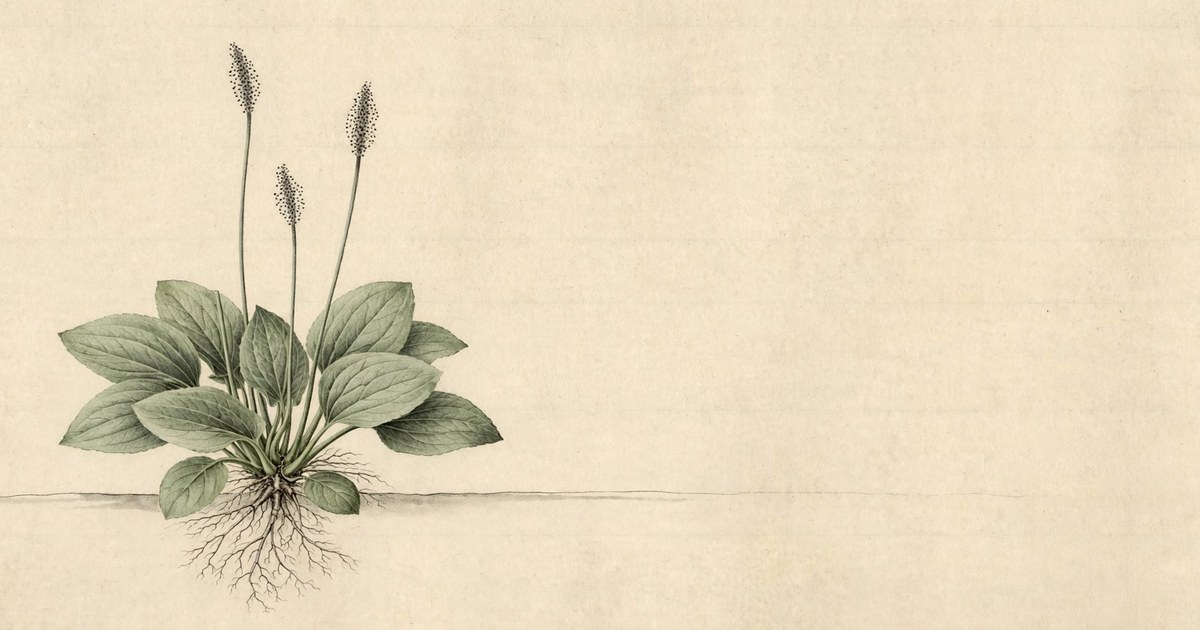
The Soil Passed the Test. The Herb Didn't: What Heavy Metals in a Common TCM Herb Teach Us About Quality Control
Here is a puzzle for anyone who buys or prescribes herbal medicine. A team of researchers in Jiangxi, China, tested the soil in which the medicinal herb Plantago asiatica — Asian plantain, known in Chinese medicine as 车前草 — was growing. The soil passed every agricultural safety screen. Then they tested the plant itself. Its roots exceeded the proposed medicinal safety threshold 100% of the time. Its leaves, nearly 60% of the time.
The soil was safe. The herb was not. Published in Scientific Reports on October 1, 2026, the study is a clear, well-constructed demonstration of something herbal quality control has long suspected but rarely quantified so neatly: you cannot read an herb's safety off its soil test. The interesting part is not the alarm — it is the method. Understanding how the researchers measured risk, and why different plant parts tell different stories, is more useful than any headline about contamination.
What the Researchers Did
The team, from the Jiangxi Academy of Agricultural Sciences, sampled Plantago asiatica and its surrounding soil, then measured ten heavy metals in four plant parts — roots, stems, leaves, and seeds — plus the soil itself, using ICP-MS, a laboratory technique sensitive enough to detect metals at trace levels.
Then came the part that matters: four analytical tools, each answering a different question.
The bioconcentration factor (BCF) asks: compared with the soil it grew in, how much metal did the plant pull into itself? A BCF above 1 means the plant concentrates the metal; the higher the number, the stronger the enrichment.
The translocation factor (TF) asks: once inside the plant, does the metal travel upward from root to shoot? A TF below 1 means the plant mostly holds metals in its roots.
The hazard index (HI) asks about non-cancer risk: it combines exposure to all the metals into a single number. Above 1, the combined exposure is considered a potential health concern.
Total carcinogenic risk (TCR) asks about cancer risk: the lifetime probability of developing cancer from exposure, again summed across metals.
Finally, the team ran everything through Monte Carlo simulation — essentially re-running the risk math thousands of times with slightly different inputs each time, so the result reflects a range of plausible exposures rather than a single optimistic or pessimistic guess. It is the standard way to keep risk estimates honest about their own uncertainty.
What They Found
The headline numbers: roots showed a 100% exceedance rate against the study's proposed medicinal-material safety threshold; leaves, 57.69%. Stems and seeds fared better. Meanwhile the growth soils themselves sat comfortably below the risk screening values for agricultural land.
The driver was cadmium. The plant proved to be a strong cadmium accumulator: a BCF of 10.18 in roots and 6.73 in leaves — meaning roots held roughly ten times the cadmium concentration of the surrounding soil. Arsenic was the other metal of concern: under the conservative assumption that all measured arsenic was the more toxic inorganic form, arsenic in roots and leaves emerged as the primary driver of potential non-carcinogenic risk for both adults and children, and roots carried a potential carcinogenic risk for adults.
Two nuances deserve attention, because they show careful science rather than alarmism.
First, the standard you measure against changes the verdict. Under the food-safety framework, only the roots exceeded the threshold. Under the stricter medicinal-material threshold the authors proposed, all four parts flagged potential non-carcinogenic risk. Neither framework is "the truth" — they are different lenses, and the authors are transparent that their medicinal threshold is a proposal, not a regulation. The lesson is that safety is always relative to the standard applied, and medicinal herbs consumed regularly over long periods arguably deserve the stricter lens.
Second, the conservative arsenic assumption does real work. Assuming all arsenic is inorganic is a standard precautionary move, but it almost certainly overstates the true inorganic fraction. The authors state it plainly. A careful reader should therefore treat the arsenic-driven risk estimates as upper bounds, not measured harms.
Why the Plant Disagrees with the Soil
This is the part worth sitting with. Plants are not passive straws. Different species — and different parts of the same plant — actively select, transport, and store metals. Plantago asiatica turns out to be an enthusiastic cadmium accumulator, pulling the metal from soil that itself tests clean and parking it in roots and leaves.
The translocation factors, all below 1, add a fascinating twist: the plant mostly traps metals in its roots rather than moving them upward. From an environmental standpoint, that makes it a candidate for phytostabilization — using plants to lock contaminants in place so they do not spread. The same trait that makes the plant useful for cleaning soil is exactly what makes its roots risky as medicine. One organism, two opposite valuations, depending entirely on what you ask it to do.
For the medicinal user, the part-by-part gradient matters. The roots — which the authors explicitly recommend avoiding or reducing in medicinal applications — are not the part most commonly used in traditional practice anyway (the dried whole herb above ground, 车前草, and the seeds, 车前子, are the standard materials). But leaves, which are part of the whole herb, showed substantial exceedance too. The takeaway is not "this herb is poison" — it is that risk in herbal medicine is part-specific, and quality control that treats the whole plant as uniform is missing the actual pattern.
What This Means for Herbal Quality Control
If you step back, the study is really an argument about where quality control should point its instruments. Testing the field is necessary but insufficient; the material itself — part by part — is where the risk lives. Three practical implications follow:
-
Test the herb, not just the farm. Soil screening and good agricultural practice are the floor, not the ceiling. A clean soil certificate says little about what the plant did with that soil.
-
Test by part. Roots, leaves, stems, and seeds of the same plant, from the same field, showed dramatically different risk profiles. Specifications that do not distinguish plant parts are averaging away the information that matters.
-
Mind the framework. Food standards and medicinal standards answer different questions. Herbs taken daily for weeks or months are closer to chronic exposure than to occasional food intake, and the thresholds should reflect that.
None of this requires fear. It requires measurement — which is exactly what the researchers did.
The Caveats, Honestly Stated
As with our earlier look at herbal evidence for dry eye, the value is in reading the study rather than the headline, and the study has limits. The samples come from one region; soils, cultivars, and contamination profiles differ elsewhere, so the numbers are not universal constants. The medicinal safety threshold is the authors' proposal, not an adopted regulation — reasonable, but provisional. And the risk estimates rest on modeled exposure assumptions (how much herb, how often, for how long), which the Monte Carlo simulation explores but cannot verify. This is a risk assessment, not a poisoning report: it identifies where to look, not what will happen.
The Bottom Line
A clean soil test told the researchers the field was safe. The plant told a different story: strong cadmium enrichment in roots and leaves, part-specific risk gradients, and a recommendation to keep high-risk parts — especially roots — out of medicinal use. The deeper message is methodological and durable: in herbal medicine, safety is a property of the material and the part, not of the land it grew on. Quality control worthy of the name tests accordingly.
If you are curious about how the classical tradition itself thinks about materia medica — the careful classification of substances by nature, flavor, and proper use that has guided Chinese pharmacy for two millennia — our book Huangdi Neijing: A Modern Introduction is a beginner-friendly guide to the foundational text of Chinese medicine.
This article is for educational purposes only and is not medical advice. It reports on a published study and its limitations; it does not recommend for or against any herb or treatment.
References
- Qiu S., Dong Y., Ai Q., et al. Discrepancy between soil safety and herbal risk: high cadmium enrichment in roots and leaves of Plantago asiatica and associated health implications. Scientific Reports (2026). https://doi.org/10.1038/s41598-026-73602-8