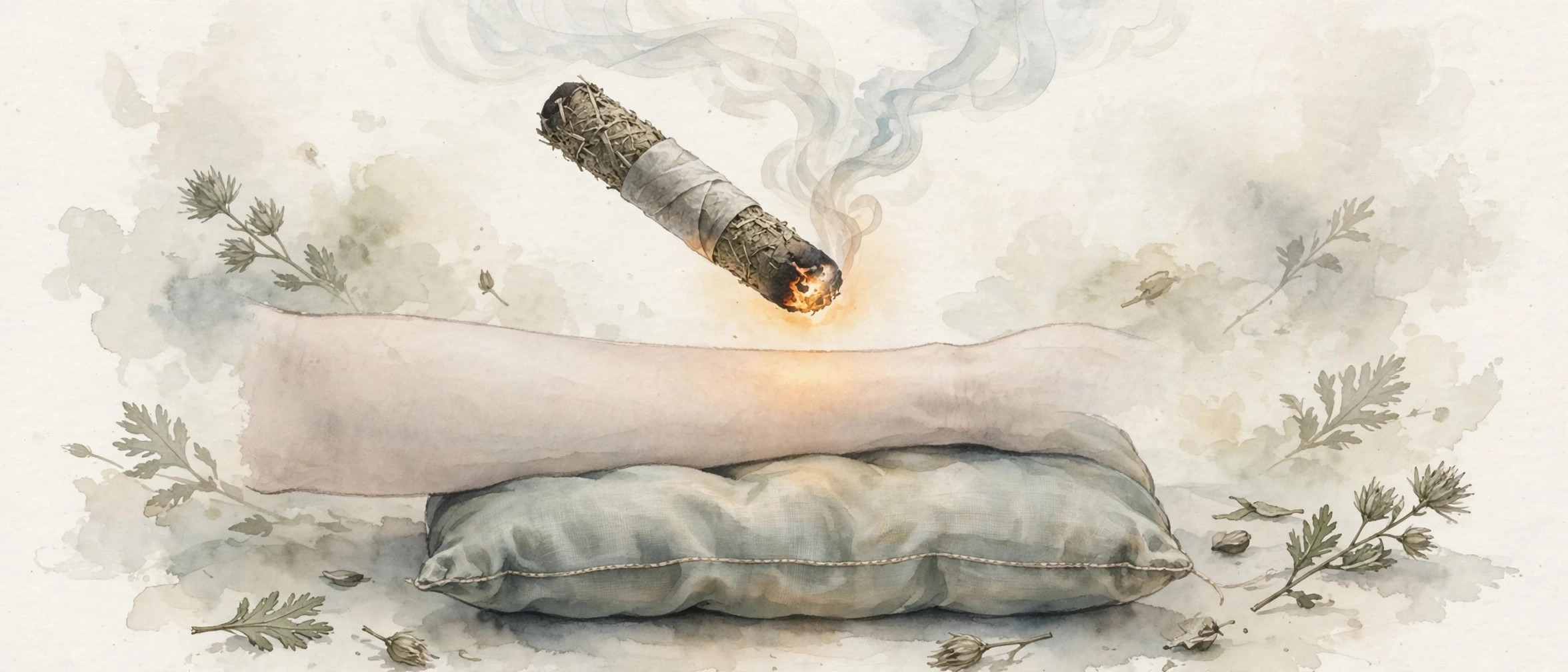
A small cone of dried herb smoulders on the skin, a thin ribbon of smoke curls upward, and the room fills with a warm, herbal smell. There is no needle, no touch — only heat, held close to the body. This is moxibustion, one of the oldest companions of acupuncture, and for many first-time visitors it is the most surprising part of a Chinese medicine clinic: a treatment that works by burning a plant.
This article introduces moxibustion for the curious modern reader. As with our companion pieces on tongue diagnosis, cupping, and pulse diagnosis, we keep the traditional framework and the modern evidence clearly separated, so you can see which is which — and we make no promises about what moxibustion can treat.
What Moxibustion Is
Moxibustion (ai jiu, 艾灿) is the practice of burning dried mugwort to warm the body. The herb is mugwort leaf, ai ye (艾叶), most often from Artemisia argyi, a plant in the daisy family that grows across East Asia. Dried and ground, the soft, woolly leaf becomes moxa — a fluffy, slow-burning material that can be rolled into sticks, pressed into cones, or packed loosely and lit like incense.
The idea is simple to state and old to the tradition: heat applied to specific points on the body warms what is cold, moves what is stuck, and supports what is weak. The Huangdi Neijing (黃帝內經, "Yellow Emperor's Inner Canon") treats needling and moxibustion as sister methods — one moving qi and blood with a needle, the other with warmth. If you are new to the classical framework, begin with our beginner's guide to the Huangdi Neijing.
Direct and Indirect: Two Ways to Apply the Heat
There are two broad ways moxibustion is done, and the difference matters for safety.
In direct moxibustion, a small cone of moxa is placed on the skin itself — sometimes on a thin slice of ginger or garlic, sometimes directly on the point — and lit. It burns down slowly and is removed before it reaches the skin, or, in an older and now uncommon style, allowed to burn until it leaves a small blister. The heat is intense, local, and brief.
In indirect moxibustion, the burning moxa never touches the skin. A lit moxa stick, like a fat cigar, is held a few centimetres above a point and moved slowly in circles; or moxa is fixed to the handle of an acupuncture needle so the heat travels down the needle; or a cone burns on a layer of salt, ginger, or a herbal cake laid over the skin. This is the form most visitors meet today, because the distance gives the practitioner control over the heat.
The choice between them is a practitioner's decision, made for a particular person and point — not a choice to experiment with at home.
What the Warmth Is For, in the Tradition
In traditional terms, moxibustion is a warming therapy, and it is used where the problem is described as cold or deficient. A cold pattern, in this language, is one marked by cold hands and feet, a dislike of cold weather, and pains that feel better with warmth and worse with cold. A deficiency of yang — the body's warming, active aspect — is described in similar terms: low energy, a pale complexion, loose stools, and a slow pulse. The Lingshu, the second part of the Huangdi Neijing, puts the division of labour plainly: where needling does not work, moxibustion may be appropriate.
The heat is applied to acupuncture points, the same network of points used in needling, and to particular regions — the lower abdomen, the navel, and the joints are common choices. The traditional claim is that warmth at these points restores the movement of qi and blood through the channels, disperses cold, and tonifies yang. Whether you accept that language or not, the picture it gives is consistent: moxibustion is not a general warming-up, like a hot-water bottle. It is heat aimed at a point, for a reason stated in the traditional system.
One use is so well known that it has crossed into Western obstetrics, and we return to it below: moxibustion at the point Zhiyin (BL67), on the little toe, has long been used in the tradition when a baby is in the breech position late in pregnancy.
What a Session Is Like
A moxibustion session is usually quieter than a first-time visitor expects. The practitioner chooses one or a few points, lights a moxa stick or cone, and holds or places the heat near the point. The sensation most people report is a slow, spreading warmth that deepens over a minute or two — not a sharp sting. The practitioner watches the skin and asks how the heat feels, moving the stick away or closer as needed, and each point is typically warmed for several minutes.
The smoke is part of the experience and worth knowing about in advance. Moxa smoke is fragrant, herbal, and persistent: it hangs in the air, settles on clothes, and fills a small room quickly. A good clinic ventilates well, and a visitor with asthma or a sensitivity to smoke should say so before the session begins.
The session usually ends with the practitioner checking the skin where the heat was applied. A little redness that fades within an hour is common after indirect moxibustion. A burn is not part of a normal session, and it should not be accepted as one.
What Modern Research Says
Here, as in the rest of this series, honesty matters most — and the picture is genuinely mixed.
The best-studied use of moxibustion is the breech presentation one. In a 1998 randomized trial published in the Journal of the American Medical Association, women with breech babies who received moxibustion at BL67 had a cephalic (head-down) presentation at 35 weeks in about 75% of cases, compared with about 48% in the control group. Later systematic reviews, including a Cochrane review, have been more cautious: moxibustion probably increases the chance of a head-down presentation, but the evidence is not conclusive, and it is studied as an addition to usual care, not as a replacement for it.
For other uses — pain, digestive complaints, fatigue, and the many conditions listed in traditional texts — the evidence is thinner. Small trials and reviews report positive results, but they are often small, short, and hard to compare with one another, and there is no strong, consistent body of evidence behind any single claim. The U.S. National Center for Complementary and Integrative Health (NCCIH) describes traditional Chinese medicine as a whole system whose individual practices have varying levels of evidence, and it advises readers to treat traditional diagnoses as part of a broader conversation about their health — not as a replacement for conventional medical evaluation.
There is also a separate question that has nothing to do with whether moxibustion works: the smoke. Moxa smoke contains fine particles, and the air in a poorly ventilated room during a session can be measurably smoky. That is a practical matter of ventilation and exposure, not a verdict on the therapy, but it is one reason sessions belong in a ventilated clinic rather than a closed room at home.
Safety: Who Should Be Careful
Moxibustion is heat applied to skin, and the main risk is the obvious one: burns. Direct moxibustion carries the highest risk, which is why it is rarely used today outside experienced hands. Anyone with reduced sensation in the skin — for example, from diabetes or nerve damage — is at greater risk, because they may not feel the heat building in time. The face, soft skin, and areas with thin skin are avoided, as are open wounds.
Extra caution applies in pregnancy, except for the breech use described above, which is done under supervision and with a plan for ordinary obstetric care alongside it. People with asthma or smoke sensitivity should discuss the smoke before a session, and anyone taking blood-thinning medication or with a bleeding tendency should mention it, since a burn would heal more slowly.
The clearest safety rule is also the simplest: moxibustion is a practitioner's treatment, not a home experiment. Moxa sticks are sold for home use, and the temptation to try a cone on a sore knee is understandable — but judging distance, duration, and skin response is the skill being paid for, and a burn from a home session is the most common way this gentle therapy causes real harm.
A Small Fire, Aimed with Care
Moxibustion is, at its simplest, a small fire aimed with care: dried mugwort, slow heat, a chosen point, a few minutes of warmth. Its traditional rationale — warming what is cold, moving what is stuck — is elaborate and internally consistent, recorded in texts more than two thousand years old. Whether it can do what its classical authors claimed is, for most uses, still an open question for modern research — with one well-studied exception that remains promising rather than proven. Like tongue diagnosis, cupping, and pulse diagnosis, it is best understood first as a tradition of careful observation, and only then judged by what modern evidence can and cannot confirm.
References
- Huangdi Neijing (黃帝內經, "Yellow Emperor's Inner Canon"), Suwen and Lingshu — classical source for the pairing of needling and moxibustion.
- Cardini F, Weixin H. Moxibustion for correction of breech presentation: a randomized controlled trial. Journal of the American Medical Association, 1998;280(18):1580–1584.
- National Center for Complementary and Integrative Health (NCCIH) — "Traditional Chinese Medicine: What You Need To Know" — https://www.nccih.nih.gov/health/traditional-chinese-medicine-what-you-need-to-know
If these ideas resonate, Huangdi Neijing: A Modern Introduction explains the classical foundations behind practices like moxibustion in clear, beginner-friendly language (Huangdi Neijing: A Modern Introduction).