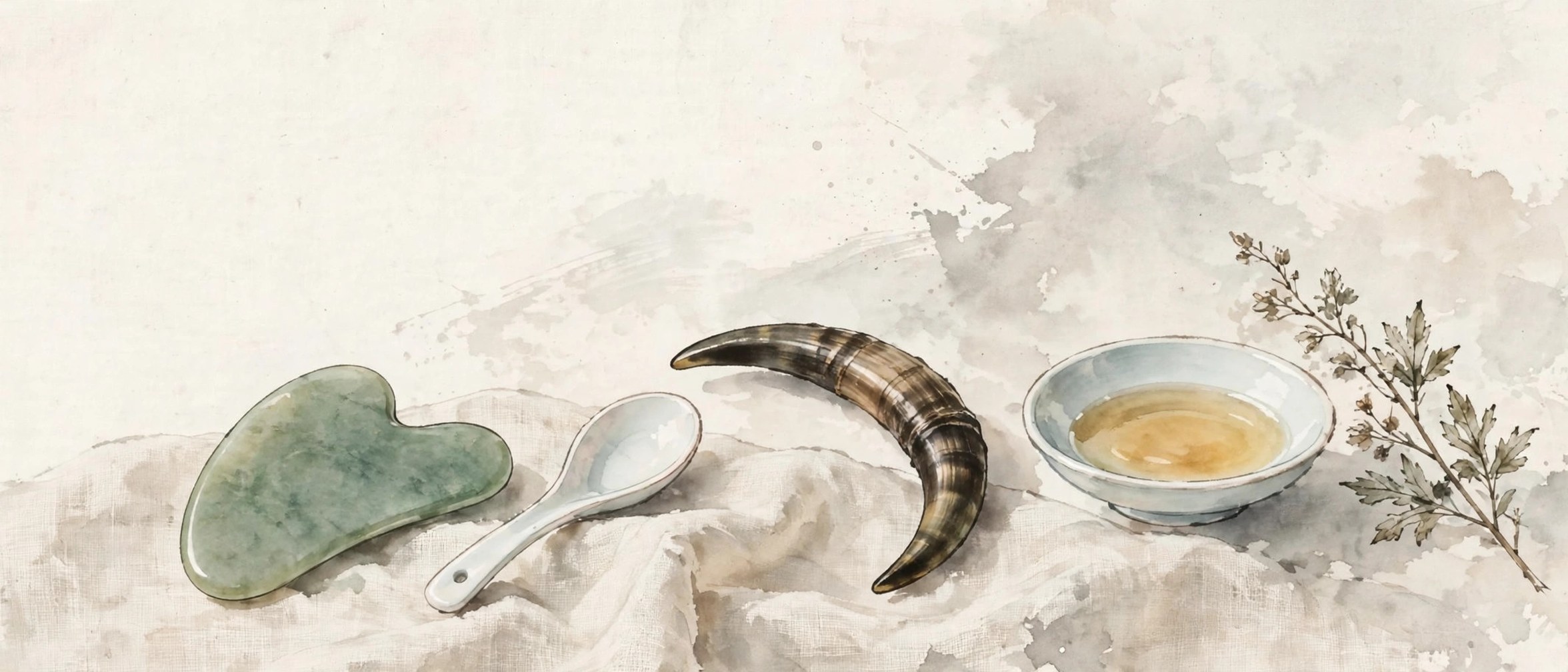
The practitioner picks up something that looks like it belongs in a kitchen drawer: a ceramic spoon, a coin, a smooth piece of jade. She rubs oil onto the patient's back, then draws the edge of the tool across the skin in long, firm strokes, always in the same direction. After a few passes, red marks bloom along the path of the strokes — small red and purple spots, as if a rash were rising exactly where the tool has been. The patient, face down on the table, says the tightness in his shoulders is easing.
What you are looking at is gua sha (刮痧), one of the oldest hands-on techniques in Chinese medicine — and also one of the most misunderstood, because the marks look alarming and because the same name now covers two very different things: a firm body treatment that is meant to leave marks, and a gentle facial routine sold as a beauty tool. As with our companion pieces on tongue diagnosis, cupping, pulse diagnosis, moxibustion, and herbal formulas, we keep the traditional framework and the modern evidence clearly separated — and we make no promises about what gua sha can treat.
What Gua Sha Is
The name tells you most of what you need to know. Gua (刮) means "to scrape," and sha (痧) is the word for the marks the scraping raises: tiny red or purple spots, known in medicine as petechiae, where small blood vessels under the skin have released a little blood into the tissue. In English the practice is also called scraping therapy, coining, or spooning — the last two after the tools most often used — and in Vietnam it is known as cao gio.
In the traditional explanation, gua sha moves what is stuck. When wind, cold, or heat invade the body, or when overwork and tension accumulate, the tradition says that qi and blood stagnate — they stop flowing freely — and the result is pain, stiffness, fever, or fatigue. Scraping the surface is meant to release that stagnation and let the flow resume. The marks are not a side effect to be avoided; they are the point of the treatment.
That is the traditional account. The modern account is simpler: the pressure and friction increase blood flow near the surface, and the marks are blood that has escaped from tiny capillaries under mechanical stress. Whether that explains any relief people feel is a separate question, and it is one we come back to below.
A Short History: From Stones to the Bathroom Shelf
Scraping the skin to relieve pain is older than Chinese medicine itself. Stone scrapers used for pain relief in China go back to the Stone Age, when sharpened stones — later called bian shi (砭石) — were pressed and scraped against the body. For most of its history, gua sha was a folk and family remedy, done at home with whatever smooth object was at hand.
Its formal place in the tradition took shape during the Ming dynasty (1368–1644), when medical texts began to document sha syndromes — conditions believed to arise when environmental factors such as wind or cold lodged in the body — and the scraping technique used to treat them. From China the practice spread across East and Southeast Asia, adapting to local tools and names wherever it went, and it travelled with Chinese communities around the world.
The newest chapter is the one most readers will know first. Around 2018 to 2020, gua sha exploded on social media as a facial beauty routine, with jade and rose quartz tools sold alongside promises of a sculpted jawline. That version is real, and it is popular — but it is a recent and much gentler cousin of the body treatment, and the two should not be confused.
Tools and Technique: What a Session Looks Like
A body session is straightforward, and its simplicity is part of its history: no machine, no needle, no drug. The practitioner first applies oil or balm to the skin, so the tool glides instead of dragging. Then, holding a smooth-edged tool at an angle, she makes long strokes in a single direction, following the lines of the muscles or the channels of the body, usually on the back, neck, shoulders, or limbs. Each stroke covers four to six inches, and the same area is stroked repeatedly until the marks appear.
The tools themselves vary by place and pocket. Traditional choices include ceramic spoons, coins, water buffalo horn, and jade; modern practitioners often use shaped stainless steel instruments, which are easier to clean. What matters is the edge: smooth, blunt, and unbroken, so it presses without cutting. A session typically lasts twenty to forty-five minutes. Most people describe the feeling as intense rather than painful, something like a deep-tissue massage with an edge to it, and some feel tender or tired for a day afterwards.
It is worth noting what gua sha shares with cupping, the subject of an earlier piece in this series. Both are traditional techniques aimed at stagnation, both leave visible marks, and both are often used for the same complaints — a stiff neck, a tight back, the aftermath of a cold. The difference is the mechanism: cupping pulls the skin upward with suction, while gua sha presses and scrapes across it.
Reading the Marks
To a first-time observer, the marks are the hardest part of gua sha to accept. A back striped with red and purple spots looks injured. It is important to be precise about what the marks are and what they are not. They are petechiae and small bruise-like patches — blood cells that have leaked from capillaries into the tissue just under the skin — not bruises from a blow. There is no impact, and no damage to the muscle beneath. The marks usually fade in three to seven days, and the skin returns to normal.
In the traditional reading, the marks are also diagnostic: darker, more extensive sha is read as more stagnation released. That reading should be treated with caution — there is no clinical evidence linking how dark the marks are to how much a person improves. What the marks reliably show is where the tool has been and how firmly it was used.
One practical consequence deserves emphasis. The marks can be mistaken for signs of physical abuse — by a teacher, a doctor, or a social worker who has never seen gua sha. Clinicians in areas with large East and Southeast Asian populations encounter this regularly. Anyone who has had body gua sha, and especially parents who use it on a child, should be ready to explain what the marks are, and it is sensible to tell a family doctor beforehand.
Body and Face: Two Practices, One Name
Here the confusion is greatest, so the distinction is worth stating plainly. Body gua sha is firm, deliberate, and meant to raise marks. Facial gua sha is light, slow, and meant to leave no marks at all: a flat stone or metal tool glided over oiled skin with gentle pressure, usually outward and upward across the jaw, cheekbones, and neck.
The facial version can plausibly do a few small things: the gliding may briefly increase local blood flow, relax tight facial muscles, and move a little fluid out of puffy tissue — which is why people often look slightly less puffy for a few hours afterwards. What it has not been shown to do is the list that sells the tools: melt fat, move bone, build collagen, or permanently change the shape of a face. No study of body gua sha for back or neck pain says anything about whether a ten-minute facial routine sharpens a jawline.
None of this makes the facial routine useless. A gentle daily massage that relaxes the jaw and feels pleasant is a reasonable thing to do, and it is far safer than the body treatment. It only becomes a problem when it is sold as a substitute for the things it cannot do.
What Modern Research Says
Here, as in the rest of this series, the honest answer is mixed — and the evidence is much thinner than the popularity.
The best-documented effect is also the least surprising: gua sha increases blood flow where it is applied. In a small pilot study in 2007, Arya Nielsen and colleagues measured surface microcirculation in eleven healthy volunteers with laser imaging, and found that blood flow at the treated spot rose about fourfold for the first seven and a half minutes, and stayed significantly raised for the full twenty-five minutes of the study. That is a real, measurable change — but the study had no control group and eleven people. It shows that something happens locally; it does not show that the change heals anything.
The strongest clinical trial is a German study from 2011. Braun and colleagues randomised forty-eight outpatients with chronic neck pain to a single gua sha session or a local heat pad, and followed them for seven days. After one week, the gua sha group reported significantly less neck pain — about 30 millimetres better on a 100-millimetre pain scale — and better movement and quality of life. The result is genuine, and it is also narrow: one session, one condition, an open-label design, and a follow-up of a single week. The authors themselves concluded that the long-term value of gua sha for neck pain remains to be clarified.
When the wider evidence is gathered, the picture thins further. A systematic review and meta-analysis of seventy-five randomised trials of traditional Chinese medicine for neck and low back pain, published in 2015, found that gua sha showed only fair effects and that no definite conclusions could be drawn. Laboratory work adds a possible mechanism rather than proof: a study in mice found that gua sha raised levels of heme oxygenase-1, an enzyme involved in the body's anti-inflammatory response — interesting biology, in animals, and a long way from a proven treatment in people.
For the broader claims made on behalf of gua sha — that it treats colds, infections, or digestive problems, or detoxifies the body — there is no good evidence at all. That does not mean people who feel better after a session are imagining it; pain and stiffness are real, and a treatment can relieve symptoms without its traditional explanation being correct. It means the claims should be kept to the size of the evidence: some short-term relief of muscle pain is plausible and has modest support; the rest is tradition, not proof.
Safety: Who Should Be Careful
For most healthy adults, body gua sha is a low-risk procedure with predictable, short-lived effects: soreness, tenderness, and sometimes fatigue the next day, and marks that take up to a week to fade. The cautions matter more than the reassurance, because the technique deliberately breaks small blood vessels.
Anyone who takes blood-thinning medication, or who has a bleeding disorder or low platelets, should skip body gua sha or ask a doctor first. It should not be done over broken skin, rashes, moles, varicose veins, or recent injuries and surgical sites, and people with diabetes or poor circulation should be cautious, since their skin heals more slowly. In the tradition, the abdomen and lower back are avoided during pregnancy. Children can be treated, but only very gently, and the marks they may carry to school are worth thinking about before the session, not after.
Rare serious complications have been reported in case reports, including severe bleeding and injuries requiring treatment. They are rare, and case reports cannot say how often they happen, but they are a reminder that "natural" and "harmless" are not the same word. Clean tools matter too: the edge should be smooth and undamaged, and a tool used on broken skin should be cleaned or set aside. And as with herbal formulas, the simplest safety rule is to tell your doctor about it — especially if you take prescription medicines or have a condition that affects bleeding or healing.
A Tool, Not a Cure-All
Gua sha is, at its simplest, a stone's edge drawn across oiled skin — a technique old enough to predate the medical texts that describe it, simple enough to have been a home remedy for centuries, and now new enough to be sold as a beauty tool in a rose quartz box. The modern evidence supports a smaller story than the classical one: blood flow rises where the tool passes, one good trial found a week of relief for chronic neck pain, and the wider evidence is too thin for definite conclusions.
Like tongue diagnosis, cupping, pulse diagnosis, moxibustion, and herbal formulas, gua sha is best understood first as a tradition of careful observation, and only then judged by what modern evidence can and cannot confirm. If you are curious, try it with a trained practitioner, with your eyes open — knowing what the marks are, what they are not, and what the treatment can and cannot promise.
References
- Braun M, Schwickert M, Nielsen A, Brunnhuber S, Dobos G, Musial F, Lüdtke R, Michalsen A. Effectiveness of traditional Chinese "Gua Sha" therapy in patients with chronic neck pain: a randomized controlled trial. Pain Medicine. 2011;12(3):362–369.
- Nielsen A, Knoblauch NTM, Dobos GJ, Michalsen A, Kaptchuk TJ. The effect of Gua Sha treatment on the microcirculation of surface tissue: a pilot study in healthy subjects. Explore (NY). 2007;3(5):456–466.
- Yuan Q-l, Guo T-m, Liu L, Sun F, Zhang Y-g. Traditional Chinese Medicine for neck pain and low back pain: a systematic review and meta-analysis. PLoS ONE. 2015;10(2):e0117146.
- Kwong KK, et al. Bioluminescence imaging of heme oxygenase-1 upregulation in the Gua Sha procedure. Journal of Visualized Experiments. 2009;(30):e1385.
- National Center for Complementary and Integrative Health (NCCIH) — "Traditional Chinese Medicine: What You Need To Know" — https://www.nccih.nih.gov/health/traditional-chinese-medicine-what-you-need-to-know
If these ideas resonate, Huangdi Neijing: A Modern Introduction explains the classical foundations behind practices like gua sha in clear, beginner-friendly language (Huangdi Neijing: A Modern Introduction).