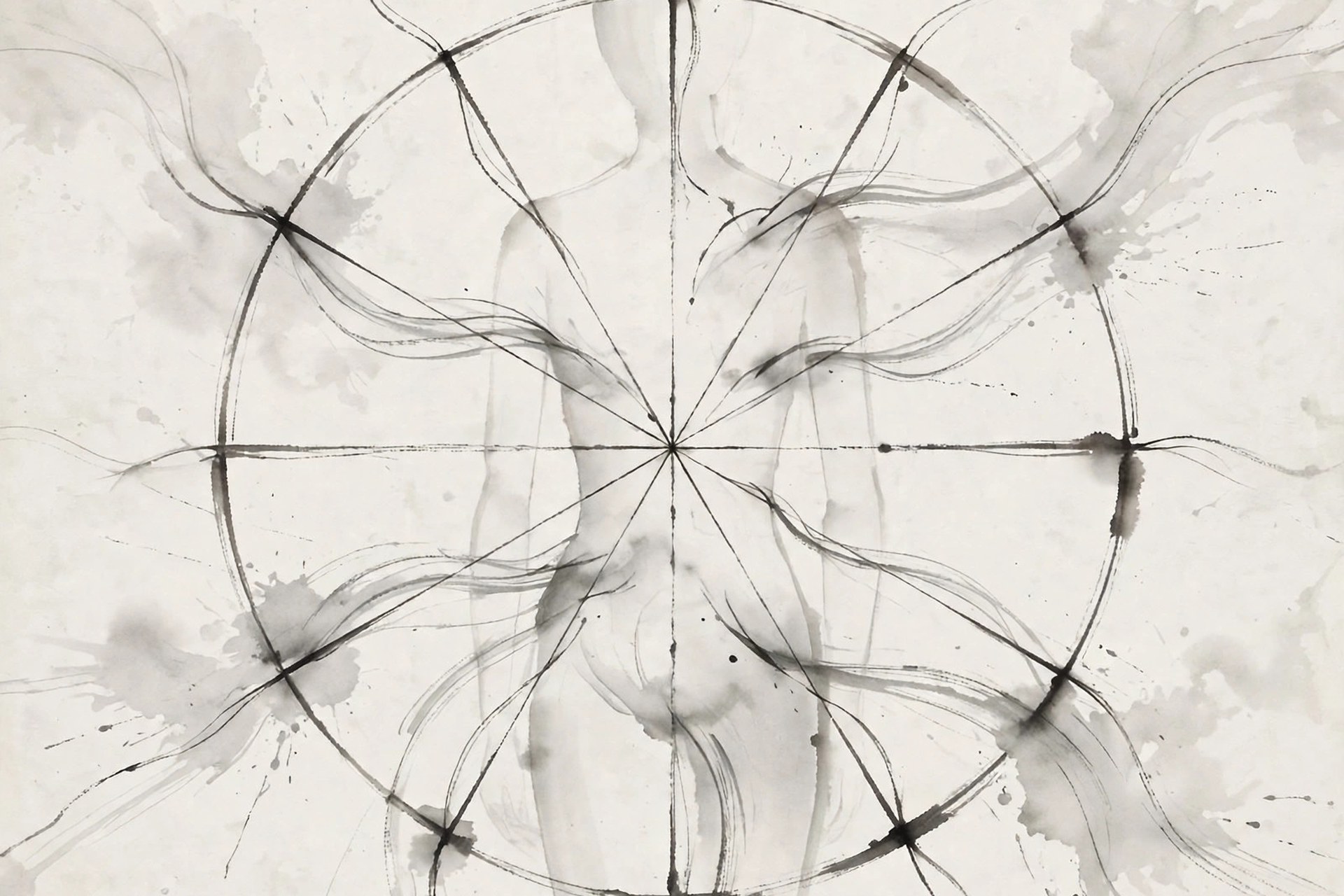
There is an old Chinese saying that the wise live with the sun: up with the light, at rest with the dark. Behind that simple advice lies an elaborate traditional map — the 子午流注 (zǐwǔ liúzhù), usually translated as the "midnight-noon ebb and flow." In the West it is better known as the Chinese organ clock, or Chinese body clock.
The idea is striking: over each 24-hour day, qi (气) — the body's motive energy — flows through twelve meridians in turn, spending about two hours in each. Every two-hour window is therefore linked to a particular organ system, and each window is traditionally considered the best time for certain activities and the worst time for others. This article walks you through the clock, explains what it suggests for daily life, and compares it honestly with what modern science says about daily rhythms.
What the Organ Clock Claims
In classical Chinese medicine, qi circulates through a network of meridians (经络 jīngluò), or channels, that connect the surface of the body with the internal organs. If you would like the fuller picture of how this circulation is imagined, the guide to how qi flows through the body explains it step by step.
The organ clock adds a timetable to that map. Just as the blood in modern physiology is always somewhere, qi in the classical model is always somewhere too — and its location changes with the hour. When qi is "visiting" an organ's meridian, that organ's functions are thought to be at their peak, and the organ is also thought to be at rest from its other duties, best left undisturbed.
A few honest caveats before we go further. This is a traditional framework, not a laboratory finding. It was developed over centuries of observation and reasoning within a medical system that understood the body very differently from modern anatomy. It is best approached as a cultural map of daily rhythm — interesting, sometimes surprisingly resonant, but not a diagnostic instrument. Waking up at 3 a.m. does not diagnose your Liver; it usually means you are a light sleeper, or had coffee too late.
The Twelve Periods at a Glance
Here is the full clock, with each period's traditional associations described in plain terms:
| Time | Organ | Traditional note | |---|---|---| | 11 p.m.–1 a.m. | Gallbladder (胆 dǎn) | Deep rest begins; the time to be asleep, when decision-making energy is restored | | 1–3 a.m. | Liver (肝 gān) | The deepest sleep; blood is said to return to the Liver to be "stored" and cleansed | | 3–5 a.m. | Lung (肺 fèi) | The hour of early waking; breathing and fresh air; grief is said to surface here | | 5–7 a.m. | Large Intestine (大肠 dàcháng) | Elimination; the body's natural time to empty the bowels | | 7–9 a.m. | Stomach (胃 wèi) | Breakfast time; digestion is considered strongest | | 9–11 a.m. | Spleen (脾 pí) | Peak clarity; the best window for focused work and study | | 11 a.m.–1 p.m. | Heart (心 xīn) | Midday high point; a short rest or calm lunch is advised | | 1–3 p.m. | Small Intestine (小肠 xiǎocháng) | Sorting the useful from the waste — of lunch, and of the morning's ideas | | 3–5 p.m. | Bladder (膀胱 pángguāng) | Afternoon energy returns; a good time for activity and water | | 5–7 p.m. | Kidney (肾 shèn) | Energy reserves; a light, early dinner suits this window | | 7–9 p.m. | Pericardium (心包 xīnbāo) | Winding down; good company and gentle enjoyment | | 9–11 p.m. | Triple Burner (三焦 sānjiāo) | Preparing for sleep; the body's systems settle into balance |
The Triple Burner deserves a footnote, since it has no Western anatomical counterpart. It is best understood as a functional system — the coordination of water metabolism and the three "burning spaces" of the torso (upper, middle, lower). In the clock, its evening window is simply the time when the whole system powers down together.
What the Clock Suggests for Daily Life
You do not need to memorize all twelve periods. Most traditional teachers emphasize just a few practical takeaways:
Be asleep by 11 p.m. This is the clock's single most repeated piece of advice. The Gallbladder and Liver windows (11 p.m.–3 a.m.) are considered the core of restorative rest — the hours when the body does its quiet maintenance. Staying up past midnight is traditionally seen as borrowing against tomorrow's energy.
Eat breakfast between 7 and 9 a.m. The Stomach window is when appetite and digestive strength are said to peak. Even a modest breakfast — congee, oatmeal, eggs, fruit — is considered better timed here than a large meal eaten late at night. If you routinely skip breakfast and feel sluggish by mid-morning, the clock would nod knowingly.
Protect the 9–11 a.m. window for important work. With digestion handled by the Spleen in this model, the mind is considered clearest late in the morning. Schedule demanding tasks here when you can, and save routine chores for the afternoon dip.
Take midday seriously. The Heart's window (11 a.m.–1 p.m.) traditionally calls for a calm lunch and, in the old Chinese custom, a short rest — the famous midday nap, or at least twenty quiet minutes. Even in a busy schedule, stepping away from the screen at noon is a small bow to this idea.
Wind down between 9 and 11 p.m. The Triple Burner window is for settling: dim the lights, put the day's problems down, and let sleep arrive on its own. Scrolling through alarming news at 10:30 p.m. is, in the clock's terms, asking the whole system to stay on duty past closing time.
These suggestions overlap closely with the classical ideal of preventing illness before it starts — small, well-timed habits that keep the body's daily cycle smooth.
A Modern Perspective: Circadian Rhythms
Modern biology has its own 24-hour map: the circadian system. Nearly every cell in the body keeps time, coordinated by a master clock in the brain that responds to light and darkness. Cortisol, the alertness hormone, typically peaks in the early morning; melatonin, the sleep signal, rises after dark; core body temperature, blood pressure, and digestive activity all follow daily curves. Disrupting these rhythms — through night shifts, jet lag, or chronic late nights — is associated with poorer sleep, metabolic strain, and lower mood.
The resonance with the organ clock is easy to see. Both systems say: sleep at night, eat in the morning, rest at midday, wind down in the evening. Some specific parallels are striking — for instance, the liver's metabolic and detoxification activity genuinely peaks during the night in modern chronobiology, much as the classical Liver window (1–3 a.m.) suggests.
But resonance is not equivalence, and honesty requires saying so. The organ clock assigns functions to meridians and organs in ways that do not map onto modern anatomy — the Spleen's role in digestion, for example, has no counterpart in Western physiology. The clock was built by correlating symptoms, times of day, and philosophical reasoning, not by controlled experiment. It is best understood as a prescientific attempt to describe something real — the body's daily tides — in the language its authors had.
Holding both views is not a contradiction. The modern view explains *mechanisms*: hormones, clock genes, light receptors. The traditional view offers *a way of living with* those rhythms: a memorable timetable that turns abstract biology into concrete habits. Many people find the clock useful precisely because it is vivid — "be asleep by 11" is easier to remember than a paragraph about melatonin onset.
This day-night rhythm also echoes the deeper pattern of yin and yang in daily life: activity by day, rest by night, each phase completing the other.
How to Try This: A One-Week Experiment
Treat the clock as a gentle experiment, not a rulebook. For one week, try aligning three anchors with the traditional timetable:
1. Set a sleep window. Aim to be in bed by 10:30 p.m. so that sleep arrives before the 11 p.m. Gallbladder window. Keep the room dark and cool. Note how you feel at 7 a.m. — not on day one, but by day five. 2. Eat breakfast in the Stomach window. Have something real between 7 and 9 a.m., even if it is small. If you currently skip breakfast, this is the single change most worth testing. 3. Create a 9–11 p.m. wind-down. Dim the lights, set the phone aside, and do something low-stimulation — reading, stretching, a warm drink. Observe whether sleep comes more easily.
Keep a few lines of notes each evening: bedtime, wake time, energy at 10 a.m. and 3 p.m., mood. After a week, look at the pattern. Some people find the rhythm suits them remarkably well; others find their own chronotype differs — night owls exist in every culture, and the clock is a traditional average, not a personal prescription.
One important boundary: the organ clock is not a diagnostic tool. If you regularly wake at 3 a.m., the most useful explanations are ordinary ones — stress, caffeine, alcohol, a snoring partner, sleep apnea. Use the clock to shape habits, and see a clinician for persistent symptoms.
A book for your shelf: The organ clock is one small chapter of a much larger medical classic. *Huangdi Neijing: A Modern Introduction* tells the story of the text where ideas like the daily cycle of qi first appeared, in plain English for the modern reader.
*This article is for general wellness education and is not medical advice.*