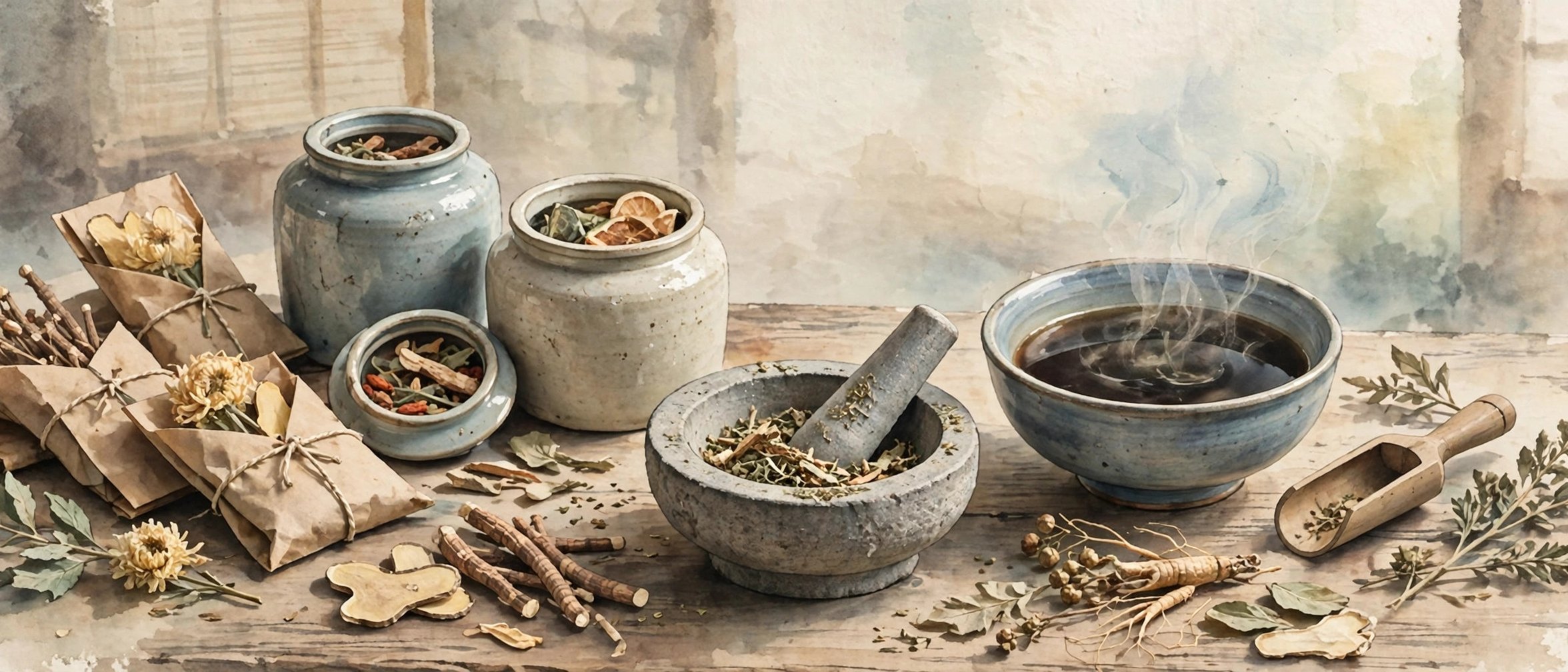
A practitioner writes down a prescription, and it lists not one herb but ten. One herb to open the sweat, one to ease the cough, one to protect the stomach from the first two, one to carry the whole mixture where it needs to go. To a modern reader it looks like a crowded recipe. To the tradition, it is a team with assigned roles — and the assignment of those roles, worked out more than two thousand years ago, is called jun, chen, zuo, shi: sovereign, minister, assistant, and courier.
This article introduces the Chinese herbal formula for the curious modern reader. As with our companion pieces on tongue diagnosis, cupping, pulse diagnosis, and moxibustion, we keep the traditional framework and the modern evidence clearly separated — and we make no promises about what any formula can treat.
What a Formula Is
A formula (fangji, 方剂) is a combination of herbs prescribed together for a particular pattern, rather than a single herb taken on its own. The classic form is a decoction (tangji, 汤剂): the herbs are boiled together in water and the liquid is drunk warm. The same combination can also be made into pills, powders, or granules, but the decoction is the oldest form, and the one the classical texts describe.
A formula is built after diagnosis, not before it. The practitioner first decides what pattern is present — in the traditional language, whether the problem is described as wind-cold or wind-heat, excess or deficiency — and only then chooses the herbs. Two people with the same modern disease name can receive different formulas, and the same person can receive a different formula a week later, because the pattern has changed. Formulas are answers to a diagnosis, not fixed recipes for a disease.
The Four Roles: Jun, Chen, Zuo, Shi
The principle that organises every formula is jun, chen, zuo, shi (君臣佐使). The words are borrowed from the organisation of an imperial court — sovereign, minister, assistant, courier — and the earliest statement of the idea is in the Huangdi Neijing (Yellow Emperor's Inner Canon): "The herb that treats the main disease is called the sovereign; the herb that assists the sovereign is called the minister; the herb that responds to the minister is called the courier." The Shennong Bencao Jing (Divine Husbandman's Classic of Materia Medica) puts it as a rule: "In using medicinals, one must combine sovereign, minister, assistant, and courier."
The sovereign (jun, 君) is the herb that acts on the main pattern. It is the one the formula cannot do without, and it is usually given in the largest dose. The physician Li Dongyuan, writing in the thirteenth century, stated the hierarchy plainly: the sovereign is given the most, the minister less, and the assistant and courier less still — and the minister must never outweigh the sovereign. The minister (chen, 臣) supports the sovereign, either by strengthening its action on the main pattern or by treating a secondary pattern at the same time.
The assistant (zuo, 佐) has three jobs: to help with a secondary symptom, to restrain the harshness or toxicity of a strong herb, or — the most interesting case — to act as a "reverse assistant," a small amount of an herb with the opposite nature that, paradoxically, helps the sovereign work. The courier (shi, 使) guides the formula to a particular channel or part of the body, or harmonises all the ingredients. The classic guiding herbs are jiegeng (Platycodon root), said to carry a formula upward, and niuxi (Achyranthes root), said to lead it downward; gancao (liquorice root) is the herb most often used to harmonise a formula.
A Worked Example: Mahuang Tang
The clearest way to see the four roles is to walk through a formula. Mahuang Tang (麻黄汤, Ephedra Decoction) comes from Zhang Zhongjing's Shanghan Lun (Treatise on Cold Damage, around 200 CE) and is one of the most studied formulas in the tradition. It is prescribed, in the classical description, for a wind-cold attack on the surface of the body: fever, headache, aching body, no sweating, and wheezing — the picture of a strong person struck by cold, with the pores closed tight. It has just four herbs, and their roles are the standard teaching example.
Mahuang (麻黄, Ephedra herb) is the sovereign. It opens the pores and drives out sweat, which is the main action the pattern calls for, and it eases the wheezing. It is given the largest dose. Guizhi (桂枝, cinnamon twig) is the minister: it warms the surface, helps the sovereign produce sweat, and eases the muscle aches. Xingren (杏仁, apricot kernel) is the assistant: it brings the lung qi downward and stops the cough and wheezing, while restraining the sovereign's strong upward, dispersing push. Zhigancao (炙甘草, honey-fried liquorice root) is the courier: it harmonises the other three and moderates the harshness of the ephedra.
One honest complication is worth stating. Classical commentators do not all assign the roles in exactly the same way: some group the apricot kernel and the liquorice together as assistant-and-courier. The roles describe what an herb does in the formula, and different readers of the same formula can reasonably disagree at the edges. That disagreement is itself part of the teaching — the labels follow the function, not the other way round. A second example shows the same pattern in a gentler formula: in Guizhi Tang, for a weaker, sweating presentation of the same wind-cold attack, the cinnamon twig is the sovereign and the peony root the minister. Same four roles, different balance — because the pattern is different.
Formulas Are Adjusted, Not Fixed
A classical formula is a starting pattern, not a finished product. Practitioners adjust it — adding herbs, removing them, changing the doses — as the patient's pattern changes. The technical word for this is jiajian (加减, adding and subtracting). Mahuang Tang without the cinnamon twig, with gypsum added and the ephedra dose increased, becomes a different formula, Maxing Shigan Tang, for a presentation with sweating and heat rather than no sweating and cold. The same herbs, rebalanced, answer a different question.
This is also why the tradition insists that formulas are matched to the person, the season, and the place. A formula that suits a strong young adult in winter may be too harsh for an older person, or for the same person in summer. The prescription is written for a moment in a particular life, and it is expected to change — a team reshuffled when the task changes, not a recipe that fails if an ingredient is left out.
What Modern Research Says
Here, as in the rest of this series, honesty matters most — and the picture is genuinely mixed.
The hardest problem for modern research is that a formula is many active compounds at once. A single herb may contain dozens of constituents, and a ten-herb formula contains hundreds, interacting with one another and with the body in ways a trial of one compound cannot capture. Researchers have responded with a field called network pharmacology, which maps the many compounds of a formula against the many targets they may act on. It is promising work, and it is still young: a network map is a hypothesis about how a formula might work, not proof that it does.
Clinical trials of whole formulas face the same difficulty. Blinding a decoction is hard — it has a distinctive taste and smell — and standardising a formula whose doses a practitioner adjusts visit by visit is harder still. Systematic reviews of Chinese herbal medicine for specific conditions have reached mixed conclusions: some find modest benefits, others find the trials too small, too short, or too different from one another to combine. There is no strong, consistent body of evidence behind any single formula comparable to the evidence behind a standard pharmaceutical drug.
There is also a separate, well-established success story that is worth getting right. Artemisinin, the antimalarial drug that won Tu Youyou the Nobel Prize in 2015, was developed from qinghao (sweet wormwood), a herb long recorded in Chinese texts. That shows that traditional herbal knowledge can lead to a mainstream drug — but it is a story about isolating a single active compound, not about proving a whole formula. The two claims should not be confused.
Safety: Who Should Be Careful
Because a formula is many active substances at once, its safety questions are also many — and some of them are serious. Mahuang (ephedra) contains ephedrine, which raises heart rate and blood pressure; ephedra supplements have been restricted or banned in several countries after reports of heart attacks and strokes. Gancao (liquorice) contains glycyrrhizin, which in large amounts or over a long time can raise blood pressure and lower blood potassium. Herbs containing aristolochic acid, once used in some formulas, damage the kidneys and are now banned in many countries. These are not theoretical concerns; they are the reason formulas belong in trained hands.
Interactions matter as much as single herbs. Herbal formulas can change how prescription drugs work — strengthening or weakening blood thinners, blood-pressure drugs, and diabetes drugs — and a formula that is safe on its own can become unsafe in combination. Quality is a further question: herbs can be misidentified, adulterated, or contaminated with heavy metals or pesticides, which is why sourcing from a regulated supplier matters. The clearest safety rule is also the simplest: a formula is a practitioner's prescription, not a home experiment. Anyone considering a herbal formula should tell their doctor about it, especially if they take prescription medicines, are pregnant, or have liver or kidney disease.
A Team, Not a Pile
A Chinese herbal formula is, at its simplest, a small team with assigned jobs: a sovereign that sets the direction, a minister that backs it, an assistant that keeps it safe and covers what the others miss, and a courier that makes sure it arrives where it is needed. Its classical rationale — recorded in texts more than two thousand years old and refined by generations of physicians — is elaborate and internally consistent. Whether any given formula does what its classical authors claimed is, for most uses, still an open question for modern research, and the honest answer varies from formula to formula. Like tongue diagnosis, cupping, pulse diagnosis, and moxibustion, it is best understood first as a tradition of careful observation, and only then judged by what modern evidence can and cannot confirm.
References
- Huangdi Neijing (黄帝内经, "Yellow Emperor's Inner Canon"), Suwen, "Zhi Zhen Yao Da Lun" — classical source for "the herb that treats the main disease is called the sovereign; the herb that assists the sovereign is called the minister; the herb that responds to the minister is called the courier."
- Shennong Bencao Jing (神农本草经, "Divine Husbandman's Classic of Materia Medica") — "In using medicinals, one must combine sovereign, minister, assistant, and courier."
- Zhang Zhongjing, Shanghan Lun (伤寒论, "Treatise on Cold Damage") — Mahuang Tang and Guizhi Tang, the worked examples in this article.
- Li Dongyuan, Pi Wei Lun (脾胃论) — on the dose hierarchy: the sovereign is given the most, the minister less, and the assistant less still.
- National Center for Complementary and Integrative Health (NCCIH) — "Traditional Chinese Medicine: What You Need To Know" — https://www.nccih.nih.gov/health/traditional-chinese-medicine-what-you-need-to-know
If these ideas resonate, Huangdi Neijing: A Modern Introduction explains the classical foundations behind practices like herbal formulas in clear, beginner-friendly language (Huangdi Neijing: A Modern Introduction).