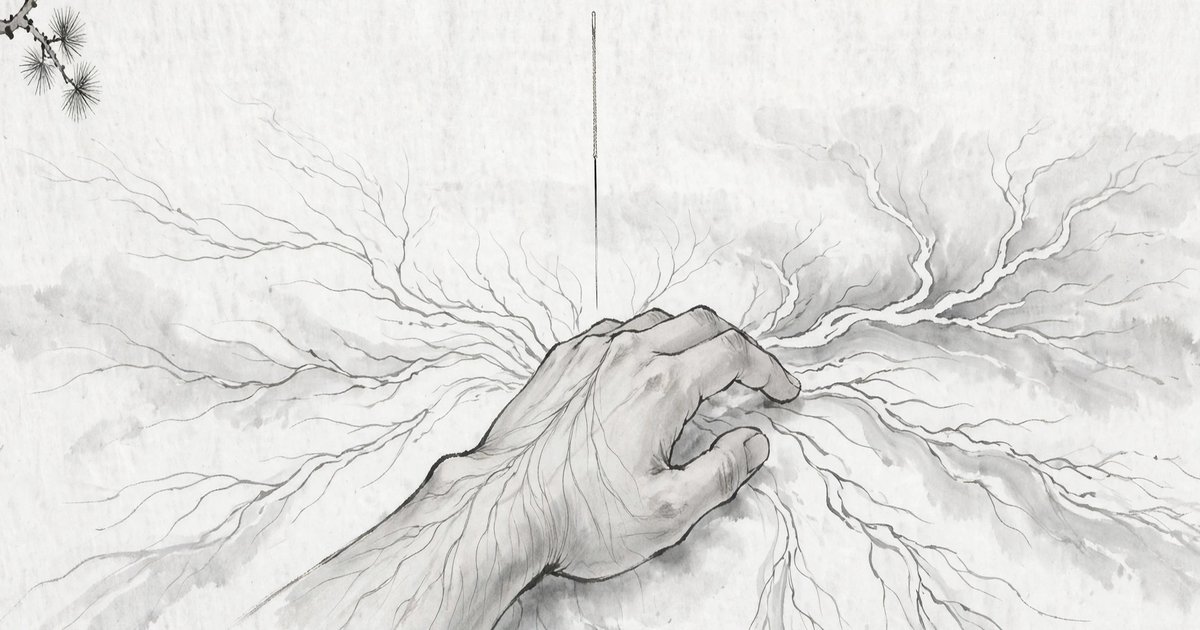
When a nerve is crushed or severed in an accident, the repair job falls partly to the body's own slow machinery. Traumatic peripheral nerve injury accounts for 1.5 to 4 percent of all new trauma cases worldwide — roughly 13 to 23 cases per 100,000 people each year in developed countries. Surgery and rehabilitation help, but nerves regenerate at a glacial pace, and incomplete recovery is common.
A new meta-analysis, published in Frontiers in Neurology this month, asks whether acupuncture — used as an add-on to standard care — can speed that recovery. The authors pooled 36 randomized controlled trials involving 2,798 patients and found improvements on every outcome they measured. And then, in their own conclusion, they declined to call the question settled.
That gap — between strong-looking numbers and a cautious conclusion — is exactly what makes this paper worth reading. It is a guided tour of how evidence earns, and fails to earn, our trust.
What the Researchers Did
The team, led by Wanjia Jia at the First Affiliated Hospital of Henan University of Chinese Medicine, ran this as a textbook systematic review. They pre-registered the protocol (PROSPERO CRD420251168215), followed the PRISMA 2020 reporting standards, and searched eight databases — four Chinese, four international — from inception through October 2025. Two reviewers screened and extracted independently, following Cochrane methods. For meta-analysis nerds, this is the machinery you want to see running.
The 36 eligible trials covered brachial plexus injuries, radial and median nerve damage, sciatic nerve injury, and common peroneal nerve palsy. The interventions included manual acupuncture, electroacupuncture, warm needling, and acupoint injection; control groups received medication, rehabilitation training, physical therapy, or biofeedback. The primary outcome was the clinical effective rate; secondary outcomes included neurological function scores and — unusually for acupuncture reviews — objective electrophysiological measures: distal motor latency, compound muscle action potential, and sensory nerve conduction velocity.
What the Numbers Show
Every pooled result favored acupuncture:
- Clinical effective rate: 24% higher than control (RR 1.24, 95% CI 1.20–1.28), with low heterogeneity (I² = 27%).
- Distal motor latency: 0.49 ms shorter — signals traveling faster from stimulation site to muscle.
- Compound muscle action potential: 1.88 mV larger — more muscle fibers recruited.
- Sensory nerve conduction velocity: 5.14 m/s faster — sensory signals recovering.
These are objective electrical measurements, not questionnaires. That matters, because one of the oldest criticisms of acupuncture research is that its benefits are subjective — "I feel better" is easy to influence. A nerve conducting signals measurably faster is harder to dismiss, and the consistency of the effect across injury types and acupuncture techniques gives the findings a certain weight.
What Weakens the Numbers
Here is where the authors start pulling at their own thread — and where the paper gets genuinely interesting.
All 36 trials were published in Chinese, and all were conducted in China. Every one reported a positive result. The authors name this plainly: it matches the known "Chinese acupuncture literature effect," where acupuncture trials from China return positive results at a much higher rate than trials from elsewhere. The likely reasons are a mix of publication bias (negative results never get published), journals that prefer positive findings, and real methodological flaws that inflate effect sizes. When every trial agrees, but all come from the same pipeline, agreement itself becomes a warning sign.
The trials were methodologically weak. Most did not report adequate randomization, almost none described allocation concealment or blinding, and few had pre-registered protocols. One caveat is fair: you cannot blind the acupuncturist, and blinding the patient is genuinely hard with needles — a problem readers of this site's sham acupuncture review will recognize. Still, unblinded trials with subjective primary outcomes reliably overestimate effects. This is the oldest bias in the book.
Almost none used sham acupuncture controls. The comparisons were acupuncture-plus-standard-care versus standard care alone. That design can't separate the physiological effect of needling from the extra attention, expectation, and ritual of receiving it. The results may still be clinically relevant — patients who get acupuncture may genuinely recover better, whatever the reason — but the paper can't tell us why.
The evidence base isn't complete yet. The authors ran a trial sequential analysis, a technique that asks whether enough patients have been accumulated for the conclusions to be stable. For two of the most interesting outcomes — compound muscle action potential and sensory nerve conduction velocity — the answer was no: the Z-curves crossed the significance boundary, but the sample hadn't reached the required information size. Significant today, potentially overturned tomorrow.
Certainty is low. Applying the GRADE system, the authors rated the clinical effective rate as moderate-certainty evidence, latency as low, and the remaining outcomes as very low. Nothing reached high certainty. GRADE "low" doesn't mean "wrong" — it means the true effect could be substantially different from the estimate. That is a formal, calibrated way of saying: interesting, not settled.
One more detail deserves attention. The strongest signals were in brachial plexus (arm) injuries; the lumbosacral (leg) subgroup estimates rested on a single trial each. The authors flagged these as exploratory. A headline that says "acupuncture helps nerve injuries" quietly papers over the difference between "tested in hundreds of arm-injury patients" and "tested in one leg-injury trial."
How to Read This Study — A Short Field Guide
This paper is useful to you not as a verdict on acupuncture but as a worked example of evidence literacy. Take these habits from it:
-
Ask how the authors describe their own limitations. The strongest signal of a trustworthy paper is a limitations section that reads like the one here: specific, quantified, and willing to name uncomfortable patterns (all-Chinese, all-positive). Researchers who argue against their own findings are handing you the most reliable sentences in the article.
-
Separate "statistically significant" from "conclusive." Trial sequential analysis is the tool that makes this distinction concrete: a p-value tells you about the data you have; the required information size tells you about the data you'd need. Both can be true at once — significant now, incomplete overall.
-
Weight the objective outcomes more. The electrophysiological measures are this study's real contribution: they move the question beyond symptom reports. Notice, though, that the objective outcomes are also the ones with the highest heterogeneity (I² up to 98%) and the lowest certainty ratings. Objective measurement doesn't rescue weak trial design.
-
Notice who wasn't studied. All trials, one country. Generalizability to other populations is unknown. This doesn't invalidate the findings, but it does limit what they can claim — and it tells you exactly where the next trials should run.
The Bottom Line
This is a serious piece of work with an honest conclusion: 36 trials, 2,798 patients, a registered protocol, objective electrical outcomes pointing in the same direction — wrapped in low-certainty evidence, missing sham controls, and a publication pipeline that only ever says yes. The authors' own verdict is that acupuncture "may be a useful adjunct therapy" for traumatic peripheral nerve injury, but that the evidence does not yet permit definitive conclusions.
That is not a dodge. It is the point. A meta-analysis that finds a positive signal and then tells you exactly why you shouldn't fully trust it has done more for science than one that finds the same signal and declares victory. The most useful thing this paper can do is tell the field precisely what the next trials must look like: larger, pre-registered, sham-controlled, multi-country — with nerves measured electrically, not just reported.
And for the rest of us, it offers a habit worth keeping: the most important sentence in a study is rarely the headline result. It's the one where the researchers tell you what they still don't know.
If you are interested in how the classical Chinese medical tradition thinks about health more broadly — its ideas of balance, prevention, and the body's patterns — our book Huangdi Neijing: A Modern Introduction offers a beginner-friendly guide to the foundational text of TCM.
This article is for educational purposes only and is not medical advice. If you have a nerve injury or any medical condition, please consult a qualified healthcare professional.
References
- Jia W, Liang R, Duan Y, et al. Clinical effects of acupuncture for traumatic peripheral nerve injury: a meta-analysis of randomized controlled trials. Frontiers in Neurology, 2026;17:1852669. https://www.frontiersin.org/journals/neurology/articles/10.3389/fneur.2026.1852669/full
- PROSPERO registration CRD420251168215. https://www.crd.york.ac.uk/PROSPERO/view/CRD420251168215