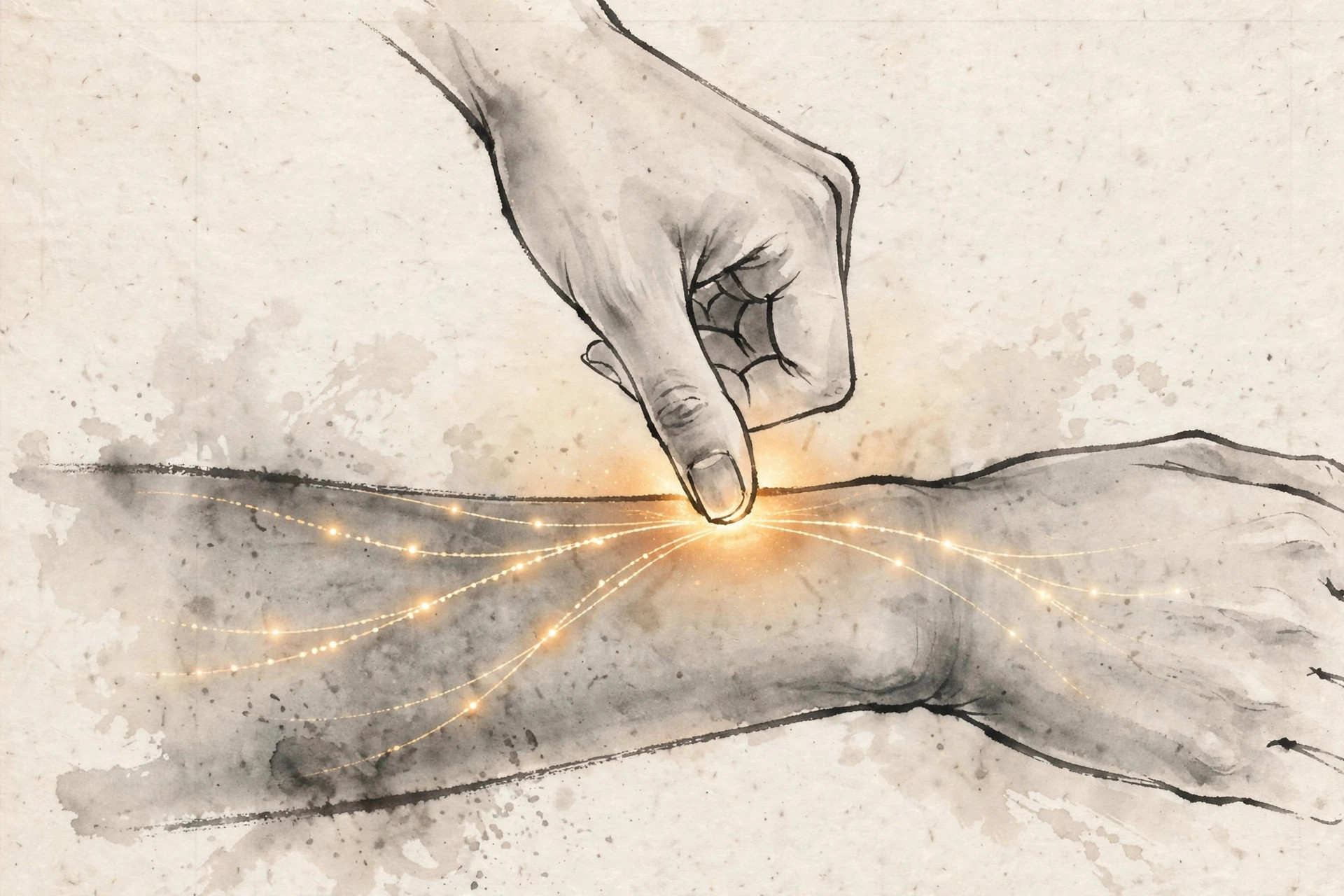
You have probably pressed your temples during a headache or squeezed the bridge of your nose when tired. Congratulations — you were doing a rough version of acupressure, the practice of applying steady pressure to specific points on the body.
In Traditional Chinese Medicine (TCM), these points are called *xuéwèi* (穴位), often translated as "acupoints." They lie along pathways called meridians or channels (*jīngluò*, 经络), the same network used in acupuncture — except acupressure uses fingers instead of needles. You can learn more about that network in how qi flows through the body.
This guide teaches exactly five points: the most commonly used, easiest to find, and most beginner-friendly in the whole system. No experience needed — just your hands and a few quiet minutes.
Before You Press: The Basics of Technique
Acupressure is simple, but a little technique goes a long way:
- - Use your thumb or fingertip. The pad of the thumb works for larger areas; the index or middle fingertip works for smaller, precise points.
- - Press firmly but comfortably. Aim for a dull, achy, "that's the spot" sensation — sometimes called *dé qì* (得气, "arrival of qi") in the traditional language. It should feel like satisfying pressure, never sharp pain.
- - Hold 1–3 minutes per point. Breathe normally and slowly while you press. You can use small circular motions or steady sustained pressure — both are fine.
- - Both sides when relevant. Most points exist on both the left and right sides of the body; do both for balance.
- - Timing matters. A calm moment — morning, a work break, before bed — works better than rushing through it between meetings.
- - Stop if it hurts sharply. Dull ache is normal; sharp, shooting, or increasing pain is a signal to stop immediately.
One more note before we begin: acupressure is self-care, not treatment. It is a traditional wellness practice for everyday comfort and relaxation. It does not replace medical care, and this guide does not diagnose or prescribe anything.
The Five Points
1. Hegu — LI4 (*hégǔ*, 合谷): The Hand Valley
Where to find it: Look at the back of your hand. Squeeze your thumb and index finger together — the fleshy mound that bulges up between them is Hegu. Its name means "joining valley," the valley where thumb and finger join.
How to press: With the thumb of your opposite hand, press firmly into the mound for 1–3 minutes. Small circles feel natural here.
Traditional use, in plain words: Hegu is traditionally the go-to point for the head and face — tension headaches, a stuffy nose, jaw tightness, tooth discomfort. Many people also use it simply to release hand and forearm tension after typing all day.
Safety: Avoid Hegu during pregnancy — it is traditionally considered a strongly stimulating point.
2. Zusanli — ST36 (*zúsānlǐ*, 足三里): The Leg's Three Miles
Where to find it: Sit down and find the bony bump just below the outer side of your knee. Place four fingers together below that bump, on the outer edge of the shinbone — the point sits roughly one finger-width outside the shinbone's edge. Its poetic name means "three *li* (miles) below the leg joint," suggesting it traditionally gave tired travelers the strength to walk three more miles.
How to press: Use your thumb or knuckle to press firmly into the muscle beside the shinbone for 1–3 minutes, on each leg. This point can take — and usually wants — fairly deep pressure.
Traditional use, in plain words: Zusanli is traditionally associated with digestion and stamina — a heavy or sluggish stomach after meals, low energy, general fatigue. It is one of the most-used points in the entire tradition, often described as a general vitality point for the body's energy center.
3. Sanyinjiao — SP6 (*sānyīnjiāo*, 三阴交): The Three Yin Crossing
Where to find it: On the inner side of your lower leg, place four fingers together above the inner ankle bone. The point sits just behind the edge of the shinbone at that height — about four finger-widths above the ankle. Its name means "the crossing of three yin channels," because three leg meridians traditionally meet here.
How to press: Press with your thumb into the soft tissue just behind the shinbone edge for 1–3 minutes per leg. This spot can feel tender — that tenderness is common and not a problem, but keep the pressure moderate.
Traditional use, in plain words: Sanyinjiao is traditionally linked to rest, relaxation, and the lower body — winding down in the evening, menstrual comfort, and general calm. Many people press it as part of a bedtime routine.
Safety: Avoid Sanyinjiao during pregnancy — like Hegu, it is traditionally considered strongly stimulating and is contraindicated in the classical texts.
4. Taichong — LR3 (*tàichōng*, 太冲): The Great Surge
Where to find it: On the top of your foot, slide a finger back from between the big toe and the second toe until you feel a slight dip just before the bones meet. That dip is Taichong — "great surge," named for the strong pulse traditionally felt here.
How to press: Press your thumb down into the dip for 1–3 minutes per foot. Gentle pulsing pressure works well here.
Traditional use, in plain words: Taichong is traditionally the point for unwinding tension — irritability after a stressful day, a tight or pressured feeling in the head, restlessness. In the traditional view it helps stuck energy move smoothly again, which is why stressed-out desk workers have loved it for centuries.
5. Neiguan — PC6 (*nèiguān*, 内关): The Inner Gate
Where to find it: Turn your palm up. Place three fingers together across your inner wrist, starting at the wrist crease. The point sits between the two tendons in the middle of the forearm, at the edge of your third finger. "Inner gate" — the gate to the inner forearm.
How to press: Press your opposite thumb firmly between the tendons for 1–3 minutes per wrist. This is a sensitive area, so start gently and build up.
Traditional use, in plain words: Neiguan is traditionally used for the chest and stomach — queasiness, motion discomfort, a fluttery or uneasy chest, and general calming. It is also the single most studied acupressure point in modern research: a number of clinical trials have examined wrist pressure at PC6 for nausea (including motion sickness and post-surgical queasiness), with modest but real supportive findings. That does not make it a cure — but it does make it the point with the most evidence behind it, which is reassuring for beginners.
How to Try This: A Five-Minute Daily Routine
Here is a simple sequence that strings all five points together. Do it once a day for a week and notice what you feel:
1. Start with the hands (Hegu, LI4): 1 minute per hand. Good for shaking off desk tension. 2. Move to the wrists (Neiguan, PC6): 1 minute per wrist. Settles the stomach and the mind together. 3. Press the feet (Taichong, LR3): 1 minute per foot. Lets the day's tension drain downward. 4. Work the shins (Zusanli, ST36): 1–2 minutes per leg. The energizing finish. 5. End with the inner ankles (Sanyinjiao, SP6): 1 minute per leg — especially nice in the evening as a wind-down.
Total: about 8–10 minutes. Sit comfortably, breathe slowly, and treat it as a small ritual rather than a task. Many people find the routine itself — the pause, the attention to the body — is half the benefit.
Safety: Read This Before You Begin
Acupressure is gentle, but it deserves the same respect as any body practice:
- - Pregnancy: Avoid Hegu (LI4) and Sanyinjiao (SP6) during pregnancy. These two points are traditionally considered strongly stimulating. If you are pregnant, check with your healthcare provider before trying any acupressure.
- - Broken skin and injuries: Never press on cuts, bruises, burns, rashes, swollen areas, or anywhere that is injured or inflamed.
- - Varicose veins: Do not press directly on varicose veins or areas with fragile blood vessels.
- - Pain is a stop sign: A dull, achy "good pressure" feeling is normal. Sharp, shooting, or worsening pain means stop immediately.
- - Medical conditions: If you have a heart condition, circulation problems, are on blood thinners, or have any serious health condition, talk to your doctor first.
- - Not a substitute for care: Acupressure is a traditional self-care practice for everyday comfort. It does not diagnose, treat, or cure disease. If something feels wrong in your body, see a healthcare professional — that is what they are for.
These cautions are not meant to scare you off; they are simply how a responsible tradition treats its own tools. Used sensibly, these five points are among the safest wellness practices in existence — which is exactly why they are taught first.
A Small Practice With Deep Roots
Five points, ten minutes, your own two hands. That is the whole of beginner acupressure — and it is also, in a sense, the whole philosophy of preventing illness before it starts: small, regular attention to the body, given freely, before anything goes wrong.
The tradition behind these points also connects to a larger picture — the organ systems they belong to are mapped in the five zang organs. But you do not need any of that theory to begin. Start with your hands, and let the practice teach you.
If these ideas resonate, *Huangdi Neijing: A Modern Introduction* explains the classical foundations — meridians, acupoints, and qi — in clear, beginner-friendly language (*Huangdi Neijing: A Modern Introduction*).
*This article is for general wellness education and is not medical advice.*